ブレラ祭壇画
ピエロ・デラ・フランチェスカ · 1472
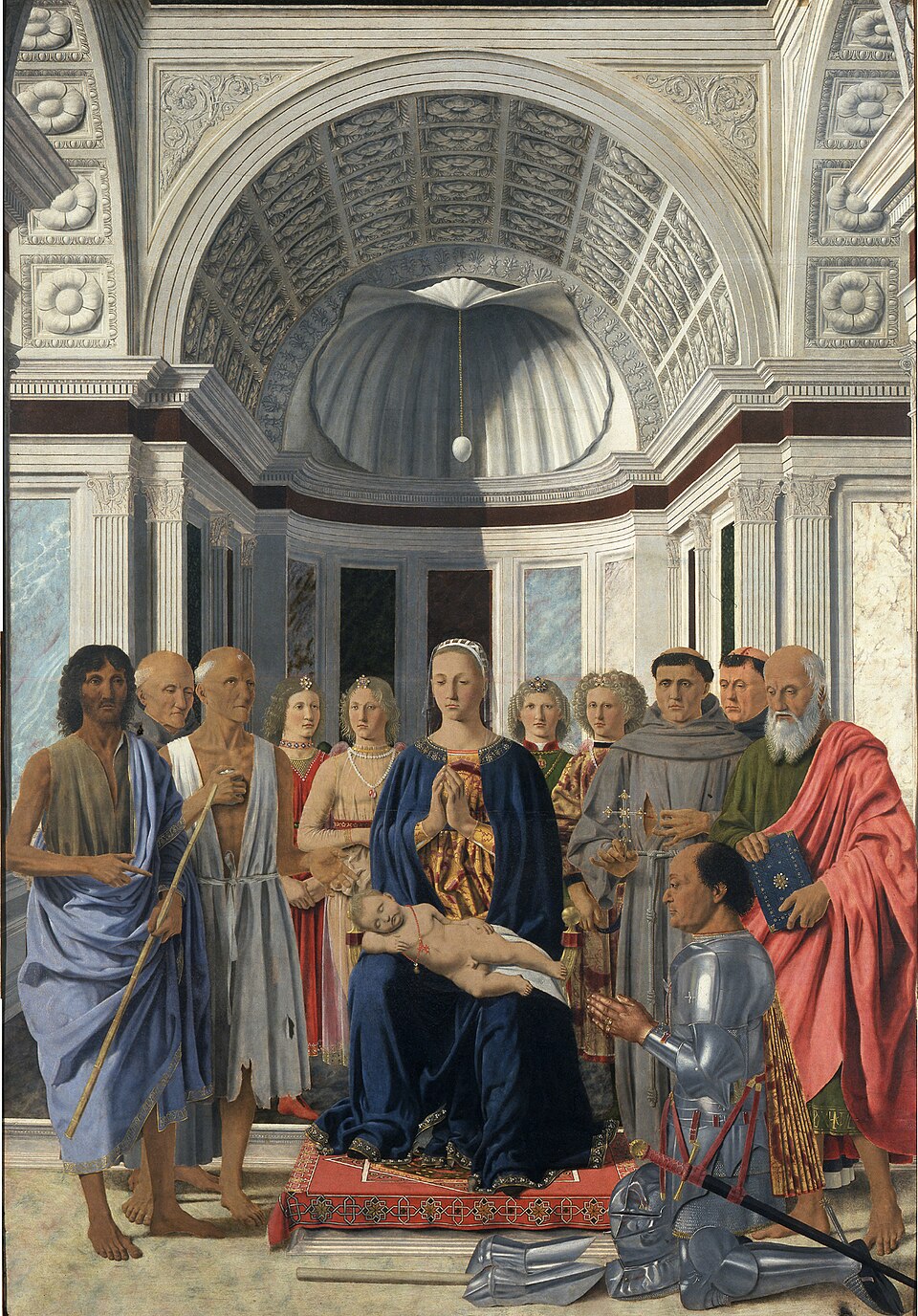
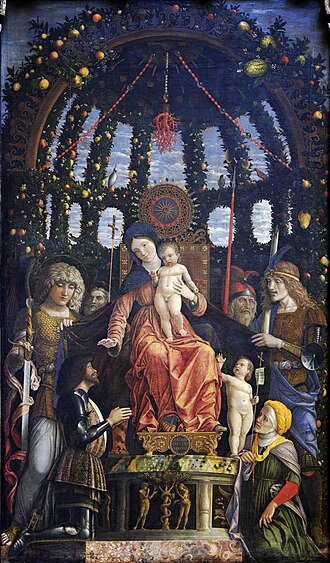
A duke in shining armour kneels before the Virgin and her sleeping Child, and above them all, hanging by a single thread from a shell, an egg holds perfectly still. Piero della Francesca built a whole church of light around that quiet moment.
The story behind the painting
Federico da Montefeltro, Duke of Urbino, commissioned this sacra conversazione from Piero della Francesca. One account says it celebrated the birth of his son Guidobaldo in 1472; other sources say it marked his conquest of several castles in the Maremma. If the birth is the reason, the Child may stand for Guidobaldo, and the Virgin may carry the features of Battista Sforza, Federico's wife, who died that same year and was buried at San Bernardino. Wikidata gives 1472, while Wikipedia dates the work 1472 to 1474: Federico does not yet wear the insignia of the Order of the Garter, which he received in 1474.
What to look for
The Virgin sits enthroned at the centre, the Child asleep across her lap, surrounded by angels and saints. Usually named are John the Baptist, Bernardino of Siena and Jerome on the left, and Francis, Peter Martyr and Andrew on the right; the historian Ricci saw in Andrew a portrait of the mathematician Luca Pacioli. Federico kneels in the lower right corner in reflective armour. Behind them, a Renaissance apse is drawn in such exact perspective that the depth of its coffered vault can be calculated. Look for the red coral necklace on the Child, the jewels of the angels and the oriental carpet under the Virgin's feet, details that show the influence of Early Netherlandish painting.
Meaning and intent
Kneeling in armour before holy figures was new for a donor portrait; here it speaks of Federico's military strength and his promise to protect his faith. The egg hanging from the shell is read as Mary's fruitfulness and a promise of regeneration and immortality, as Creation itself, and as Guidobaldo's birth; the ostrich was also a heraldic emblem of the Montefeltro. Another reading sees a pearl, born from the shell without any male part, as a sign of the virgin conception. The coral recalls blood, life and death and the redemption brought by Christ, though coral was also simply given to teething babies.
Legacy
Napoleon had the altarpiece deposited in the Pinacoteca di Brera in Milan, where it remains. When it was rediscovered there at the end of the 19th century, darkened varnish had disfigured it so much that it was attributed to Fra Carnevale, because Piero's use of oil was not yet known. Modern cleaning revealed the fine detail of the clothes, the jewels and Federico's gleaming armour. The art historian Carlo Ludovico Ragghianti argued that the panel was cut down on both sides, pointing to traces of entablature barely visible in the upper corners. Wikidata records it at 248 by 170 cm.
豆知識
- Commissioned by Federico da Montefeltro, Duke of Urbino.
- Dated 1472 to 1474, before Federico received the Order of the Garter.
- Once attributed to Fra Carnevale under darkened varnish.
- Now in the Pinacoteca di Brera, Milan.
画家について
ピエロ・デラ・フランチェスカ (1415-1492)
宗教美術 · 女性 · 聖母マリア · イエスの幼少時代 · 少年 · Early Renaissance · 母 · 洗礼者ヨハネ · ブレラ美術館
同じ画家の作品: ピエロ・デラ・フランチェスカ
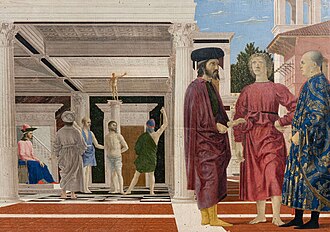 キリストの鞭打ち - Piero della Francesca (1450s)
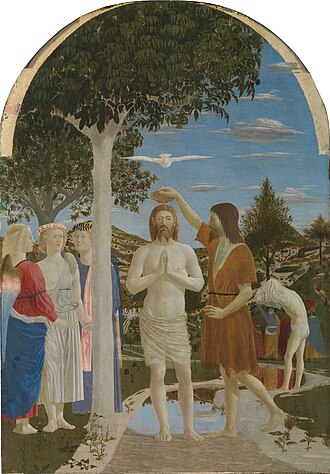 キリストの洗礼 - Piero della Francesca (1448)
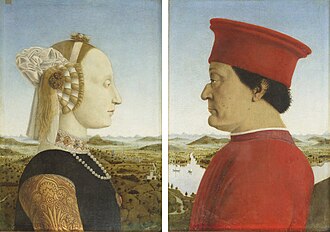 ウルビーノ公夫妻像 - Piero della Francesca (1465)
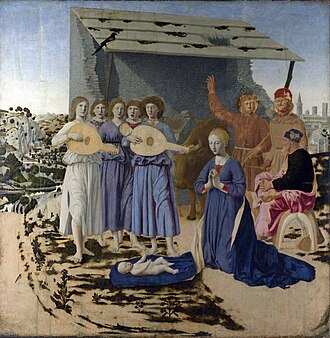 キリストの降誕 - Piero della Francesca (1480s)
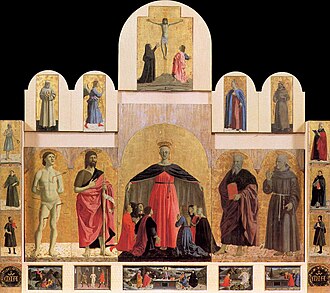 ミゼリコルディアの多翼祭壇画 - Piero della Francesca (1460s)
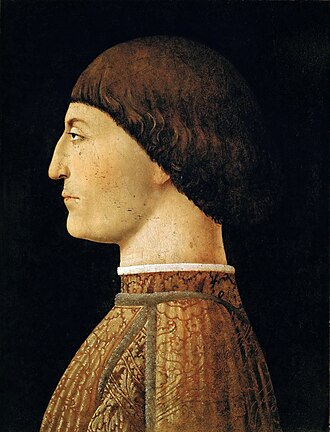 シジスモンド・パンドルフォ・マラテスタの肖像 - Piero della Francesca (1450s)
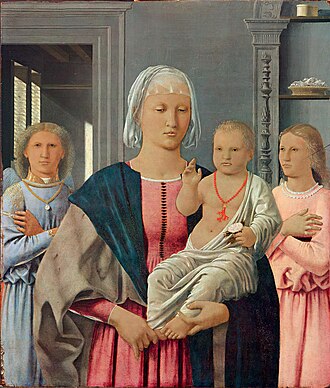 セニガッリアの聖母 - Piero della Francesca (1470s)
 聖ヒエロニムスと寄進者ジロラモ・アマーディ - Piero della Francesca (1440)
 ヴィーナスの誕生
 プリマヴェーラ
 モナ・リザ
 白貂を抱く貴婦人
 受胎告知
 東方三博士の礼拝
 死せるキリスト
 勝利の聖母