聖母子と天使
Sandro Botticelli · 1470
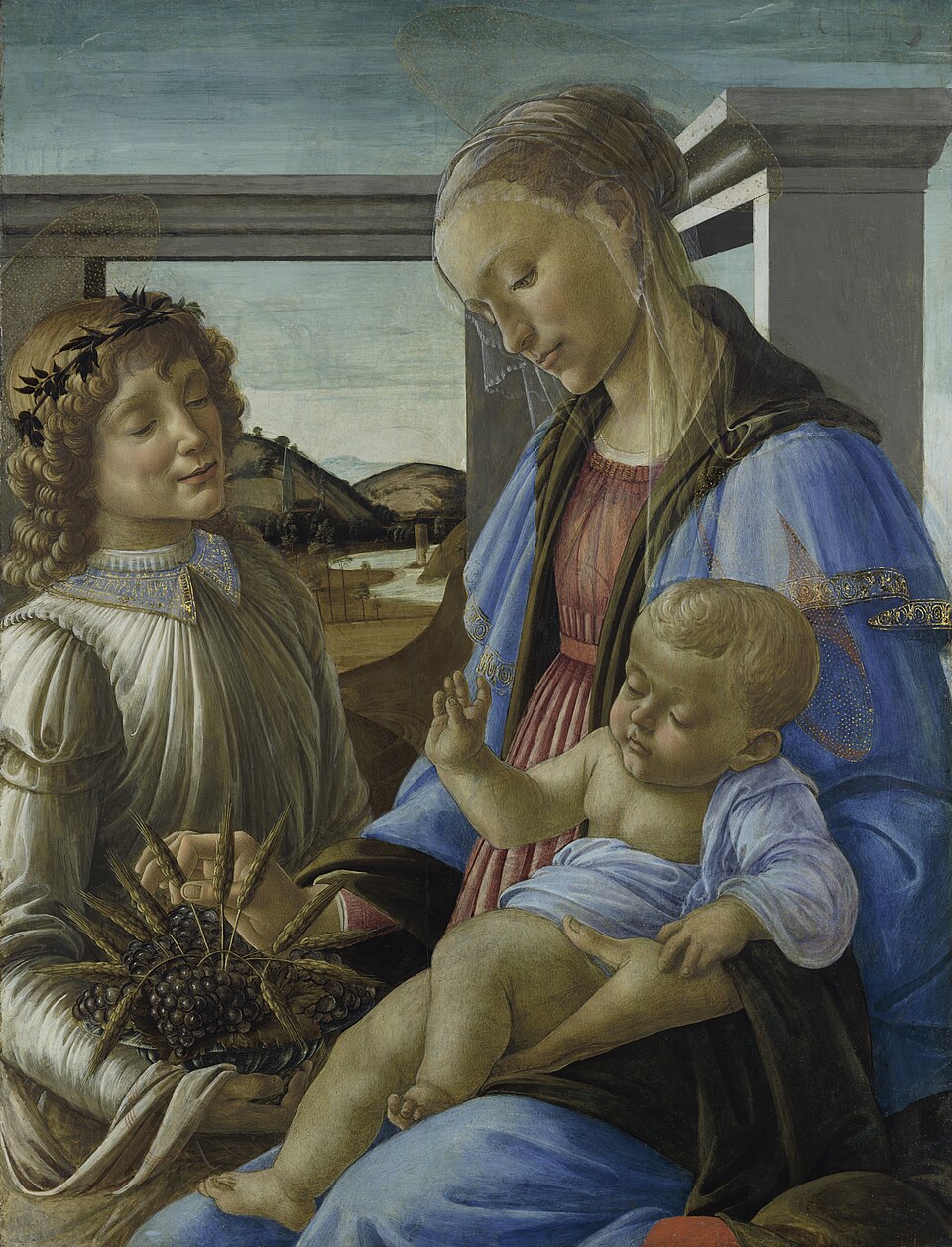
A smiling angel in a crown of myrtle holds out a bowl of wheat and grapes, and the child lifts his hand in blessing. Young Botticelli painted it around 1470; its sale four centuries later caused a scandal in Italy.
The story behind the painting
Virgin and Child with an Angel, also called Our Lady of the Eucharist, is a tempera painting on wood panel by Sandro Botticelli from about 1470. It belongs to a series of Madonnas he made between 1465 and 1470, and it shows the influence of Filippo Lippi's Virgin and Child with Two Angels of about 1465, now in the Uffizi. For a long time it was known as the Chigi Madonna, after its owner, Prince Chigi. In 1899 the prince offered it to the American collector Isabella Stewart Gardner, who was urged on relentlessly by Bernard Berenson to buy it.
What to look for
The panel measures 85.2 by 65 cm. Mary is shown in three-quarter view with the Christ Child on her lap. A smiling angel, crowned with myrtle, offers them a bowl holding twelve ears of wheat and bunches of grapes. The child raises a hand in benediction, and Mary takes hold of one of the ears. Behind them runs an arcade around a wall, and through an opening you can see a landscape of hills and a river. The scene may be set in a walled garden, the hortus conclusus.
Meaning and intent
Every detail carries meaning. The walled garden is a symbol of Mary's virginity. The wheat and grapes stand for the bread and wine of the Eucharist, which in turn symbolise the body and blood of the incarnate Jesus. The twelve ears of wheat may refer to the twelve apostles at the Last Supper. So the gentle exchange between angel, mother and child quietly points ahead to the sacrifice to come: Mary touches the wheat as if already accepting it, while the child blesses the offering.
Legacy
Gardner hesitated at first, and by the time she decided to buy, the asking price had more than doubled. The sale was controversial in Italy, where the press said it was illegal, and Prince Chigi was fined. The painting was shown at Colnaghi in London before travelling to Boston. It entered the Isabella Stewart Gardner Museum in 1899 and is still there. The museum bought it from a prince, through the urging of a scholar, against the protests of a nation: the long journey of a small devotional picture painted around 1470.
豆知識
- Painted in tempera on panel around 1470.
- Wheat and grapes stand for the bread and wine of the Eucharist.
- Its 1899 sale from the Chigi family caused a scandal in Italy.
- In the Isabella Stewart Gardner Museum, Boston.
画家について
Sandro Botticelli (1445-1510)
宗教美術 · 女性 · 聖母マリア · イエスの幼少時代 · 少年 · Early Renaissance · 天使 · 母 · イザベラ・スチュワート・ガードナー美術館
同じ画家の作品: Sandro Botticelli
 ヴィーナスの誕生 - Sandro Botticelli (c. 1485)
 プリマヴェーラ - Sandro Botticelli (1480s)
 ヴィーナスとマルス - Sandro Botticelli (1485)
 東方三博士の礼拝 - Sandro Botticelli (1470s)
 マニフィカートの聖母 - Sandro Botticelli (1481)
 アペレスの誹謗 - Sandro Botticelli (1490s)
 パラスとケンタウロス - Sandro Botticelli (1482)
 Idealized Portrait of a Lady - Sandro Botticelli (1480)
 キリストの鞭打ち
 ブレラ祭壇画
 モナ・リザ
 白貂を抱く貴婦人
 受胎告知
 東方三博士の礼拝
 死せるキリスト
 勝利の聖母