View of the Garden of the Villa Medici
Diego Velázquez · 1630
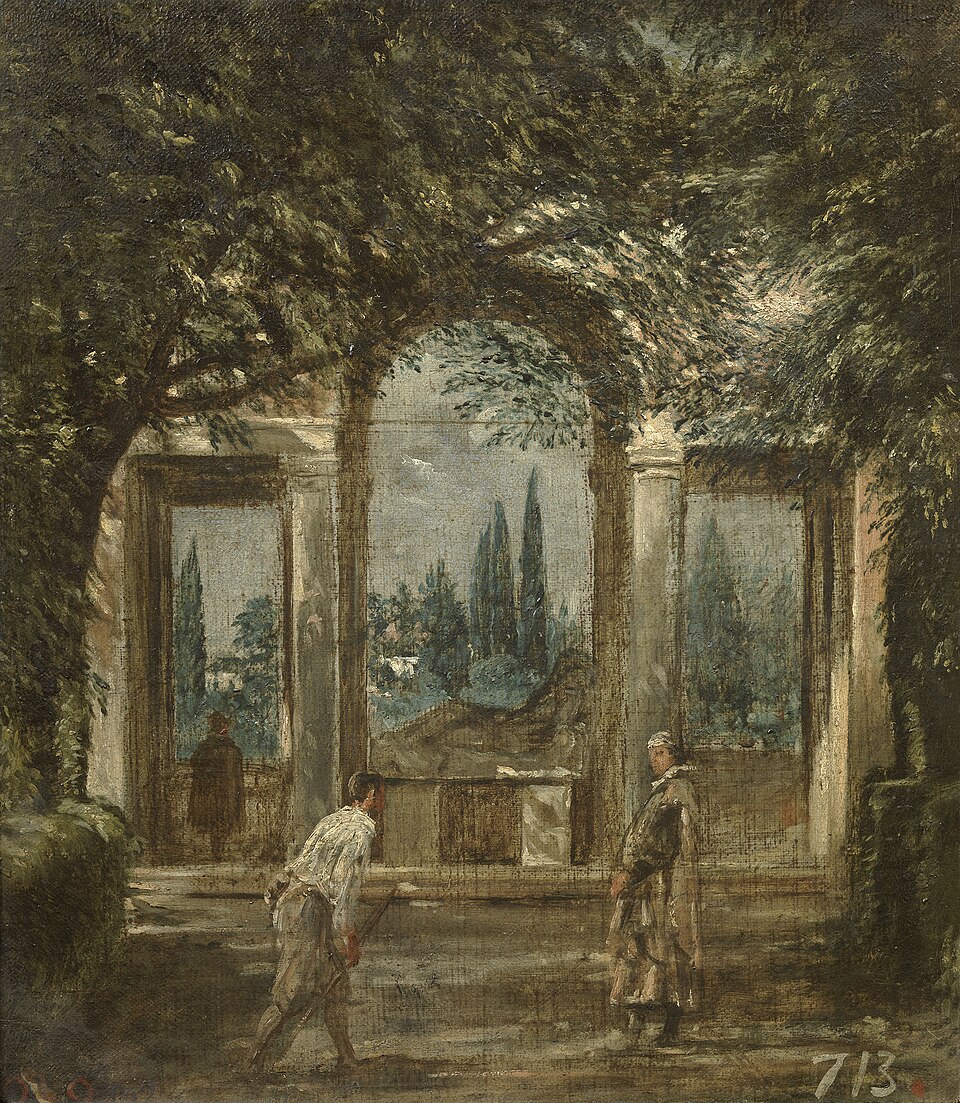
Noon sun pours through a Roman garden, so bright that the people in it almost dissolve. Velazquez painted this little canvas outdoors, in oil, at a time when almost nobody did.
The story behind the painting
The French Wikipedia article says Velazquez painted it in Rome between 1629 and 1631. Francisco Pacheco and Antonio Palomino record that in summer 1630 he moved into the Villa Medici, after staying in the Vatican palaces with the support of Cardinal Francesco Barberini, nephew of Pope Urban VIII. That first trip was a journey of study, full of drawings after ancient sculpture, Michelangelo, Raphael and the Venetians. The dating has been argued over: in 1913 Von Loga moved the work to the second trip of 1649 to 1651, and many critics followed, but Lopez-Rey held to about 1630, and the Prado's technical studies support that earlier date.
What to look for
The canvas, 44 by 38 cm, is also called the Pavilion of Ariadne, the Loggia of Cleopatra, or Midday. It shows part of the Villa Medici garden with a Serlian opening that shelters a copy of the Greek sculpture of the sleeping Ariadne, similar to one Velazquez brought back to Madrid on his second trip. The loggia works like a balcony onto a landscape where cypresses stand out, lit by a noon sun that shines through dense branches. The light is so strong that the figures turn vaporous, sketched so lightly that the background shows through them.
Meaning and intent
Landscape ranked low in the hierarchy of genres, beneath history painting. In Rome, Claude Lorrain and Nicolas Poussin painted classical landscapes with figures that justified the scenery. Velazquez had cared about landscape early; his father-in-law Pacheco said the landscapes in his first equestrian portraits of the king were made from nature. What was new here was putting the easel outside and painting the landscape directly in oil, something only Dutch artists in Rome had done, and then only for quick sketches in pencil, pen or watercolour. That sketch-like lightness and open-air method later linked these canvases to the Impressionists.
Legacy
The picture may be one of four small landscapes bought from Velazquez for King Philip IV by Jeronimo de Villanueva. In 1666 it was listed in the Alcazar of Madrid together with its pendant, the Entrance to the Grotto. After the Alcazar fire of 1734 it went to the Buen Retiro Palace, where inventories of 1789 and 1794 credited it to Juan Bautista Martinez del Mazo, a lesser artist. It entered the Museo del Prado in 1819, where it hangs again under Velazquez's name.
豆知識
- Painted in oil outdoors in the Villa Medici garden.
- Shows a loggia sheltering a copy of the sleeping Ariadne.
- Dated about 1630 by Prado studies, though many critics argued for 1649-1651.
- In the Museo del Prado since 1819.
画家について
Diego Velázquez (1599-1660)
同じ画家の作品: Diego Velázquez
 ラス・メニーナス - Diego Velázquez (1656)
 ブレダの開城 - Diego Velázquez (1635)
 鏡のヴィーナス - Diego Velázquez (1644)
 アラクネの寓話 - Diego Velázquez
 インノケンティウス10世の肖像 - Diego Velázquez
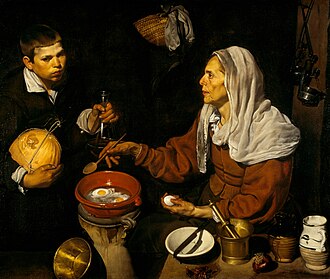 卵を調理する老女 - Diego Velázquez (1618)
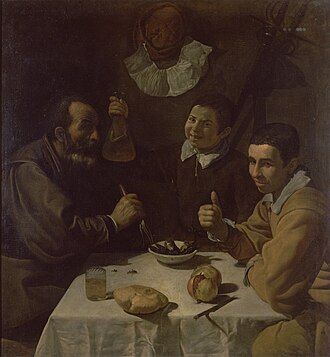 昼食 - Diego Velázquez (1617)
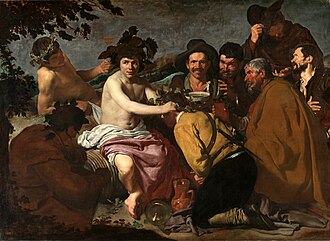 バッカスの勝利 - Diego Velázquez (1628)
関連する画家の作品
 エマオの晩餐 - Caravaggio (1601)
 聖マタイの召命 - Caravaggio (1609)
 Saint Francis in Meditation - Francisco de Zurbarán (1639)
 The Immaculate Conception - Francisco de Zurbarán (1661)
 チャールズ1世の三面肖像画 - Anthony van Dyck (1635)
 馬上のチャールズ1世とサン・アントワーヌの領主の肖像 - Anthony van Dyck (1636)
 キリスト昇架 - Peter Paul Rubens (1609)
 レウキッポスの娘たちの略奪 - Peter Paul Rubens (1618)
 夜警 - Rembrandt van Rijn (1642)
 自画像 - Rembrandt van Rijn (1659)
 陽気な酒飲み - Frans Hals (1620s)
 微笑む騎士 - Frans Hals (1624)