ヴィーナスとアドーニス
ティツィアーノ・ヴェチェッリオ · 1550s
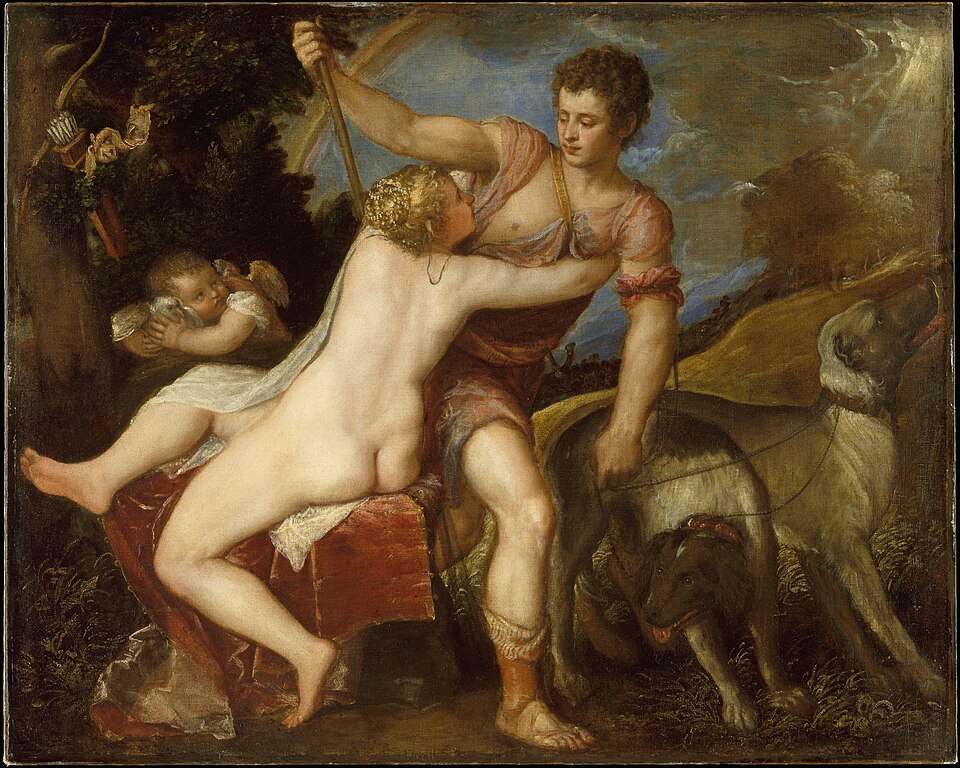
At dawn a young Adonis leaves his lover to go hunting, while a rainbow hangs in the sky. Titian knew, as the viewer knows, that the boar is waiting.
The story behind the painting
The story comes from Ovid: Venus falls in love with the young Adonis, who will be torn open without mercy by a wild boar. In Titian's telling, Adonis does not seem satisfied with the goddess's love. As soon as dawn appears he leaves his beautiful lover to go hunting with his dogs, and soon, as the myth goes, he is killed, and Venus can only mourn him. This is one of many versions Titian painted of their doomed love. The Spanish Wikipedia dates it to 1560, while Wikidata gives the 1550s.
What to look for
This canvas, 106.7 by 133.4 cm, belongs to the type based on a lost painting made for the Farnese family. Compared with the version in the Prado, the scene is narrower and the landscape less open. There is a rainbow in the sky. Adonis has two dogs on the leash instead of three, he looks like an adolescent, and his right shoulder is covered. Cupid is not asleep but follows the scene closely. The surface is less smooth and shiny, the outlines vaguer, painted with quick, broad strokes and flashes of light.
Meaning and intent
What interested Titian was a very personal reading of the myth. The hunt, a metaphor for life, can be dangerous and regrettable, and it often foreshadows doom. Such a personal interpretation did not necessarily suit the tastes of the time. That is why, from the 1550s, Titian worked only for Philip II of Spain or kept paintings for himself, even those refused by the emperor. The open-eyed Cupid here watches the parting, as if love itself were witnessing the moment it is about to lose.
Legacy
The theme must have been a great success, as had happened with Danae: Titian made a cartoon and a series of more or less faithful replicas of the original kept in the Prado in Madrid. His versions fall into two types, the Prado type and the Farnese type, and this painting, now in the Metropolitan Museum of Art in New York, belongs to the second. According to the source it dates from about ten years after the Prado version, and shows the late manner of Titian's final years.
豆知識
- Painted by Titian; dated 1560 by Spanish Wikipedia, 1550s by Wikidata.
- A Farnese type version, with two dogs and a rainbow.
- Cupid is awake and watching.
- In the Metropolitan Museum of Art, New York.
画家について
ティツィアーノ・ヴェチェッリオ (1488-1576)
神話画 · メトロポリタン美術館 · ヴェネツィア派 · 座法 · 裸 · ウェヌス · clothed male, naked female · 背中 · ティティアンヘア · アドーニス
同じ画家の作品: ティツィアーノ・ヴェチェッリオ
 ウルビーノのヴィーナス - Titian (1538)
 聖母被昇天 - Titian (1510s)
 聖愛と俗愛 - Titian (1510s)
 騎乗像 - Titian (1548)
 フローラ - Titian (1517)
 賢明の寓意 - Titian (1550)
 ディアナとアクタイオン - Titian (1550s)
 バッカスとアリアドネ - Titian (1520s)
関連する画家の作品
 最後の晩餐 - Jacopo Tintoretto (1563)
 奴隷を解放する聖マルコ - Jacopo Tintoretto (1540s)
 カナの婚礼 - Paolo Veronese (1560s)
 レヴィ家の饗宴 - Paolo Veronese (1573)