The Story of Nastagio Degli Onesti, part four
Sandro Botticelli · 1483
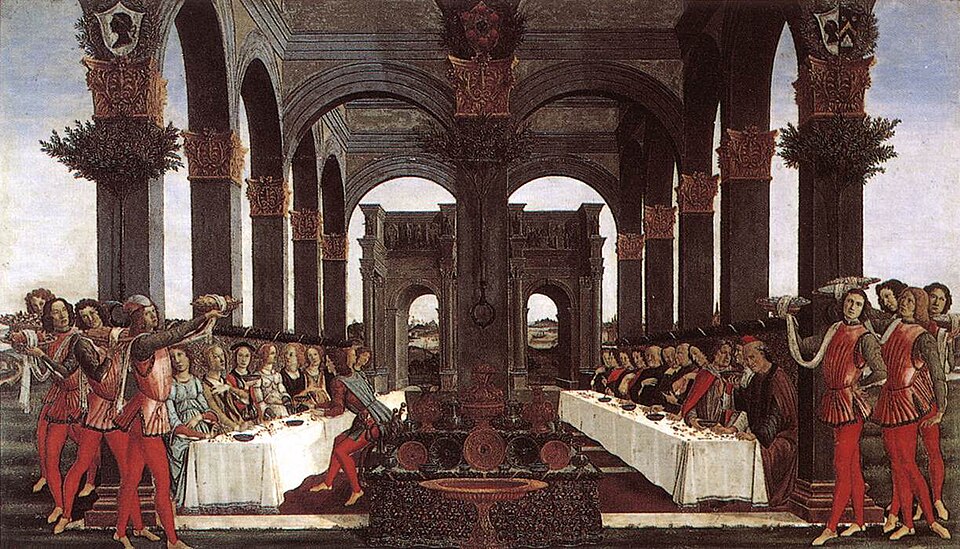
After the terror in the woods comes a wedding feast under a triumphal arch. The last panel of Botticelli's Nastagio series was lost from view for centuries, then reappeared in Florence in 2004.
The story behind the painting
The tale of Nastagio degli Onesti is the eighth story of the fifth day of Boccaccio's Decameron, written between 1348 and 1351, a day devoted to loves that begin unhappily and end well. This fourth and last panel, tempera on wood of about 83 by 142 cm dated 1483, shows the final banquet. Frightened by the punishment she saw in the third episode, the daughter of the Traversari family agrees to marry Nastagio, who arranges the ceremony for the very next Sunday. The panel belongs to a series of four, commissioned by Lorenzo the Magnificent as a wedding gift for Giannozzo Pucci and Lucrezia Bini, probably for a bed head or a cassone; both families' coats of arms appear in the scenes.
What to look for
The wedding feast takes place in an architectural setting of colonnades at the sides and arches at the back, partly hidden by central pillars. Two long tables face each other, with guests seated on the outer sides; on the left the bride and groom face each other too, since Nastagio sits between the tables opposite his future wife. Precious display plate rests on a central sideboard with a basin in front, elegant servants carry food in from both sides, and rich ceremonial clothes are everywhere. On the square columns in front, the torch holders hold myrtle branches, a symbol of love, under the arms of the Pucci, the Medici and the Pucci-Bini. Far behind stands an ancient-style triple triumphal arch with reliefs.
Meaning and intent
Unlike the first three panels, full of story, action and nature, this one is a single static scene in an antique setting. Botticelli builds it with straight lines and one vanishing point, and the central column of the arch marks a strong vertical symmetry. The source notes that the marriage hardly seems the centre of interest: the couple are not prominent and the guests do not look especially delighted. The panel breaks sharply with the series by its rigidity, chasing away dream and unreality and returning to the rigour of a scientific composition, to make the message clear and satisfy the patron. The arch was probably inspired by those Botticelli had seen in Rome while painting frescoes in the Sistine Chapel.
Legacy
The four panels stayed in the Pucci palace in Florence until they were sold in 1868. They then passed through several collections; in 1929 Francisco de Asís Cambó bought three from the heirs of Joseph Spiridon and in 1941 gave them to the Prado. The fourth, the wedding banquet, was lost from view for centuries and reappeared in Florence in April 2004 at a Botticelli and Filippino Lippi exhibition at the Palazzo Strozzi; according to this source it may never have left the Pucci palace. The careful depiction of tableware, furniture and ceremonial clothing gives it particular historical interest. Critics agree that Botticelli conceived all four scenes, but believe the execution was partly given to assistants, especially Bartolomeo di Giovanni for the first three and Jacopo del Sellaio for the last.
豆知識
- Tempera on wood, about 83 by 142 cm, dated 1483.
- Shows the wedding banquet that ends the tale.
- Reappeared in Florence in April 2004.
- Kept in the Palazzo Pucci, Florence.
画家について
Sandro Botticelli (1445-1510)
同じ画家の作品: Sandro Botticelli
 ヴィーナスの誕生 - Sandro Botticelli (c. 1485)
 プリマヴェーラ - Sandro Botticelli (1480s)
 ヴィーナスとマルス - Sandro Botticelli (1485)
 東方三博士の礼拝 - Sandro Botticelli (1470s)
 マニフィカートの聖母 - Sandro Botticelli (1481)
 アペレスの誹謗 - Sandro Botticelli (1490s)
 パラスとケンタウロス - Sandro Botticelli (1482)
 Idealized Portrait of a Lady - Sandro Botticelli (1480)
 キリストの鞭打ち
 ブレラ祭壇画
 モナ・リザ
 白貂を抱く貴婦人
 受胎告知
 東方三博士の礼拝
 死せるキリスト
 勝利の聖母