無原罪の御宿り
Diego Velázquez · 1618
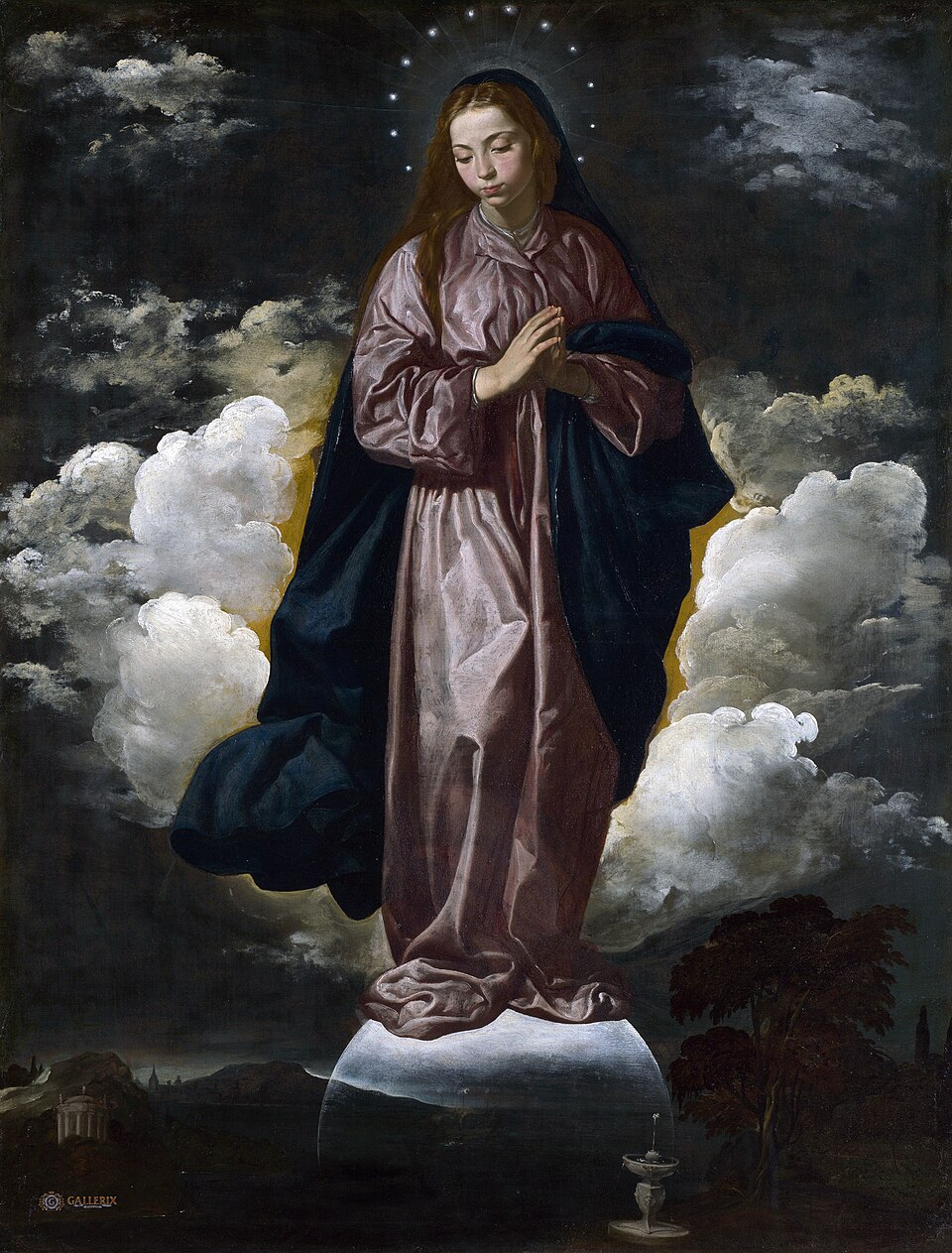
A young girl stands on a moon you can see through, crowned with stars, painted by a Velazquez of barely eighteen. It may be among the very first works that survive from his hand, born in a Seville gripped by a fierce religious quarrel.
The story behind the painting
The Immaculate Conception, painted around 1618 and now in the National Gallery in London, may be, together with its companion piece, among the earliest surviving works of Velazquez, then barely eighteen. That companion is the Saint John on Patmos in the same museum, with identical dimensions, and the two probably formed a diptych. In 1800 Juan Agustin Cean Bermudez recorded both in the chapter house of the Calced Carmelite convent in Seville. They left Spain in 1809, through canon Lopez Cepero, for the British ambassador Bartholomew Frere, and the museum acquired them in 1974. Since Cean, critics have agreed unanimously that they are authentic.
What to look for
The canvas is 135 by 102 cm. The Virgin stands in a gentle contrapposto, a pose taken from Velazquez's master Francisco Pacheco. At her feet the moon is no longer a crescent but a transparent, crystal-like solid through which you can see the landscape. Pacheco had advised painting the half moon with its points turned downward, for reasons of astronomical plausibility. In the landscape look for symbols from the Litany of Loreto: a ship, a tower, a fountain, a cedar. She wears a red-purple tunic rather than the white tunic Pacheco recommended, as was common in Seville at the time. The colours have darkened under wax from an old treatment, and the strong light comes from the left, as in its companion.
Meaning and intent
In Seville the Immaculate Conception was the subject of passionate debate. In 1613 the Dominican friar Domingo de Molina denied it from the pulpit, saying Mary had been conceived like you and me and like Martin Luther, and the controversy exploded. Pacheco was a fervent defender of the doctrine, and the heat of the dispute brought painters many commissions. Velazquez follows his master's patterns, but he breaks with him radically in one thing: he paints the Virgin from life. He leaves out the serpent, figure of the devil, and her face, far from Pacheco's idealised types, has led to speculation about who posed, with scholars looking among the painter's close circle.
Legacy
This small canvas shows a young painter learning a strict set of rules and quietly bending them. Pacheco, who was his master and later his father-in-law, wrote detailed instructions on how to paint this mystery: a girl of twelve or thirteen, very beautiful, golden hair, crowned with twelve stars, surrounded by an oval of ochre and white light. Velazquez keeps much of this programme yet turns the Virgin into a real, reserved young woman. The source notes that even in its first state the picture was unlikely to match the brightness of Pacheco's own versions, since it had to harmonise with Saint John on Patmos. Today the two works are reunited in London.
豆知識
- Painted around 1618, when Velazquez was about eighteen.
- Companion to Saint John on Patmos, also in the National Gallery.
- Recorded in 1800 in a Carmelite convent in Seville.
- Acquired by the National Gallery in 1974.
画家について
Diego Velázquez (1599-1660)
宗教美術 · 聖母マリア · ナショナル・ギャラリー
同じ画家の作品: Diego Velázquez
 ラス・メニーナス - Diego Velázquez (1656)
 ブレダの開城 - Diego Velázquez (1635)
 鏡のヴィーナス - Diego Velázquez (1644)
 アラクネの寓話 - Diego Velázquez
 インノケンティウス10世の肖像 - Diego Velázquez
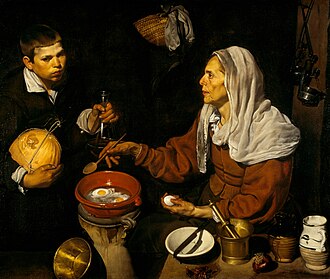 卵を調理する老女 - Diego Velázquez (1618)
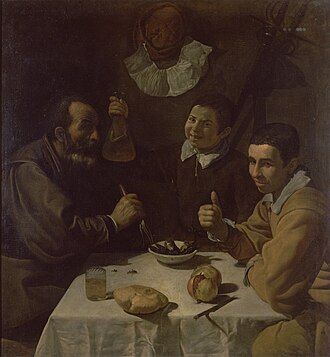 昼食 - Diego Velázquez (1617)
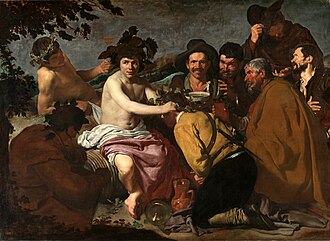 バッカスの勝利 - Diego Velázquez (1628)
関連する画家の作品
 エマオの晩餐 - Caravaggio (1601)
 聖マタイの召命 - Caravaggio (1609)
 Saint Francis in Meditation - Francisco de Zurbarán (1639)
 The Immaculate Conception - Francisco de Zurbarán (1661)
 チャールズ1世の三面肖像画 - Anthony van Dyck (1635)
 馬上のチャールズ1世とサン・アントワーヌの領主の肖像 - Anthony van Dyck (1636)
 キリスト昇架 - Peter Paul Rubens (1609)
 レウキッポスの娘たちの略奪 - Peter Paul Rubens (1618)
 夜警 - Rembrandt van Rijn (1642)
 自画像 - Rembrandt van Rijn (1659)
 陽気な酒飲み - Frans Hals (1620s)
 微笑む騎士 - Frans Hals (1624)