The Education of the Virgin
Diego Velázquez · 1617
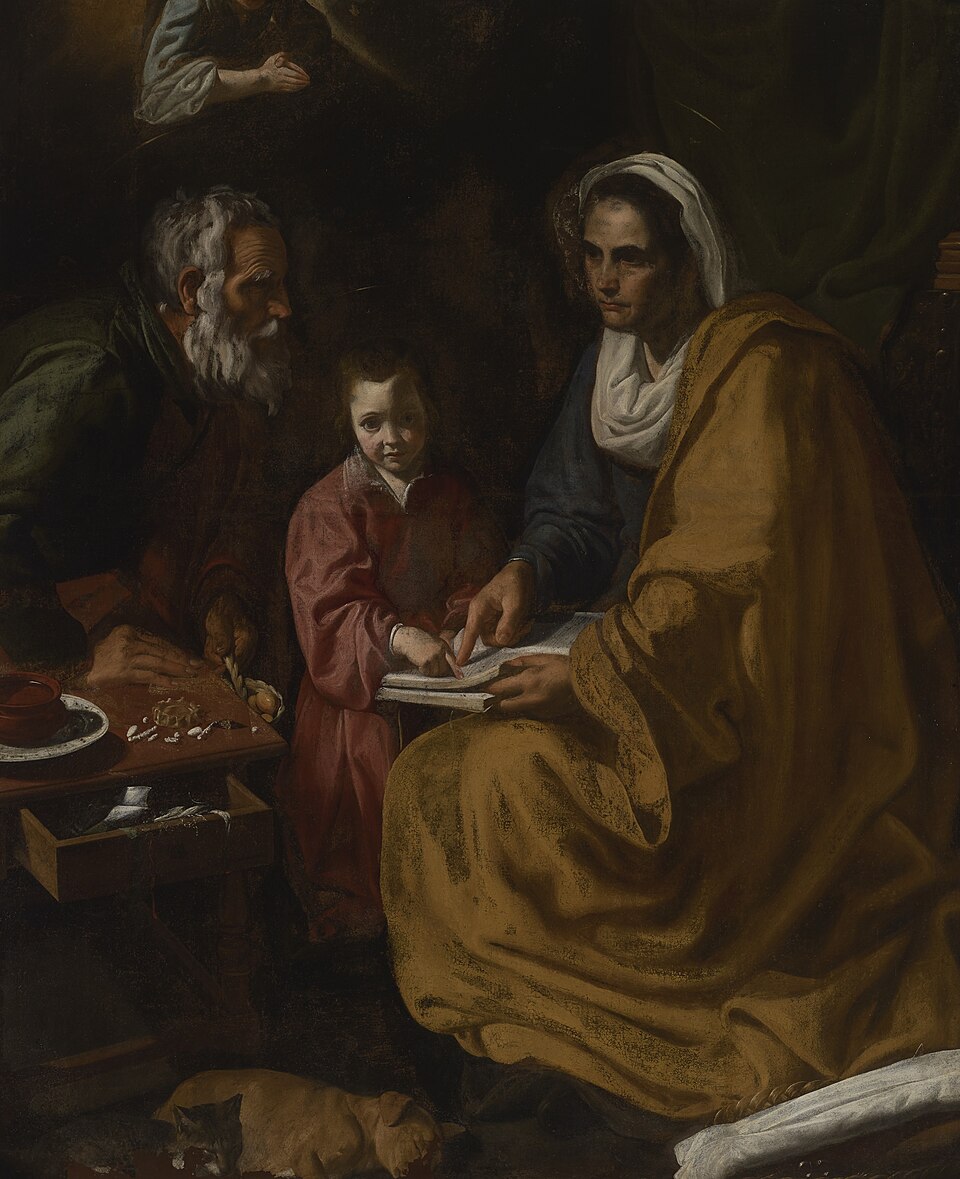
A little girl in red points to a line in an open book while her parents watch in silence. Forgotten for years in a museum storeroom, this burned and battered canvas may be the earliest surviving painting by Velázquez, though not every historian agrees.
The story behind the painting
The canvas was painted around 1617, when the young Velázquez was in his last year as an apprentice in the Seville workshop of Francisco Pacheco. Pacheco enjoyed great prestige among the clergy and moved in the literary circles of the local nobility, and the subject reflects the themes he taught. Another apprentice, Alonso Cano, had joined the workshop in 1616 and later painted his own Education of the Virgin, in 1650. For a long time the picture sat forgotten in the storerooms of the Yale University Art Gallery, catalogued as the work of an anonymous painter, until the curator John Marciari brought it to light in 2004.
What to look for
Four figures and a dog appear in the dark, tenebrist colours typical of the painter's Seville years. In the centre stands the child Mary in red. Her mother Anne, seated, holds the book of Scripture on her knees, points to a line with her finger and gazes vaguely to the right, while the girl points to another place in the book. Anne wears blue with a white scarf and a yellow cover over her left side. Joachim, probably the old man leaning forward in profile, watches mother and daughter, his grey hair and beard catching the light. Though it looks like a lesson, every mouth is closed. At the front right are a bedside table with an open drawer of papers, a sleeping dog and a drowsy cat. Above, an angel's head is cut off: 25 cm of the canvas is missing at the top.
Meaning and intent
The scene of Saint Anne teaching her daughter shows the kind of devout subject Pacheco's workshop practised, painted by a young artist still learning his craft. For its supporters, it is precious as the first known step of Velázquez. Its attribution remains disputed, partly because of the poor condition of the canvas. After five years of study, a group of 29 experts meeting in Seville in 2015 concluded that it was authentic. Javier Portús and Jonathan Brown reject this; Brown sees it as one of many pastiches made by local painters riding the fashion for Roelas and the young Velázquez, a sign of the young painter's fame, he says, but not of his talent.
Legacy
The canvas had been badly damaged, burned and harshly restored in the past. Marciari introduced it to the world through the specialist journal Ars magazine, and it then went through ten years of restoration in the early twenty-first century. Today it belongs to the Yale University Art Gallery, which lists it at 168 by 136 cm. If the attribution holds, it is the earliest painting by Velázquez known to have survived, a rare look at the young painter before the masterpieces that made his name, and a reminder of how much can wait unseen in a museum storeroom.
豆知識
- Painted around 1617, during Velázquez's apprenticeship with Pacheco.
- Rediscovered by John Marciari at Yale in 2004.
- 29 experts in Seville backed the attribution in 2015; some historians still reject it.
- 25 cm is missing from the top of the canvas.
画家について
Diego Velázquez (1599-1660)
同じ画家の作品: Diego Velázquez
 ラス・メニーナス - Diego Velázquez (1656)
 ブレダの開城 - Diego Velázquez (1635)
 鏡のヴィーナス - Diego Velázquez (1644)
 アラクネの寓話 - Diego Velázquez
 インノケンティウス10世の肖像 - Diego Velázquez
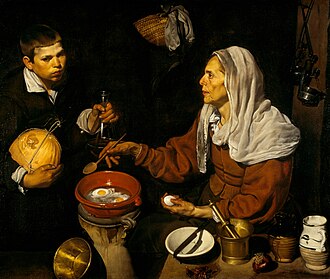 卵を調理する老女 - Diego Velázquez (1618)
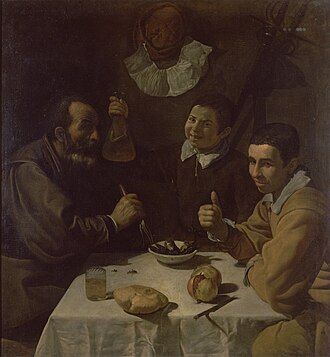 昼食 - Diego Velázquez (1617)
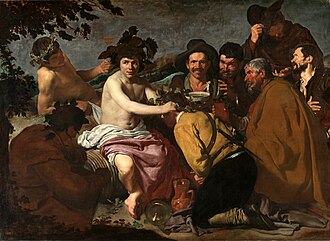 バッカスの勝利 - Diego Velázquez (1628)
関連する画家の作品
 エマオの晩餐 - Caravaggio (1601)
 聖マタイの召命 - Caravaggio (1609)
 Saint Francis in Meditation - Francisco de Zurbarán (1639)
 The Immaculate Conception - Francisco de Zurbarán (1661)
 チャールズ1世の三面肖像画 - Anthony van Dyck (1635)
 馬上のチャールズ1世とサン・アントワーヌの領主の肖像 - Anthony van Dyck (1636)
 キリスト昇架 - Peter Paul Rubens (1609)
 レウキッポスの娘たちの略奪 - Peter Paul Rubens (1618)
 夜警 - Rembrandt van Rijn (1642)
 自画像 - Rembrandt van Rijn (1659)
 陽気な酒飲み - Frans Hals (1620s)
 微笑む騎士 - Frans Hals (1624)