キリストの磔刑
エル・グレコ · 1590s
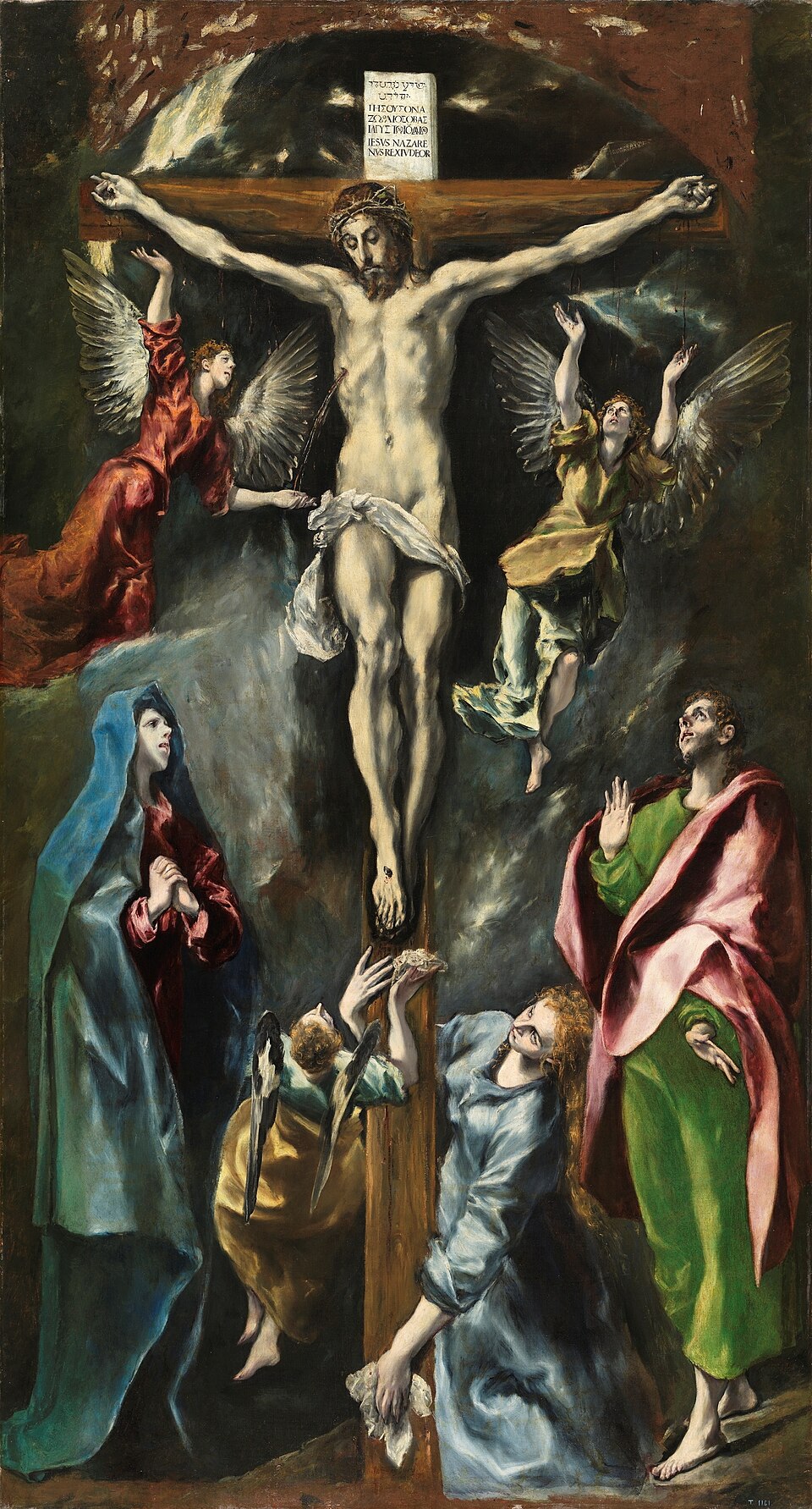
Against the night of Calvary, Christ's body glows with a violent light, and three angels gather the blood from his wounds. In this huge canvas El Greco turned away from his graceful earlier crucifixions toward something almost medieval.
The story behind the painting
In 1596 El Greco agreed to paint an altarpiece for the church of the college of Doña María de Aragón in Madrid, commissioned by the Council of Castile after her death. Documents say it was to be finished in three years, but nothing records how many pictures it had or what they showed. Many authors place this canvas at its centre, but there is no consensus: Harold Wethey and José Gudiol do not believe it belonged there, and Wethey dates it about five years later. The article gives 1600 to 1605 according to Wethey and 1597 to 1600 according to the Prado.
What to look for
The scene is built on two triangles. Christ on the cross is the axis; on one side stands the Virgin, on the other John the Evangelist. Mary Magdalene and three angels complete the group, collecting the blood flowing from Christ's wounds. The colours are carefully balanced: the Virgin in green and dark red, John in light red and green, the Magdalene in neutral blue, the angel at the foot of the cross in greenish yellow, the others in red and yellow. Together they bring out the first pallor of death in Christ. The canvas measures 312 by 169 cm, signed faintly at the foot of the cross.
Meaning and intent
El Greco breaks sharply with his earlier versions, in which Christ was still alive, curving gracefully, without blood or pain. Here he adopts almost medieval features, which cannot be explained only by the meditations of Alonso de Orozco, who never mentioned the Magdalene or angels catching the blood; perhaps El Greco had to follow the patron's instructions. The composition is very still, broken only by a light circular rhythm among the angels and the Magdalene. The rising lines of the cross, Mary and John are balanced by Christ's long outstretched arms.
Legacy
Even the history of the painting is told two ways. According to the Prado, it stayed in the college from 1600 to 1813, then passed to the church of San Felipe el Real and the Inquisition house, the Royal Academy of San Fernando and the Museo de la Trinidad until 1872. According to Wethey, it came from the church of San Ildefonso in Toledo before the Trinidad. Today it is in the Museo del Prado, catalogue number P000823, number 75 in Wethey's catalogue, and the second of El Greco's four variants of the Crucifixion with other figures.
豆知識
- Possibly the centre of the altarpiece of Doña María de Aragón, but disputed.
- Dated 1600 to 1605 by Wethey, 1597 to 1600 by the Prado.
- Measures 312 by 169 cm, in the Museo del Prado.
- Three angels collect Christ's blood.
画家について
エル・グレコ (1541-1614)
宗教美術 · プラド美術館 · イエス・キリスト · マニエリスム · クロス · ラ・トリニダード美術館
同じ画家の作品: エル・グレコ
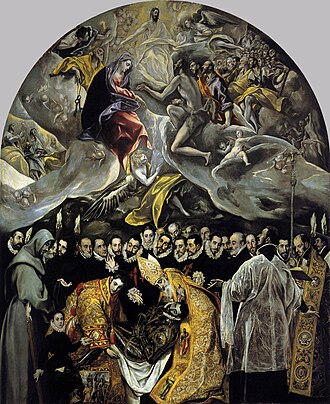 オルガス伯の埋葬 - El Greco (1586)
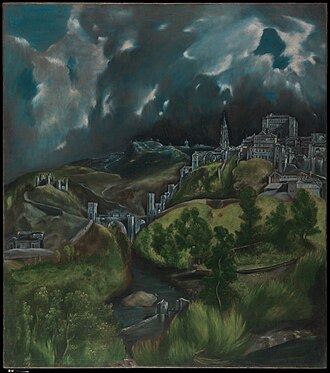 トレドの風景 - El Greco (1596)
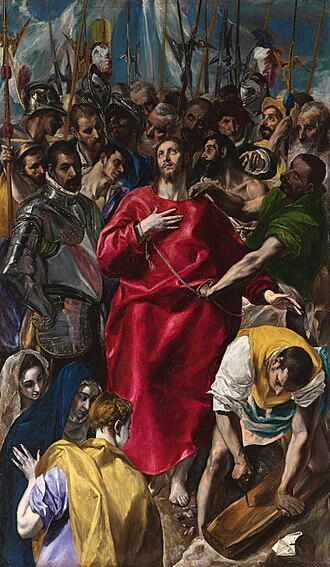 聖衣剥奪 - El Greco (1570s)
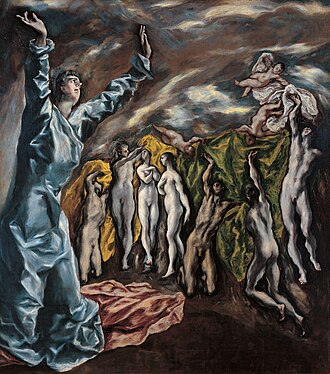 黙示録第5の封印 - El Greco (1610)
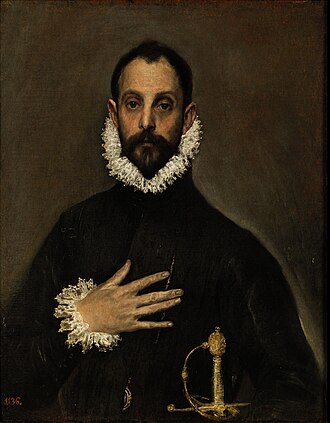 胸に手を置く騎士 - El Greco (1580)
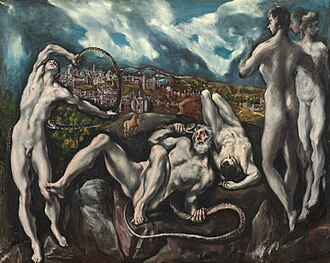 ラオコーン - El Greco (1610s)
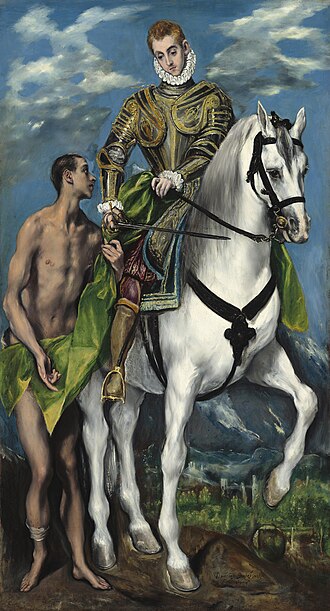 聖マルティヌスと乞食 - El Greco (1597)
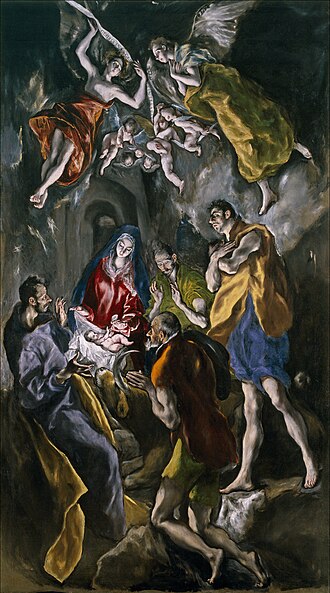 羊飼いの礼拝 - El Greco (1612)
関連する画家の作品
 カナの婚礼 - Paolo Veronese (1560s)
 レヴィ家の饗宴 - Paolo Veronese (1573)
 最後の晩餐 - Jacopo Tintoretto (1563)
 奴隷を解放する聖マルコ - Jacopo Tintoretto (1540s)
 ウルビーノのヴィーナス - Titian (1538)
 聖母被昇天 - Titian (1510s)
 エマオの晩餐 - Caravaggio (1601)
 聖マタイの召命 - Caravaggio (1609)
 大使たち - Hans Holbein the Younger (1533)
 墓の中のキリストの屍 - Hans Holbein the Younger (1520s)