The Annunciation
エル・グレコ · 1600
.jpg)
Gabriel has only just arrived: his wings still point upward and the folds of his sleeves are still lifted by the flight. Mary turns in surprise, her hand on a book, and the dove of the Holy Spirit hovers between them.
The story behind the painting
The Annunciation is one of El Greco's most repeated subjects. Harold Wethey counted three versions from his Italian years, ten from Spain with more or less workshop help, plus several false or doubtful attributions. Shortly after the altarpiece of Doña María de Aragón, El Greco created a new variant based on his Italian model, and this canvas seems to be its prototype, from which a group of copies derives. The article dates it around 1600 to 1605 according to Wethey, or 1597 to 1603 according to José Gudiol, while Wikidata gives 1600. The episode comes from the Gospel of Luke (1:26-39).
What to look for
Mary sits in the foreground beside a prie-dieu, her left hand on a book, turning toward Gabriel. He stands on a cloud with a lily in his left hand, his face in profile, his right hand raised in greeting, and Mary answers with her right hand. The pale yellow of his tunic harmonises with the greyish whites of his wings and the bluish greys of the background. The basket of needlework and the vase of flowers are symbols rather than furniture. The canvas measures 128 by 84 cm in the article, 128 by 83 cm in Wikidata.
Meaning and intent
Compared with his Italian versions, El Greco simplifies the figures to their essence, brings Mary to the front and Gabriel very close to her, and goes deeper into the meaning of the event. The only setting is the prie-dieu. Everything creates a sense of movement and reflects the agitation of both figures. The scholars cited judge Gabriel splendid, especially his profile and finely modelled left arm, and think El Greco must have painted this angel himself, while Mary seems to be the work of an assistant.
Legacy
The canvas was excessively cleaned, so the ground layer shows through in places, such as the prie-dieu, the basket and the vase. Old illustrations show false folds in Mary's skirt, added in the nineteenth century and later removed. It passed through the Marqués de Corvera, F. Ortiz de Piñedo in Madrid, Baron Stanislas in Paris and Durand-Ruel, then Ralph M. Coe in Cleveland from 1928 to 1951, before the Toledo Museum of Art in Ohio. Wikidata places it there, though the Spanish article describes it as formerly located in that museum.
豆知識
- Seems to be the prototype of a later group of Annunciations.
- Dated 1600 to 1605 by Wethey, 1597 to 1603 by Gudiol.
- Gabriel is thought to be by El Greco, Mary by an assistant.
- Linked to the Toledo Museum of Art, Ohio.
画家について
エル・グレコ (1541-1614)
同じ画家の作品: エル・グレコ
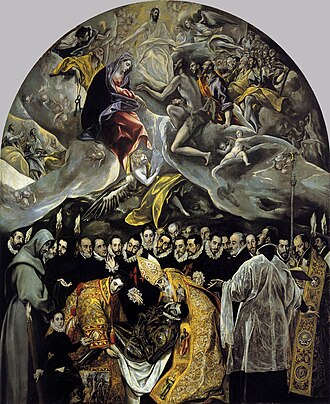 オルガス伯の埋葬 - El Greco (1586)
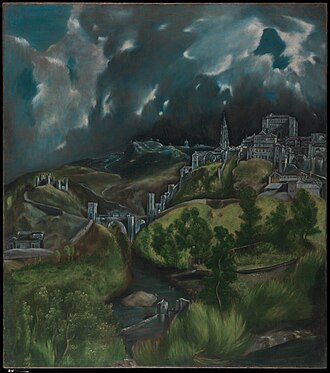 トレドの風景 - El Greco (1596)
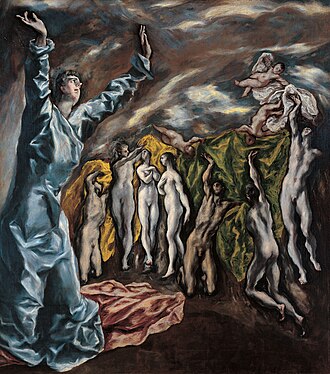 黙示録第5の封印 - El Greco (1610)
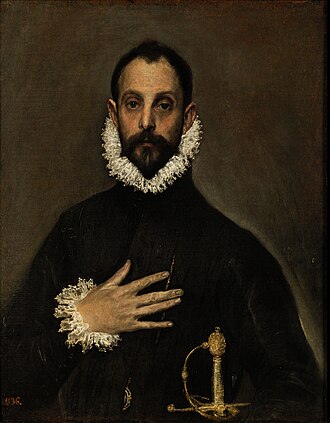 胸に手を置く騎士 - El Greco (1580)
%20-%20Laoco%C3%B6n%20-%20Google%20Art%20Project.jpg) ラオコーン - El Greco (1610s)
ラオコーン - El Greco (1610s)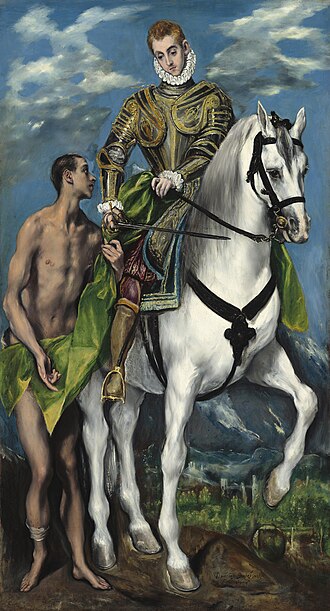 聖マルティヌスと乞食 - El Greco (1597)
.jpg) 羊飼いの礼拝 - El Greco (1612)
羊飼いの礼拝 - El Greco (1612)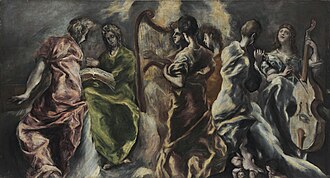 The Concert of the Angels - El Greco (1600s)
関連する画家の作品
.jpg) ウルビーノのヴィーナス - Titian (1538)
ウルビーノのヴィーナス - Titian (1538)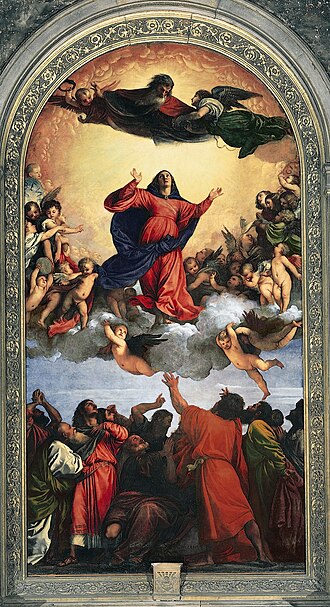 聖母被昇天 - Titian (1510s)
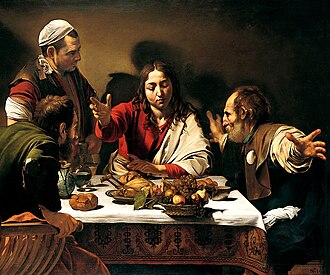 エマオの晩餐 - Caravaggio (1601)
 聖マタイの召命 - Caravaggio (1609)
 大使たち - Hans Holbein the Younger (1533)
 墓の中のキリストの屍 - Hans Holbein the Younger (1520s)