自画像
ティツィアーノ・ヴェチェッリオ · 1550s
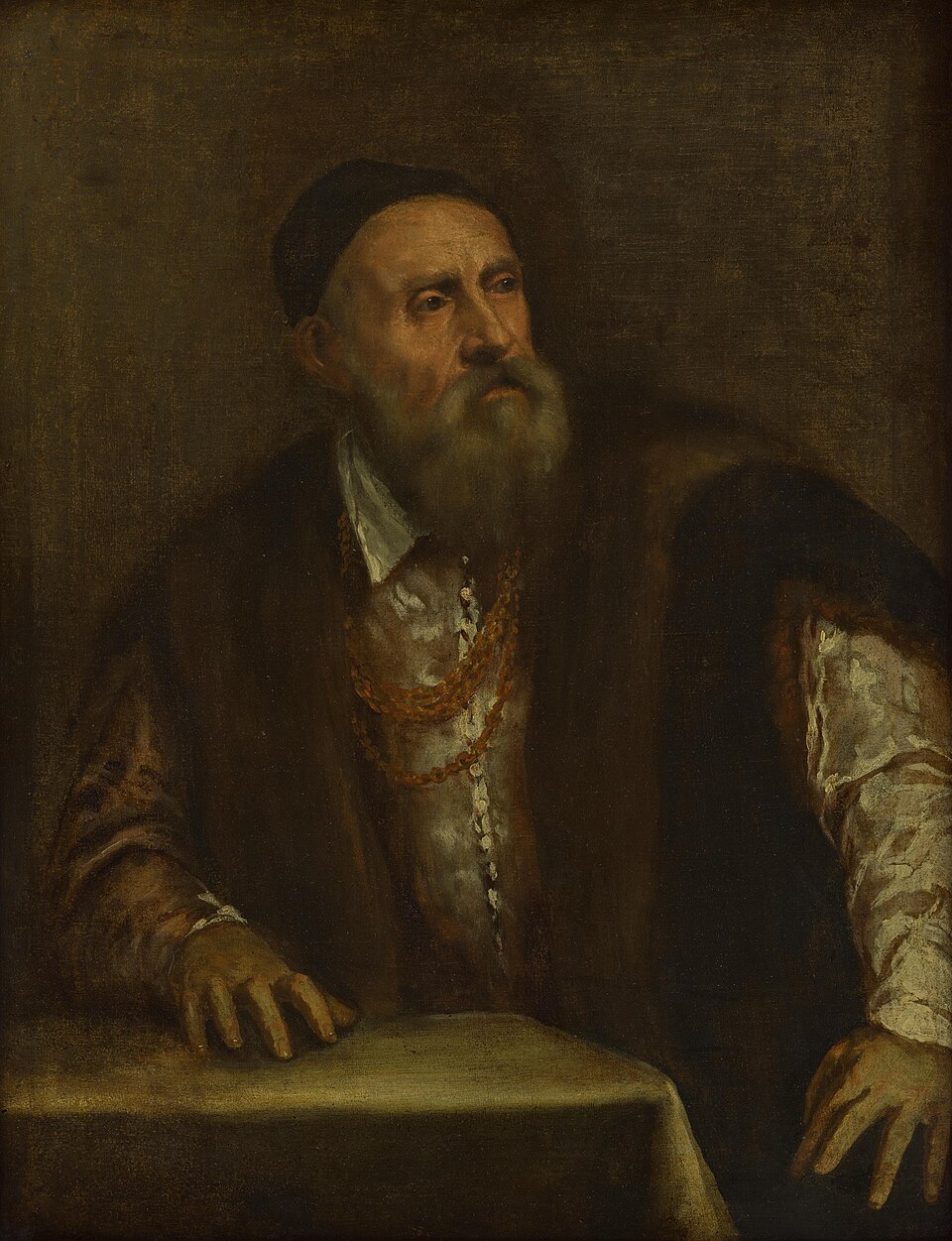
Strong shoulders, a gold chain from an emperor, a gaze fixed somewhere beyond us: Titian left this self-portrait unfinished, and the rough, open brushwork lets us watch the master at work.
The story behind the painting
Titian painted several self-portraits, but this is one of only two painted examples to survive; the other is in Madrid. The sources disagree on the date: Wikipedia gives 1546 to 1547, matching a record of a portrait given to Paolo Giovio in 1549, while Wikidata says the 1550s, and Vasari wrote of self-portraits around 1562 to 1564. Parts of the canvas, especially the hands, the dark area around the face and the drapery, are unfinished. It stayed in Titian's studio in the Biri Grande in Venice until his death. Some see it as a study for a lost work; Vasari wrote that Titian made self-portraits for his family to remember him by.
What to look for
Titian is shown at half length in three-quarter profile, seated behind a table and looking into the distance. He seems about sixty. Around his neck, wrapped three times, is the golden chain of the Order of the Golden Spur, given to him by the Emperor Charles V in 1533 as a sign of knighthood and high status. He wears a black cap, perhaps linking him with scholars such as Aristotle and Saint Jerome, or perhaps hiding a bald spot. Look at the thick, irregular white paint laid on in large patches, and at the left hand and the clothes, only roughly sketched.
Meaning and intent
His expression is complex, but it can be read as more outward looking and optimistic than in the later Madrid self-portrait. As in all his independent self-portraits, he looks to the side, avoiding the viewer, perhaps out of humility, yet his pose is dignified, with strong shoulders and a keen, alert gaze in which some detect combativeness, disquiet and misgiving. Unlike the Madrid picture, no brush or palette names his trade. David Rosand believes the open brushwork itself declares the painter's art, and the emphasis on his hands may point to the source of his talent.
Legacy
Because it is unfinished, the canvas gives rare insight into Titian's methods. It is linked in theme and style to his 1545 Portrait of Pietro Aretino, and several versions exist, including drawings by his own hand and paintings given to his workshop. In 1581 his son Pomponio Vecellio sold the house and its contents to the collector Cristoforo Barbarigo, and the portrait stayed in the Palazzo Barbarigo della Terrazza. Leopoldo Cicognara bought it in 1815, it passed almost at once to the Solly collection, and the Gemaldegalerie in Berlin acquired it in the early 1820s.
豆知識
- One of only two painted self-portraits by Titian to survive.
- Dated 1546 to 1547 by Wikipedia and the 1550s by Wikidata.
- He wears the gold chain given by Charles V in 1533.
- Unfinished, it stayed in Titian's studio until his death.
画家について
ティツィアーノ・ヴェチェッリオ (1488-1576)
ヴェネツィア派 · 自画像 · 絵画館 · ティツィアーノ・ヴェチェッリオ
同じ画家の作品: ティツィアーノ・ヴェチェッリオ
 ウルビーノのヴィーナス - Titian (1538)
 聖母被昇天 - Titian (1510s)
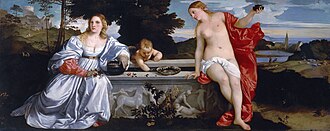 聖愛と俗愛 - Titian (1510s)
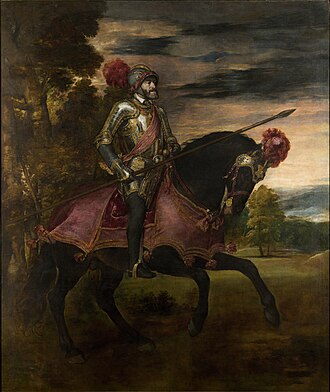 騎乗像 - Titian (1548)
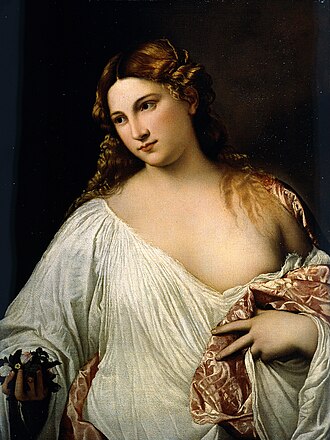 フローラ - Titian (1517)
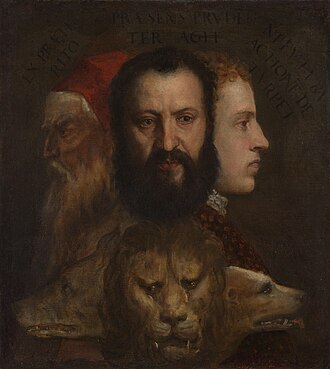 賢明の寓意 - Titian (1550)
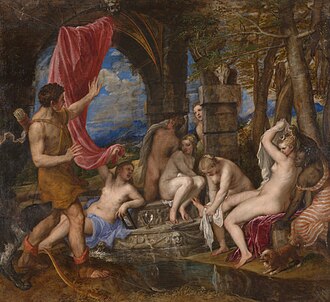 ディアナとアクタイオン - Titian (1550s)
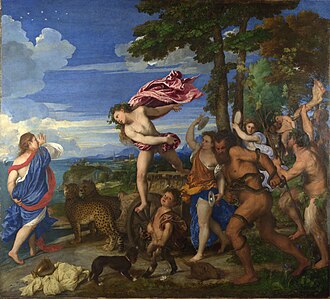 バッカスとアリアドネ - Titian (1520s)
関連する画家の作品
 最後の晩餐 - Jacopo Tintoretto (1563)
 奴隷を解放する聖マルコ - Jacopo Tintoretto (1540s)
 カナの婚礼 - Paolo Veronese (1560s)
 レヴィ家の饗宴 - Paolo Veronese (1573)