『パトモス島の福音書記者聖ヨハネ』
Diego Velázquez · 1618
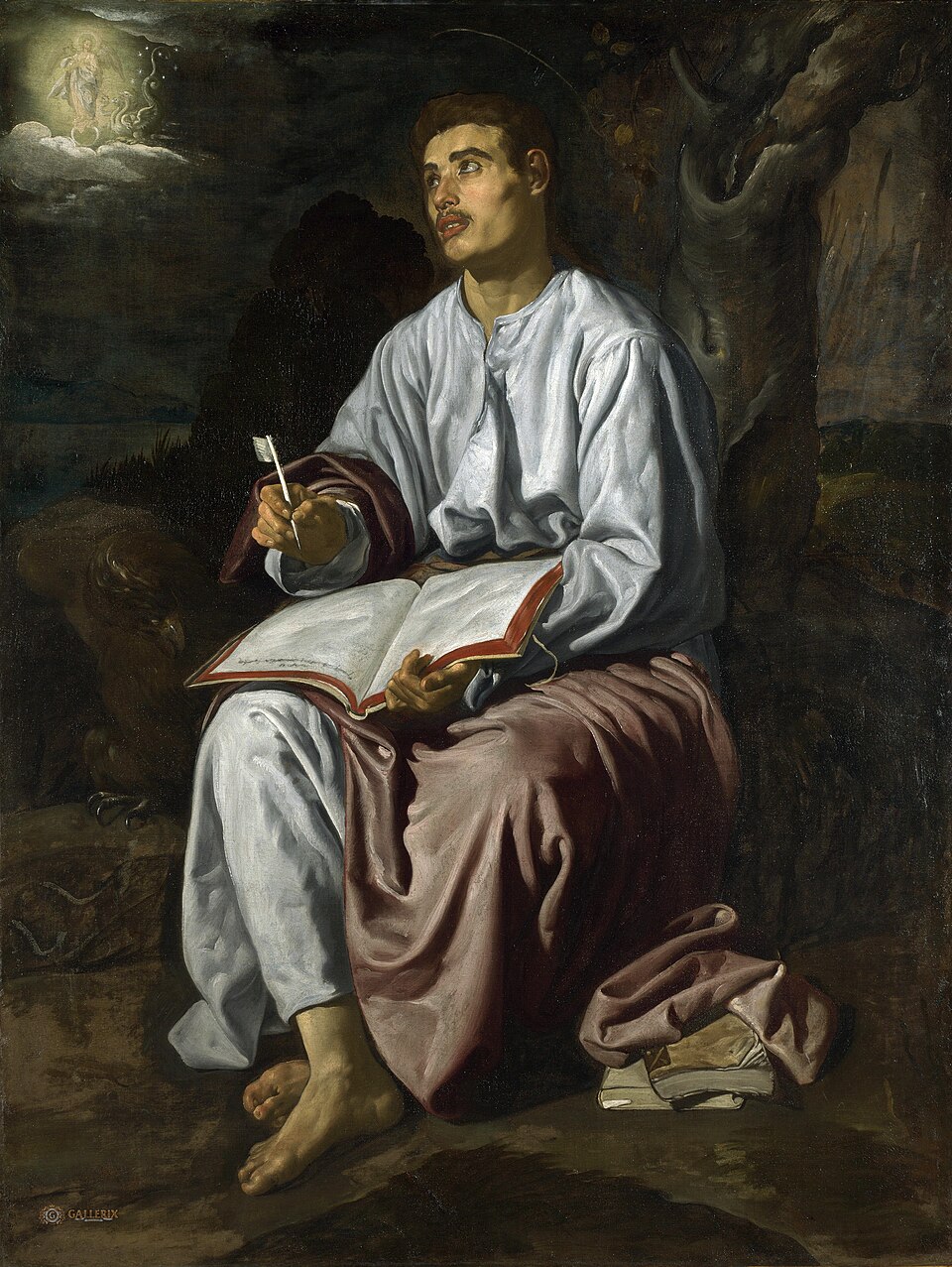
A young man sits on a rocky island, pen in hand, looking up at a tiny vision in the sky. Velázquez was at the start of his career in Seville when he painted Saint John on Patmos, and the face he gave the apostle was taken straight from life.
The story behind the painting
Velázquez painted this picture in Seville around 1618, in his early period. In 1800 the historian Ceán Bermúdez recorded it, together with an Immaculate Conception of identical size, in the chapter house of the Calced Carmelite convent in Seville, for which it was probably made. Both paintings were sold in 1809, through the canon López Cepero, to the British ambassador Bartholomew Frere. The National Gallery in London held it on loan from 1946 and acquired it in 1956. Since Ceán, critics have agreed unanimously that it is by Velázquez.
What to look for
Saint John sits with a book on his knees, writing down the revelation he receives. At his feet two more books, one on top of the other, probably stand for his Gospel and his letters. Top left, small and wrapped in diffuse light, is his vision: a woman clothed with the sun, the moon under her feet, and a dragon. The saint's head was painted from a model, probably the same one used for a profile head study in the Hermitage. Light from outside the frame bounces off his white clothes and carves his hard features. To his right, in half shadow, the eagle of the evangelist is barely visible: a talon, a few white touches on head and beak.
Meaning and intent
The vision comes from the Book of Revelation and was read as the Immaculate Conception, a doctrine that had ardent defenders in Seville. Velázquez drew on known prints, by Jan Sadeler after Maerten de Vos and by Juan de Jáuregui, for the vision, and more discreetly on Dürer for the saint. He painted John young, though by tradition he was about eighty when he wrote Revelation. His teacher Pacheco advised painting him young as a model of purity. The vision is small because the painting hung beside the Immaculate Conception, where the same woman appears as the Virgin.
Legacy
Even in this early work, the strong volume and careful attention to textures, as Fernando Marías noted, set Velázquez apart from his master. Small accidental touches to the right of the tree trunk, where he cleaned his brush, show a habit he kept. The painting now hangs at the National Gallery beside its companion, the Immaculate Conception, so viewers can again read the two as a pair: the apostle who saw the vision, and the vision itself made flesh. Wikidata gives the date as 1618, matching the source.
豆知識
- Painted in Seville around 1618.
- Probably made for the Calced Carmelite convent in Seville.
- Sold in 1809 together with its companion, the Immaculate Conception.
- Acquired by the National Gallery, London, in 1956.
画家について
Diego Velázquez (1599-1660)
同じ画家の作品: Diego Velázquez
 ラス・メニーナス - Diego Velázquez (1656)
 ブレダの開城 - Diego Velázquez (1635)
 鏡のヴィーナス - Diego Velázquez (1644)
 アラクネの寓話 - Diego Velázquez
 インノケンティウス10世の肖像 - Diego Velázquez
 卵を調理する老女 - Diego Velázquez (1618)
 昼食 - Diego Velázquez (1617)
 バッカスの勝利 - Diego Velázquez (1628)
関連する画家の作品
 エマオの晩餐 - Caravaggio (1601)
 聖マタイの召命 - Caravaggio (1609)
 Saint Francis in Meditation - Francisco de Zurbarán (1639)
 The Immaculate Conception - Francisco de Zurbarán (1661)
 チャールズ1世の三面肖像画 - Anthony van Dyck (1635)
 馬上のチャールズ1世とサン・アントワーヌの領主の肖像 - Anthony van Dyck (1636)
 キリスト昇架 - Peter Paul Rubens (1609)
 レウキッポスの娘たちの略奪 - Peter Paul Rubens (1618)
 夜警 - Rembrandt van Rijn (1642)
 自画像 - Rembrandt van Rijn (1659)
 陽気な酒飲み - Frans Hals (1620s)
 微笑む騎士 - Frans Hals (1624)