Portrait of the Jester Calabazas
Diego Velázquez · 1626
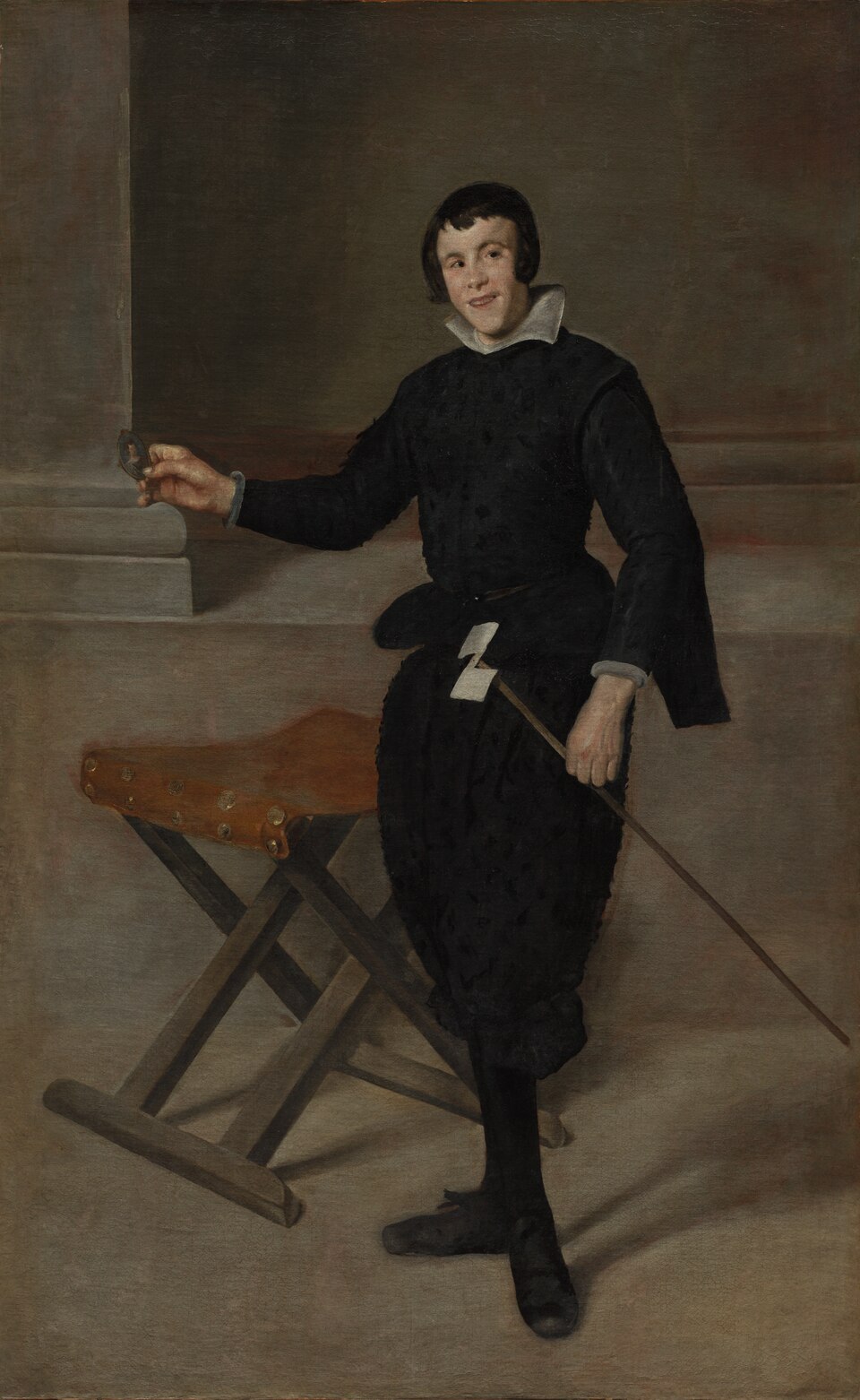
A court jester grins in a dim palace room, a small portrait in one hand and something like a toy windmill in the other. Is it by Velázquez, and is it even Calabazas? Scholars still disagree.
The story behind the painting
The painting is thought to show the jester Juan Calebasse, known as Calabacillas, whom Velázquez also painted in a work now in Madrid and in a lost picture of him in a turban, recorded in 1642 and 1655 inventories. It probably hung in the Buen Retiro Palace before it was seized after the French occupation of Spain in 1808. In 1866 it appeared at a Velázquez retrospective in Paris, then owned by the Duke of Persigny. After passing through other hands it was sold at Christie's in London in 1965 and reached the Cleveland Museum of Art the same year. Dates range from 1626 to 1632.
What to look for
The jester is life-size, about 175 by 106 cm, standing in an interior. In one hand he holds a miniature portrait of a woman; in the other a small object usually read as a paper windmill. Julián Gállego thought it was a small arrow or a banderilla instead. When Antonio Ponz visited the palace he described the happy jester with a paper windmill, to Velázquez's taste. The woman's low neckline in the miniature looks later than the 1620s, which the museum explains as a later addition. The paint surface was badly affected by later re-stretching of the canvas.
Meaning and intent
José López-Rey based the attribution on style, comparing the face to that of Bacchus in The Triumph of Bacchus, and dated it 1628 to 1629. He linked it to a 1701 inventory entry for a jester with a portrait in one hand and a paper in the other, calling the difference a copyist's error. A 1789 inventory mentions a portrait of Velasquillo the jester, adding that the old inventory said Calabacillas with a portrait and a windmill. So the sitter might be Velasquillo, perhaps the stage name of Cristóbal Velázquez. The picture asks us to look at a jester as an individual, while leaving his identity open.
Legacy
Leo Steinberg attributed the work to Alonso Cano, and Elizabeth du Gué Trapier and Jonathan Brown doubted both subject and painter. They point out that the canvas is smaller than the inventory size of just over two metres, and that Calabacillas only entered the service of Philip IV in 1632. Brown still rejects Velázquez, citing the vague architecture, the uniform brushwork and heavy passages such as the right hand. Today it hangs in Cleveland as a Velázquez, carrying an open debate with it.
豆知識
- Dated between 1626 and 1632; López-Rey proposed 1628 to 1629.
- Probably from the Buen Retiro Palace, taken after 1808.
- In the Cleveland Museum of Art since 1965.
- Attribution doubted by Jonathan Brown and others.
画家について
Diego Velázquez (1599-1660)
肖像 · 男性 · Cook collection · クリーヴランド美術館
同じ画家の作品: Diego Velázquez
 ラス・メニーナス - Diego Velázquez (1656)
 ブレダの開城 - Diego Velázquez (1635)
 鏡のヴィーナス - Diego Velázquez (1644)
 アラクネの寓話 - Diego Velázquez
 インノケンティウス10世の肖像 - Diego Velázquez
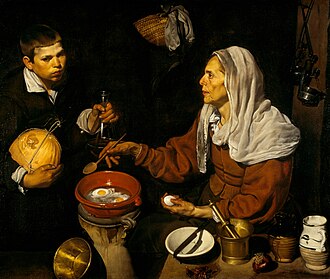 卵を調理する老女 - Diego Velázquez (1618)
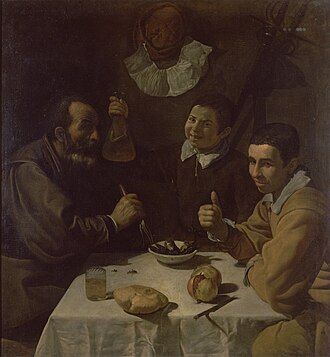 昼食 - Diego Velázquez (1617)
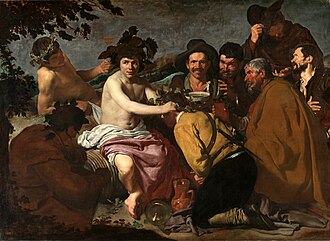 バッカスの勝利 - Diego Velázquez (1628)
関連する画家の作品
 エマオの晩餐 - Caravaggio (1601)
 聖マタイの召命 - Caravaggio (1609)
 Saint Francis in Meditation - Francisco de Zurbarán (1639)
 The Immaculate Conception - Francisco de Zurbarán (1661)
 チャールズ1世の三面肖像画 - Anthony van Dyck (1635)
 馬上のチャールズ1世とサン・アントワーヌの領主の肖像 - Anthony van Dyck (1636)
 キリスト昇架 - Peter Paul Rubens (1609)
 レウキッポスの娘たちの略奪 - Peter Paul Rubens (1618)
 夜警 - Rembrandt van Rijn (1642)
 自画像 - Rembrandt van Rijn (1659)
 陽気な酒飲み - Frans Hals (1620s)
 微笑む騎士 - Frans Hals (1624)