フアン・マルティネス・モンタニェースの肖像
Diego Velázquez · 1635
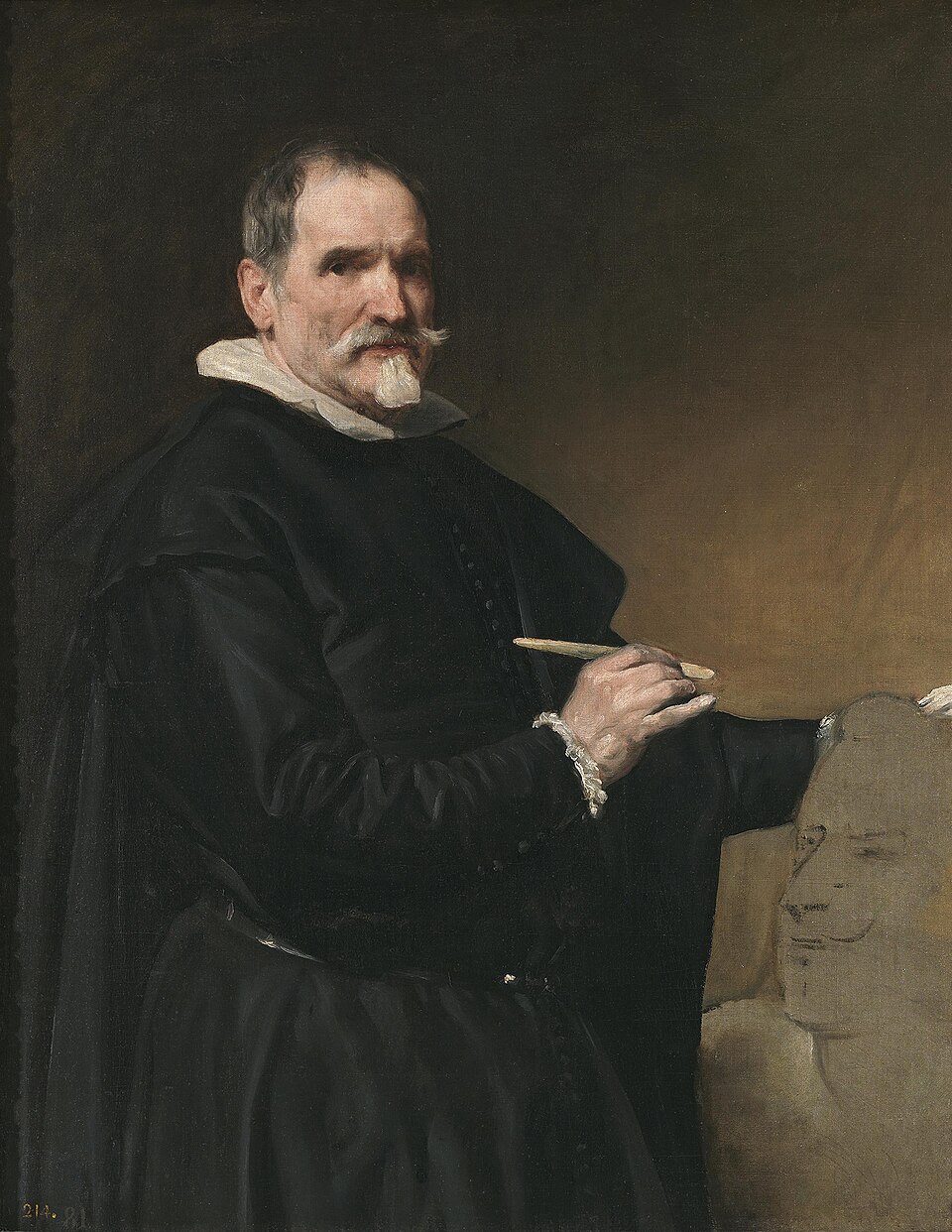
A sculptor in black, a stick in his hand, works on a head of the king that is still only an outline. Velázquez never finished this portrait, and that is part of its charm: we see one artist honouring another, caught in the middle of the work.
The story behind the painting
In 1635 the sculptor Juan Martínez Montañés was called from Seville to the royal court in Madrid to make a clay bust of Philip IV of Spain. It would serve as the model for the Florentine sculptor Pietro Tacca, who was to cast a bronze equestrian statue of the king, now in the Plaza de Oriente in Madrid. Montañés was in Madrid between June 1635 and January 1636, and the portrait was probably painted when he called on Velázquez during that visit. The two men knew each other well: Velázquez's master and father-in-law, Francisco Pacheco, had painted many sculptures made by Montañés.
What to look for
The sculptor is shown working on the bust of the king, shaping the clay with a stick. Because the painting is unfinished, the bust appears only as an outline, so the eye goes first to the man and his hands. He wears formal black dress with a white collar and white cuffs, the clothing of a nobleman. The canvas measures 109 by 88 cm. Some art historians have suggested that the sitter is Velázquez's brother-in-law Alonso Cano, which would date the picture to Cano's visit to Madrid in 1658, but most agree it shows Montañés, because of his resemblance to other identified portraits.
Meaning and intent
At a time when artists were often seen as mere craftsmen, Velázquez raises the sculptor's social standing by painting him like a nobleman. The picture is also a meeting of two generations from Seville: when it was made, Velázquez was 36 and Montañés was 67, an older master of the previous artistic generation. The unfinished bust turns the portrait into a scene of work in progress, the clay king still waiting to take shape under the sculptor's hand while the painter's own work is left open too.
Legacy
The painting belonged to the Spanish royal collection and is now in the Museo del Prado in Madrid. The bronze equestrian statue of Philip IV for which Montañés modelled the bust still stands in the Plaza de Oriente. Wikidata dates the portrait to 1635, matching the sculptor's stay at court, while the Wikipedia article gives about 1635 and records the minority view that would move it to 1658 and change the sitter. The portrait remains a rare image of a Spanish sculptor of that age at work, shown with the dignity of a courtier.
豆知識
- An unfinished portrait of the sculptor Juan Martínez Montañés, about 1635.
- He is shaping a clay bust of Philip IV for a bronze equestrian statue.
- Velázquez was 36 and Montañés 67 at the time.
- Now in the Museo del Prado, Madrid.
画家について
Diego Velázquez (1599-1660)
同じ画家の作品: Diego Velázquez
 ラス・メニーナス - Diego Velázquez (1656)
 ブレダの開城 - Diego Velázquez (1635)
 鏡のヴィーナス - Diego Velázquez (1644)
 アラクネの寓話 - Diego Velázquez
 インノケンティウス10世の肖像 - Diego Velázquez
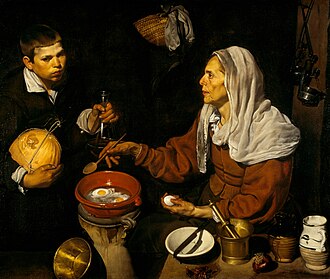 卵を調理する老女 - Diego Velázquez (1618)
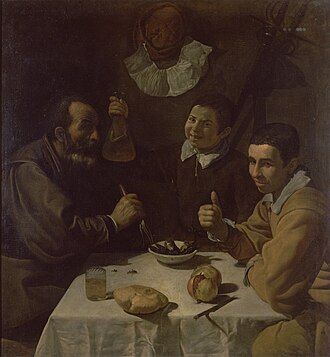 昼食 - Diego Velázquez (1617)
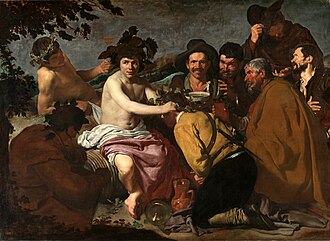 バッカスの勝利 - Diego Velázquez (1628)
関連する画家の作品
 エマオの晩餐 - Caravaggio (1601)
 聖マタイの召命 - Caravaggio (1609)
 Saint Francis in Meditation - Francisco de Zurbarán (1639)
 The Immaculate Conception - Francisco de Zurbarán (1661)
 チャールズ1世の三面肖像画 - Anthony van Dyck (1635)
 馬上のチャールズ1世とサン・アントワーヌの領主の肖像 - Anthony van Dyck (1636)
 キリスト昇架 - Peter Paul Rubens (1609)
 レウキッポスの娘たちの略奪 - Peter Paul Rubens (1618)
 夜警 - Rembrandt van Rijn (1642)
 自画像 - Rembrandt van Rijn (1659)
 陽気な酒飲み - Frans Hals (1620s)
 微笑む騎士 - Frans Hals (1624)