ヨハン・クレーベルガーの肖像
アルブレヒト・デューラー · 1526
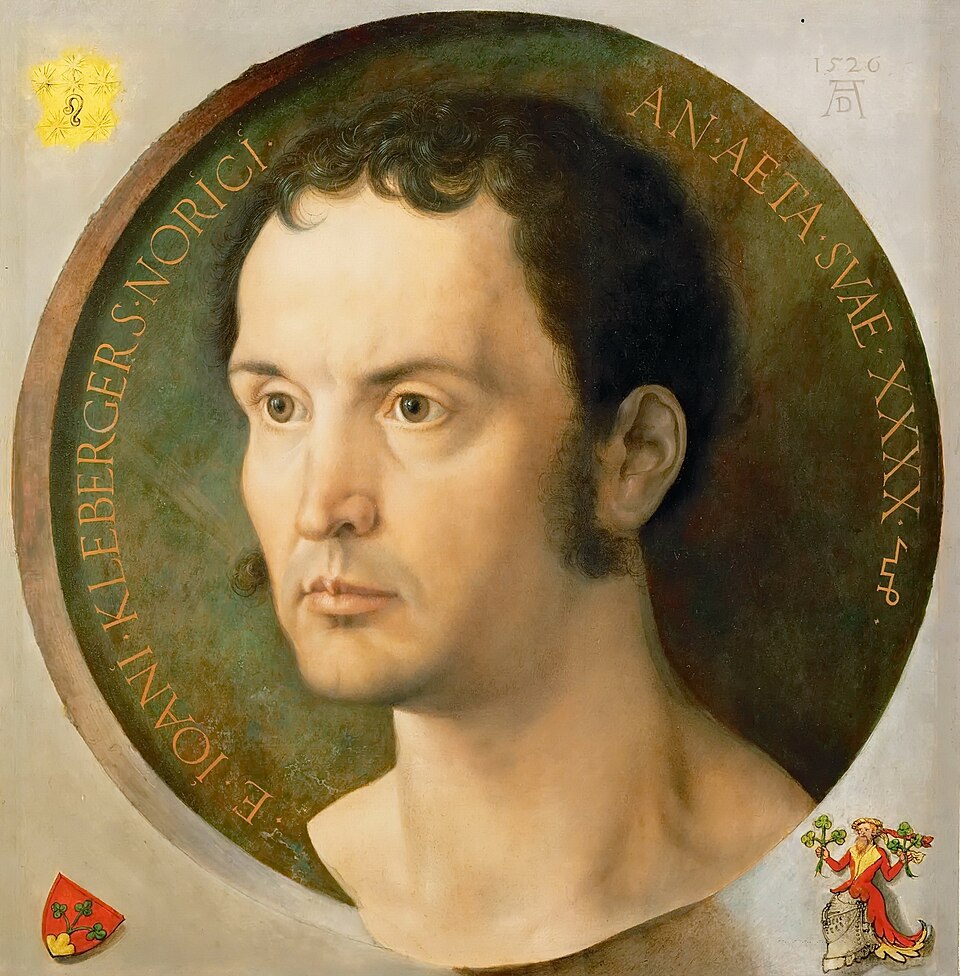
A man's head floats in a round opening in a painted stone wall, like a living face on an ancient coin. In 1526 Dürer turned a wealthy financier into a classical medal.
The story behind the painting
Johann Kleberger was a rich merchant and financier, and he had a close link to Dürer's own circle: he married the widowed daughter of Willibald Pirckheimer, one of Dürer's closest friends. Dürer painted his portrait in Nuremberg in 1526, in the same year as his portraits of Hieronymus Holzschuher and Jakob Muffel. The work is oil on a limewood panel, signed and dated by the artist. Its later history is a small story of inheritance and royalty. When Kleberger died, the picture passed to his stepson Willibald Imhof, who then sold it to Rudolf II, the Holy Roman Emperor. From there it eventually reached the museum in Vienna where it hangs today.
What to look for
This is one of Dürer's most unusual portraits. Instead of a sitter in a room or against a plain background, he paints a trompe-l'oeil wall, a flat surface made to fool the eye, pierced by a circular opening. Inside that circle Kleberger appears as a bust that looks almost like sculpture, as if carved or cast rather than alive. Around the circle runs an inscription naming the sitter and giving his age as forty, written E. IOANI KLEBERGERS NORIKER UN AETA SVAE XXXX. In three corners of the square panel are heraldic motifs, and in the fourth Dürer places the date 1526 and his own monogram. The square format, about 36.5 centimetres each side, frames it all.
Meaning and intent
The source explains that the portrait is painted in the format of a classical medal. Dürer may have been inspired by Hans Burgkmair's engravings of Roman medals. Medals of the ancient world carried the heads of emperors and great men, so to show a Nuremberg financier this way is to give him a kind of timeless, antique dignity. The illusion is playful too: a living face held inside a painted stone wall, both a person and a monument. Name, age, coats of arms and date surround him like the text around a coin, fixing who he was and when, in a form meant to last.
Legacy
The panel now belongs to the Kunsthistorisches Museum in Vienna, the path having passed through the hands of an emperor, Rudolf II. It stands among Dürer's late portraits made in Nuremberg in 1526, yet it looks different from all of them because of its medallion idea. For visitors, it is a reminder that Dürer was always experimenting, even late in life, borrowing forms from coins and prints and turning them into painting. The trompe-l'oeil wall makes us look twice: is this a face, a sculpture or a coin? That double reading is part of the pleasure, and part of how Kleberger has been remembered for five centuries.
豆知識
- Oil on limewood panel, signed and dated 1526
- Size: 36.5 × 36.5 cm
- Collection: Kunsthistorisches Museum, Vienna
- Once sold by Kleberger's stepson Willibald Imhof to Emperor Rudolf II
画家について
アルブレヒト・デューラー (1471-1528)
肖像 · 男性 · 美術史美術館 · ドイツのルネサンス期 · 黒髪
 自画像
自画像 東方三博士の礼拝
.jpg) 薔薇冠の祝祭
薔薇冠の祝祭 自画像
自画像 自画像
自画像 ヘラー祭壇画
 一万人のキリスト教徒の殉教
%20-%20Google%20Art%20Project.jpg) 聖三位一体の礼拝
聖三位一体の礼拝