悔悛するマグダラのマリア
ティツィアーノ・ヴェチェッリオ · 1533
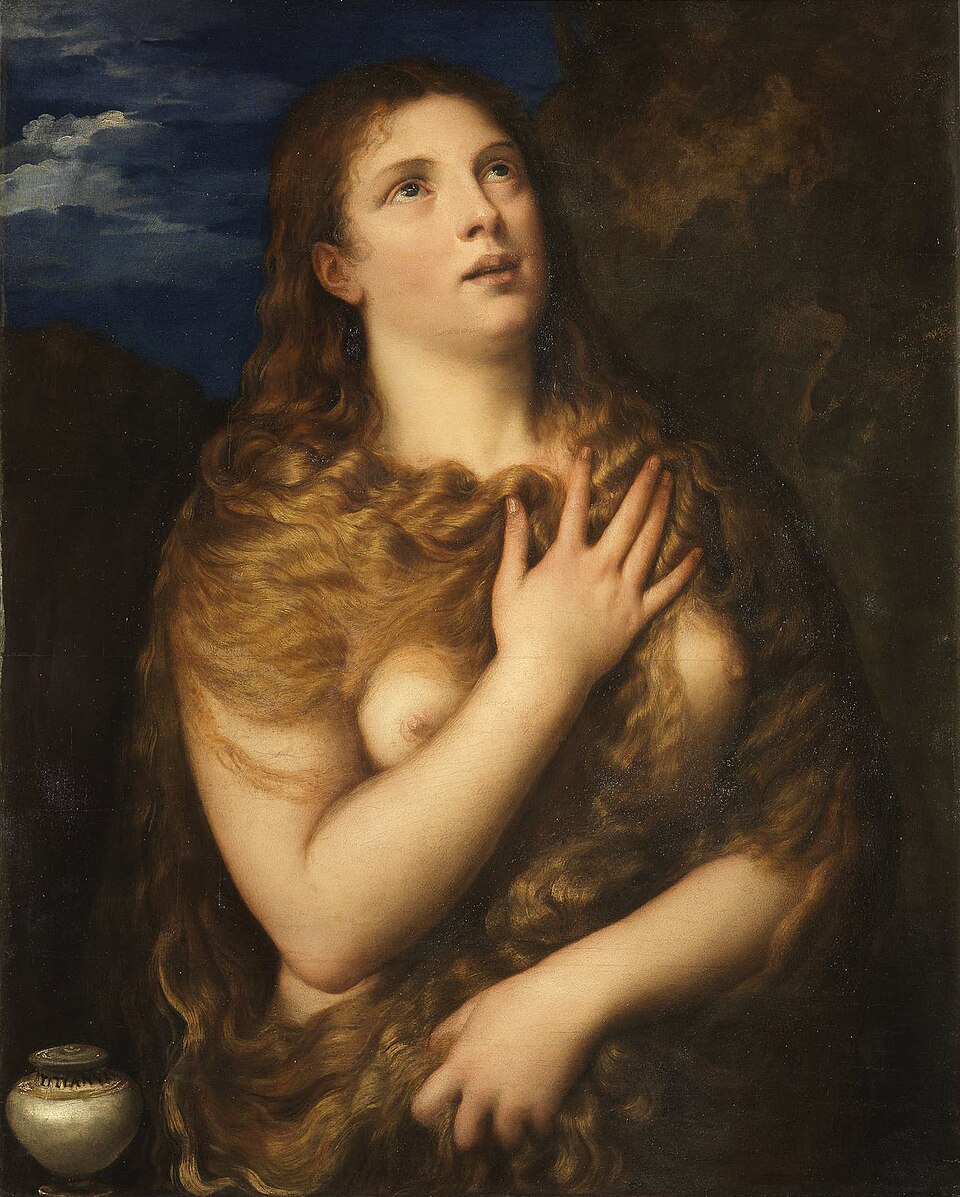
Wrapped only in her golden hair, Mary Magdalene raises tear-filled eyes to heaven and seems to glow from within. Titian painted her for a famous poet, and the image moved that devout reader deeply.
The story behind the painting
Titian painted this Penitent Magdalene for Federico Gonzaga, Duke of Mantua, who commissioned it as a devotional image for the celebrated poet Vittoria Colonna. Colonna, a learned and devout woman, was greatly inspired by it, even though the saint is portrayed very sensuously. Seeing the Magdalene's radiant body before the dark background, as if her light came from within, she believed the saint was aglow with her burning passion for Christ. The Wikipedia article dates the painting to around 1531, while Wikidata gives 1533. Titian signed it TITIANUS on the ointment jar at the left.
What to look for
Look at her eyes first: they are full of tears and raised heavenwards, catching a moment of elation and deep repentance. The tears recall the story of her washing the feet of Jesus and drying them with her hair. That hair, golden and long, flows over her body and covers it almost like a garment, while her fleshy body and full lips follow the Renaissance ideals of beauty of the time. Her figure shines against a dark, cave-like background. At the left, find the ointment jar, her traditional attribute, bearing the painter's signature.
Meaning and intent
In the sixteenth century the Magdalene, a sinner brought back to virtue by Jesus, was a very popular subject, because it let artists combine eroticism and religion without causing scandal. Her nudity, as Vasari noted, refers to the medieval legend that her clothes fell apart during the thirty years she spent repenting in the desert after the Ascension. According to works such as the Golden Legend, she lived her last years naked and alone in the mountains of Provence, fed by singing angels. Her lack of clothing therefore symbolises giving up jewels, gold and worldly goods for her faith.
Legacy
It is universally believed that Vittoria Colonna later gave the painting to Eleonora Gonzaga, since it was found in 1631 in the collection of her son, the Duke of Urbino. Today it hangs in the Sala di Apollo of the Palazzo Pitti in Florence. The way her hair wraps the body may also recall an older tradition: at the end of the Middle Ages a belief grew that she had grown a covering of hair over her whole body except face, hands and feet, an idea often shown in South German art and thought to come from liturgical drama. Titian's picture achieves a similar effect.
豆知識
- Commissioned by Federico Gonzaga for the poet Vittoria Colonna.
- Signed TITIANUS on the ointment jar.
- Dated around 1531 by Wikipedia, 1533 by Wikidata.
- Now in the Palazzo Pitti, Florence.
画家について
ティツィアーノ・ヴェチェッリオ (1488-1576)
宗教美術 · ヌード · ヴェネツィア派 · ロングヘア · マグダラのマリア · パラティーナ美術館 · 乳房 · 赤毛 · 裸婦 · 乳輪 · 洞窟
同じ画家の作品: ティツィアーノ・ヴェチェッリオ
.jpg) ウルビーノのヴィーナス - Titian (1538)
ウルビーノのヴィーナス - Titian (1538)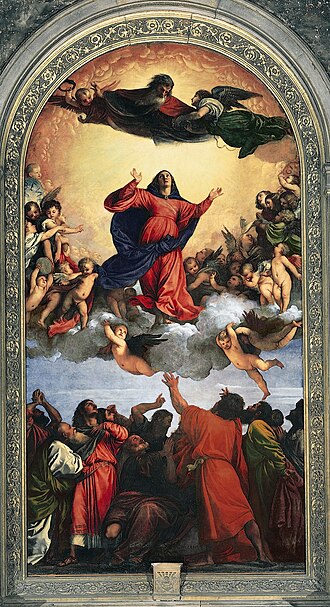 聖母被昇天 - Titian (1510s)
FXD.jpg) 聖愛と俗愛 - Titian (1510s)
聖愛と俗愛 - Titian (1510s)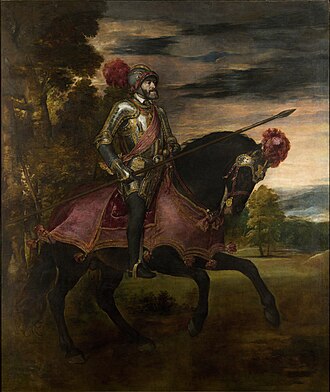 騎乗像 - Titian (1548)
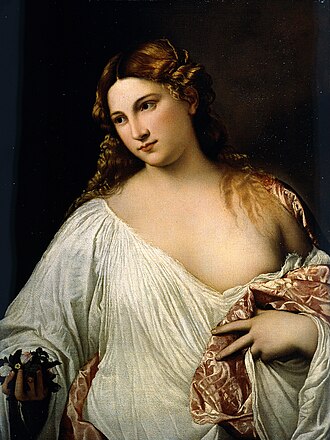 フローラ - Titian (1517)
 賢明の寓意 - Titian (1550)
 ディアナとアクタイオン - Titian (1550s)
 バッカスとアリアドネ - Titian (1520s)
関連する画家の作品
 最後の晩餐 - Jacopo Tintoretto (1563)
 奴隷を解放する聖マルコ - Jacopo Tintoretto (1540s)
 カナの婚礼 - Paolo Veronese (1560s)
.jpg) レヴィ家の饗宴 - Paolo Veronese (1573)
レヴィ家の饗宴 - Paolo Veronese (1573)