メルクリウスとアルゴス
Diego Velázquez · 1659
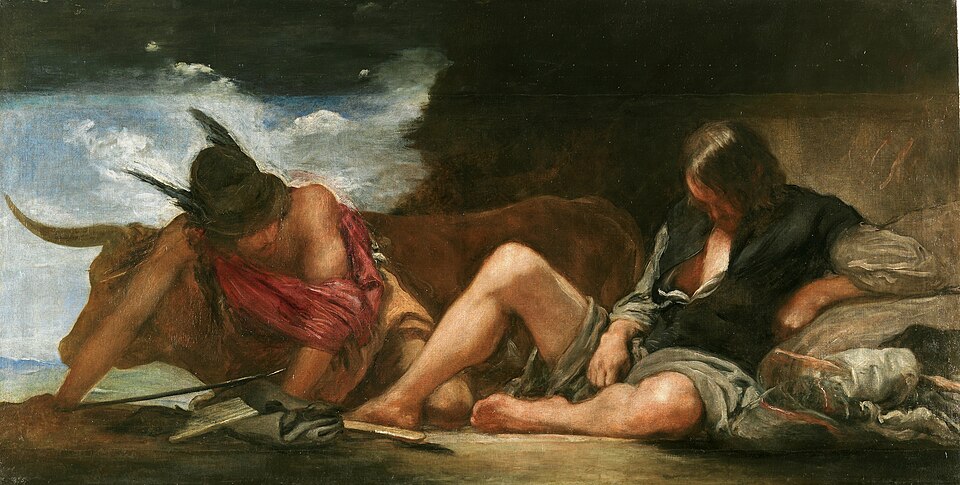
In the dusk between two rocks, a giant falls asleep and a god creeps closer with a sword. Velazquez painted this quiet moment just before a killing near the very end of his life, for a hall of mirrors in the royal palace.
The story behind the painting
After becoming superintendent of the king's works in 1643, Velazquez also acted as decorator of the Alcazar of Madrid. His last such task, in 1658, was the great Hall of Mirrors, where he planned the ceiling and wrote in each frame the story to be painted there. For himself he kept four mythological pictures for the spaces between the windows. The 1686 inventory lists Mercury and Argus with three others, all later lost when the Alcazar burned. Critics date it almost unanimously to 1659, making it one of his last canvases.
What to look for
Ovid tells how Jupiter turned Io into a cow, and jealous Juno set Argus, the hundred-eyed giant who never sleeps, to guard her. Mercury lulls him with music, and this is the instant Velazquez shows: the guard nodding off, Mercury leaving his pan pipes for the sword. Life-size figures in a wide format had to lie or crouch, so Mercury is no heroic soldier but a cunning killer edging in from the shadows. Io the cow sits in shadow. Two strips were later added to the canvas, the top one, 25.5 cm high, clearly visible.
Meaning and intent
The picture is often set beside Rubens's version of the same myth. Both painters made Argus a rough, bald herdsman rather than a hundred-eyed giant. But Rubens placed his figures in a dramatic landscape with violent contrasts, while Velazquez reduced the setting to an opening between rocks and a twilight sky. For Fernando Marias, the four lost hall paintings may have shared a reflection on sight and its absence. Scholars have proposed the Dying Gaul and a Michelangelo figure from the Sistine Chapel as models for Argus.
Legacy
Mercury and Argus survived the fire, was moved to the Royal Palace of Madrid, and entered the Prado in 1819. In 1990 Julian Gallego, and in 1999 Jonathan Brown, compared it with Rubens's picture when the Prado brought the two together for the exhibition Velazquez, Rubens and Van Dyck. Their conclusion is the heart of its fame: Rubens makes the gods superhuman heroes, while for Velazquez the marvellous melts into the everyday and is received in silence.
豆知識
- Painted around 1659 for the Hall of Mirrors in the Alcazar of Madrid.
- Its three companion pictures were lost in a palace fire.
- Enlarged later by two added strips of canvas.
- In the Prado since 1819.
画家について
Diego Velázquez (1599-1660)
同じ画家の作品: Diego Velázquez
 ラス・メニーナス - Diego Velázquez (1656)
 ブレダの開城 - Diego Velázquez (1635)
 鏡のヴィーナス - Diego Velázquez (1644)
 アラクネの寓話 - Diego Velázquez
 インノケンティウス10世の肖像 - Diego Velázquez
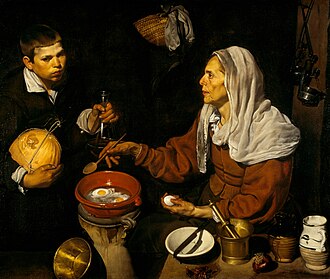 卵を調理する老女 - Diego Velázquez (1618)
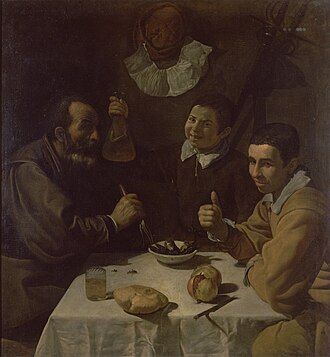 昼食 - Diego Velázquez (1617)
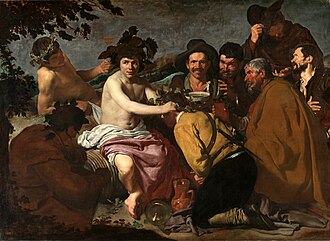 バッカスの勝利 - Diego Velázquez (1628)
関連する画家の作品
 エマオの晩餐 - Caravaggio (1601)
 聖マタイの召命 - Caravaggio (1609)
 Saint Francis in Meditation - Francisco de Zurbarán (1639)
 The Immaculate Conception - Francisco de Zurbarán (1661)
 チャールズ1世の三面肖像画 - Anthony van Dyck (1635)
 馬上のチャールズ1世とサン・アントワーヌの領主の肖像 - Anthony van Dyck (1636)
 キリスト昇架 - Peter Paul Rubens (1609)
 レウキッポスの娘たちの略奪 - Peter Paul Rubens (1618)
 夜警 - Rembrandt van Rijn (1642)
 自画像 - Rembrandt van Rijn (1659)
 陽気な酒飲み - Frans Hals (1620s)
 微笑む騎士 - Frans Hals (1624)