無原罪の御宿り
エル・グレコ · 1608
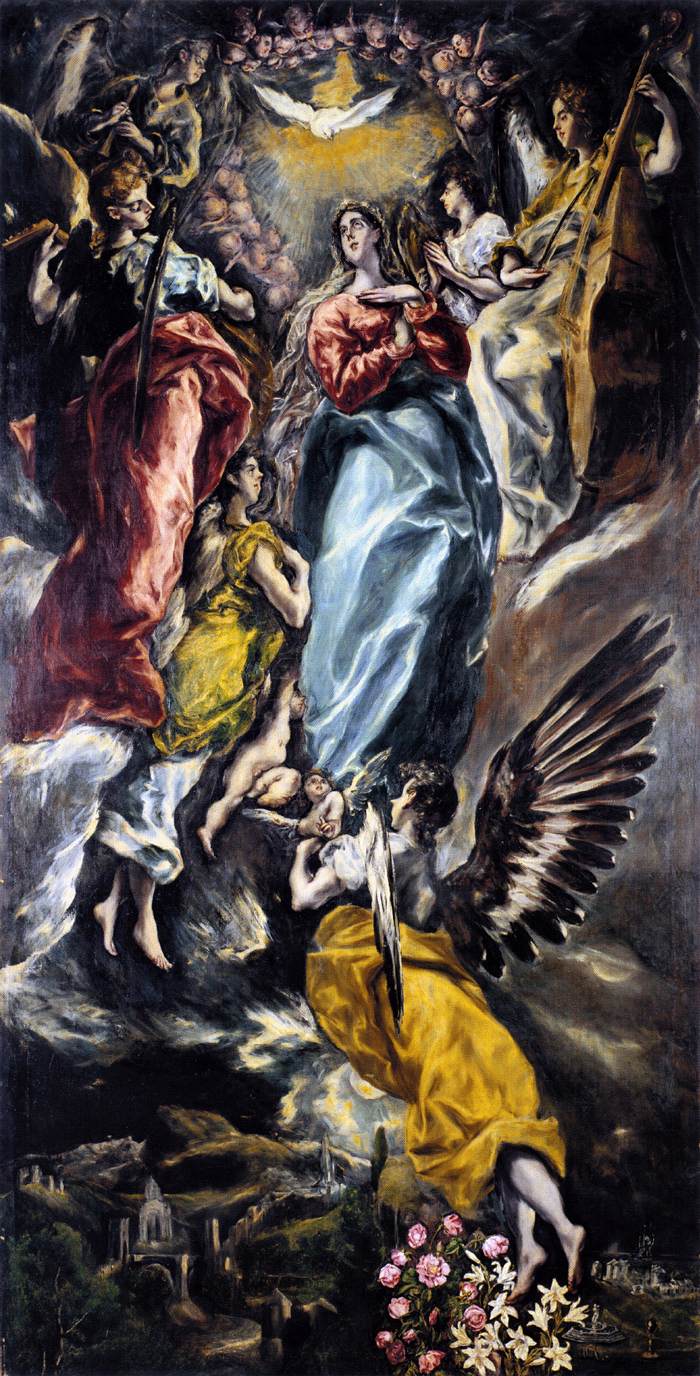
The Virgin rises through a sky where sun and moon glow at once, above roses, lilies and a small view of Toledo. El Greco even asked for the altarpiece to be made taller so he would not have to shorten her.
The story behind the painting
El Greco settled in Toledo in 1577 after years in Venice and Rome. He hoped for the patronage of King Philip II, but after legal disputes over what he saw as inadequate pay he never won the king's approval, and he stayed in Toledo for the rest of his life. The decade from 1597 to 1607 was profitable for him and his workshop. This Virgin of the Immaculate Conception was painted for the high altar of the Oballe Chapel in San Vicente, Toledo; Wikipedia says work began in 1607 and ended in 1613, while Wikidata gives 1608.
What to look for
The canvas, about 347 by 174 cm, draws the eye straight to the Virgin. Around her El Greco places the symbols attached to Mary: roses and lilies, a fountain of clear water, an enclosed garden. A view of Toledo appears at the lower left, and the sun and moon shine together in a supernatural glow. The figures are radically elongated, with an ethereal, ghostly skin tone, set against flowers painted like a lifelike still life. That contrast expresses the passage from the earthly to the divine.
Meaning and intent
In his late years El Greco cared less for proportion, scale, atmospheric perspective, realistic anatomy and smooth colour blending. Trained in Venice, he believed colour stood above form, and his late figures are more theatrical than descriptive, conveying pathos without melodrama. His habit of stretching figures grew stronger in altarpieces: for this one he asked that the altarpiece be lengthened so the Virgin's figure would not be compromised. The painting was the centrepiece of the altar, accompanied by the Visitation, and probably by images of Saint Peter and Saint Ildefonso.
Legacy
El Greco was criticised in his lifetime, but from the nineteenth century artists such as Delacroix and Manet admired his colour and expression, and Cézanne and Picasso later used his blurring of space and form. He came to be called a forefather of Expressionism and Cubism. The poet Rainer Maria Rilke wrote poems in 1913, Himmelfahrt Mariae I and II, after seeing this painting, and the contemporary artist Kysa Johnson has based works on it. It belongs to the church of San Nicolás de Bari in Toledo and is shown in the city's Museum of Santa Cruz.
豆知識
- Painted for the Oballe Chapel, Toledo: 1607-1613 per Wikipedia, 1608 per Wikidata.
- About 347 x 174 cm, with a view of Toledo at lower left.
- Inspired Rilke's poems Himmelfahrt Mariae (1913).
- Owned by San Nicolás de Bari, shown in the Museum of Santa Cruz, Toledo.
画家について
エル・グレコ (1541-1614)
宗教美術 · 聖母マリア · マニエリスム · サンタ・クルス美術館
同じ画家の作品: エル・グレコ
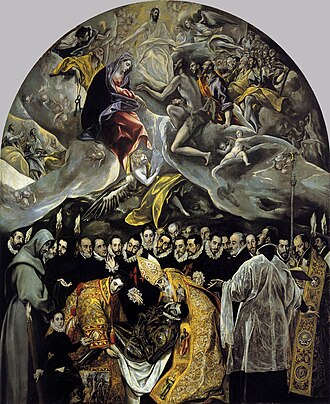 オルガス伯の埋葬 - El Greco (1586)
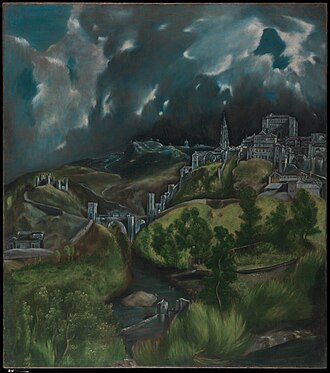 トレドの風景 - El Greco (1596)
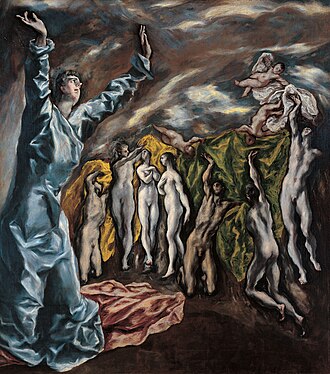 黙示録第5の封印 - El Greco (1610)
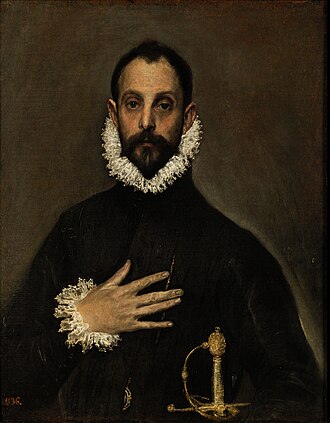 胸に手を置く騎士 - El Greco (1580)
%20-%20Laoco%C3%B6n%20-%20Google%20Art%20Project.jpg) ラオコーン - El Greco (1610s)
ラオコーン - El Greco (1610s)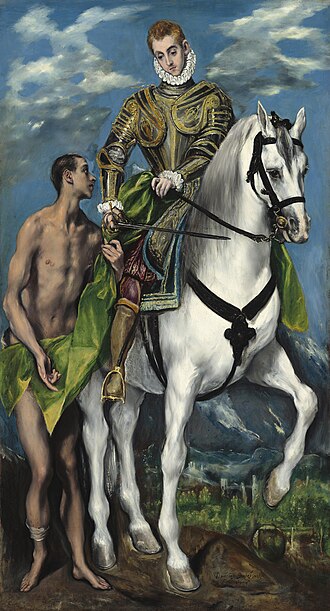 聖マルティヌスと乞食 - El Greco (1597)
.jpg) 羊飼いの礼拝 - El Greco (1612)
羊飼いの礼拝 - El Greco (1612) The Concert of the Angels - El Greco (1600s)
関連する画家の作品
.jpg) ウルビーノのヴィーナス - Titian (1538)
ウルビーノのヴィーナス - Titian (1538)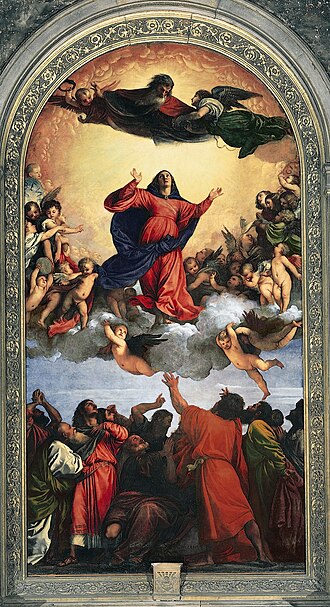 聖母被昇天 - Titian (1510s)
 エマオの晩餐 - Caravaggio (1601)
 聖マタイの召命 - Caravaggio (1609)
 大使たち - Hans Holbein the Younger (1533)
 墓の中のキリストの屍 - Hans Holbein the Younger (1520s)