Don Cristóbal Suárez de Ribera
Diego Velázquez · 1620
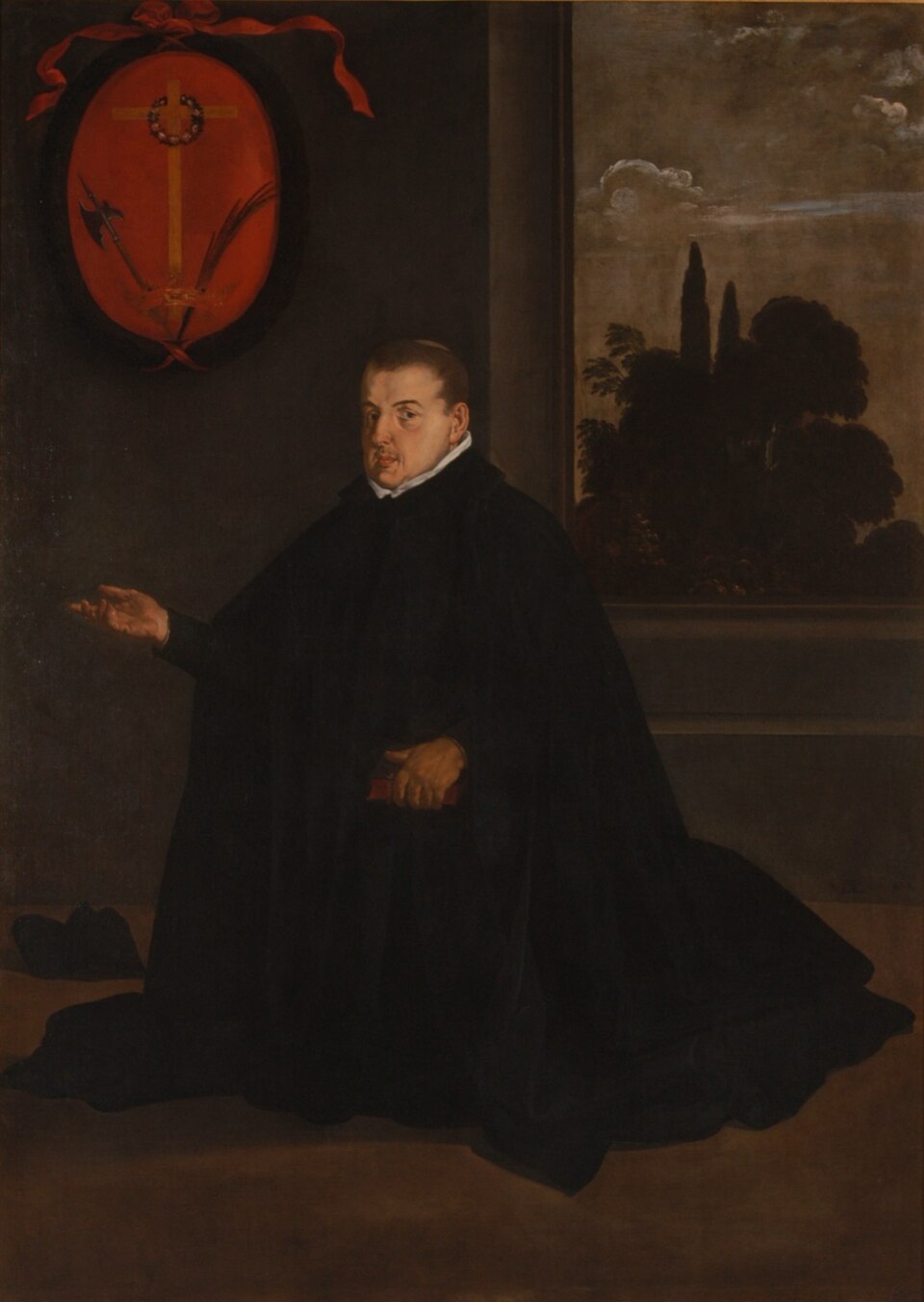
A priest kneels alone in an empty room, painted after his death by the young Velázquez. He had been godfather at the baptism of the woman Velázquez married, and for centuries nobody knew who had painted him.
The story behind the painting
Cristóbal Suárez de Ribera founded the chapel or hermitage of San Hermenegildo in Seville, built between 1607 and 1616. He had been godfather at the baptism of Juana Pacheco, who married Velázquez in April 1618. He died that same year, on 13 October, aged 68. The portrait, dated 1620, is therefore posthumous, and the face does not show the age he would have had when Velázquez knew him. It hung in San Hermenegildo until its restoration and transfer to the Museum of Fine Arts of Seville in 1910, where it remains on deposit from the Brotherhood of San Hermenegildo.
What to look for
The cleric, devoted to Saint Hermenegild, kneels in a bare room. Behind him a large window opens onto trees and clouds that hide the sun. At the top are the arms of the brotherhood: a cross with a garland of roses between an axe, the instrument of the saint's martyrdom, and a palm wound with a crown, on a red ground. The canvas, about 207 by 148 cm, is in poor condition with flaking paint. Because it was painted after death, the face looks pale and too small, and a garment seems too large and empty, far from the lifelike force of Velázquez's Venerable Mother Jerónima de la Fuente.
Meaning and intent
This kind of portrait, perhaps modelled on carved funerary busts, kept a strong bond with the person shown and was normally displayed in the very space of the sacred scene. Because it shows the chaplain praying on his knees, it may have been placed in a quiet spot over his tomb, joined to the sacred decorations of San Hermenegildo above the high altar, which are attributed to Martínez Montañés. It is a picture of remembrance and devotion: the founder kneeling for ever in the chapel he built.
Legacy
An inventory of 1795 attributed the painting to Francisco de Herrera the Elder, and later it was given to the Seville school in general. During cleaning in 1910 two inscriptions appeared: the date 1620 and a monogram read as DOVZ or DLZ, with interlaced letters. On that basis it was attributed to Velázquez, though other readings were proposed. The source says it then came to be considered unanimously his, despite its condition. It remains a rare early work tying the painter's own family life in Seville to his art.
豆知識
- Posthumous portrait dated 1620; the sitter died in October 1618.
- He was godfather at the baptism of Juana Pacheco, Velázquez's wife.
- Cleaning in 1910 revealed the date and a monogram read as DOVZ or DLZ.
- On deposit at the Museum of Fine Arts of Seville.
画家について
Diego Velázquez (1599-1660)
同じ画家の作品: Diego Velázquez
 ラス・メニーナス - Diego Velázquez (1656)
 ブレダの開城 - Diego Velázquez (1635)
 鏡のヴィーナス - Diego Velázquez (1644)
 アラクネの寓話 - Diego Velázquez
 インノケンティウス10世の肖像 - Diego Velázquez
 卵を調理する老女 - Diego Velázquez (1618)
 昼食 - Diego Velázquez (1617)
 バッカスの勝利 - Diego Velázquez (1628)
関連する画家の作品
 エマオの晩餐 - Caravaggio (1601)
 聖マタイの召命 - Caravaggio (1609)
 Saint Francis in Meditation - Francisco de Zurbarán (1639)
 The Immaculate Conception - Francisco de Zurbarán (1661)
 チャールズ1世の三面肖像画 - Anthony van Dyck (1635)
 馬上のチャールズ1世とサン・アントワーヌの領主の肖像 - Anthony van Dyck (1636)
 キリスト昇架 - Peter Paul Rubens (1609)
 レウキッポスの娘たちの略奪 - Peter Paul Rubens (1618)
 夜警 - Rembrandt van Rijn (1642)
 自画像 - Rembrandt van Rijn (1659)
 陽気な酒飲み - Frans Hals (1620s)
 微笑む騎士 - Frans Hals (1624)