ドージェのアンドレア・グリッティの肖像
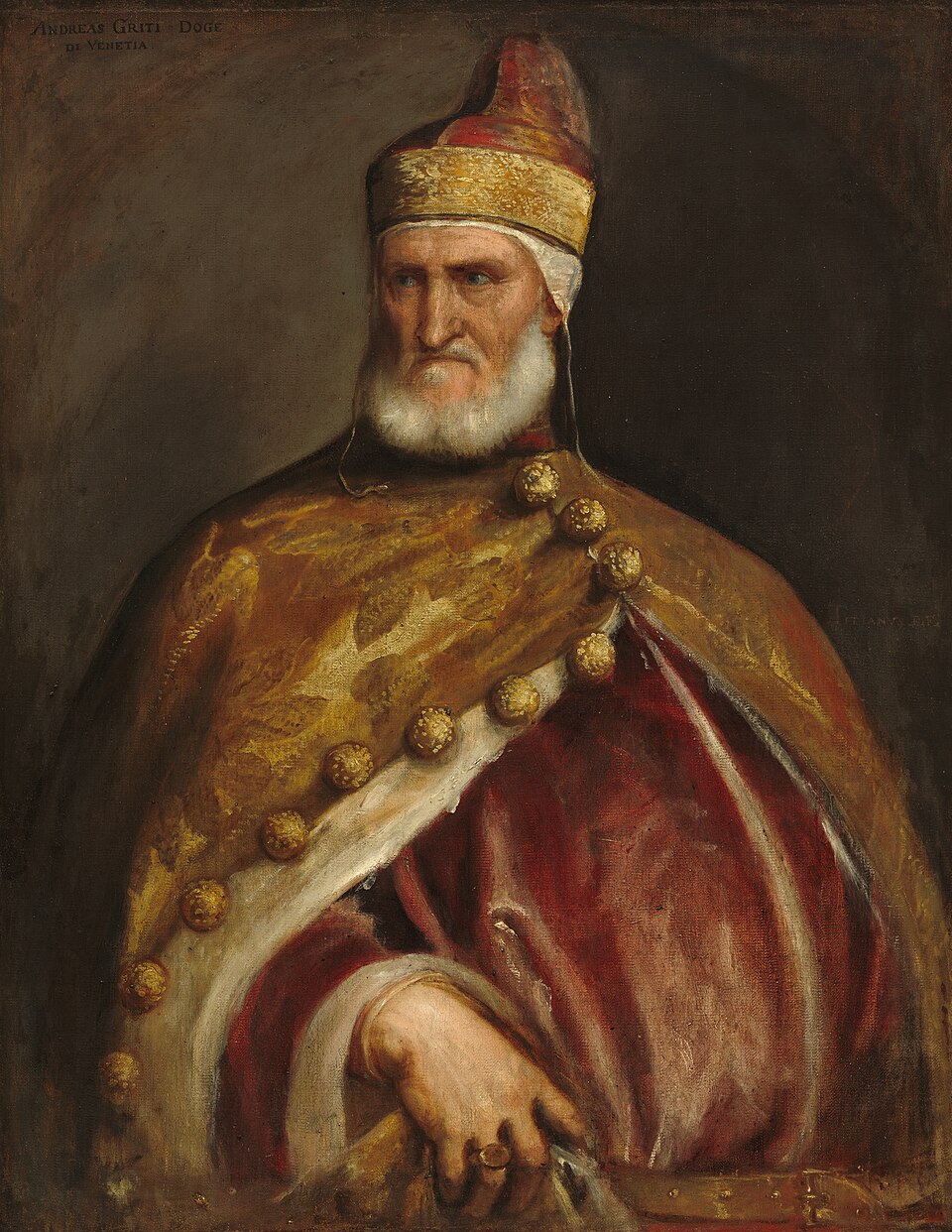
A clenched fist, a hard mouth, eyes deep in shadow: this is how Titian remembered the doge of Venice Andrea Gritti, years after his death. It is the only one of all the doges' portraits Titian painted that survives.
The story behind the painting
Andrea Gritti was doge of Venice from 1523 until his death in 1538. Titian, official painter to the Republic, portrayed him more than once, including a picture made between 1537 and 1540 for the Hall of the Great Council, destroyed in the fire of 1577. This canvas is posthumous, painted in the late 1540s and likely based on earlier depictions of the doge. The National Gallery of Art in Washington dates it between 1546 and 1550. Its style, according to the scholar Gronau, approaches Titian's portraits after 1540, such as that of Aretino in the Pitti, not the years of Gritti's reign.
What to look for
Gritti is shown down to about the hips, wearing the ducal cap and a robe of state glittering with gold. He looks attentively to the left with a somewhat severe expression around his firmly closed mouth, and his clenched hand emerges from under a broad sleeve. Titian uses the light on the gold brocade, the broad stripe of white fur lining, the white beard and the gold lace of the cap as bits of colour. The eyes, partly in shadow under projecting brows, are the central point of the whole personality. The picture is signed Titianus E. F. and measures about 133.6 by 103.2 cm.
Meaning and intent
The portrait may have served as a preliminary study for a state portrait, broadly sketched in and finished by Titian in a few sittings. Gronau wrote that it cannot fail to impress through the spontaneous freshness of its design and the truth to nature of its technique. The picture has been compared to Michelangelo's statue of Moses, a possible influence: both give their subject terribilità, an awe-inspiring force. Crowe and Cavalcaselle once attributed it to Pordenone, but Gronau judged this in no way probable, and the signature and style now place it firmly with Titian.
Legacy
The painting was bought in Italy in 1626 for Charles I of England and hung at the Palace of Whitehall, then was sold in the Commonwealth sale at Somerset House on 23 October 1651. Later it belonged to Prince Kaunitz in Vienna, passed to his heir in 1794, was sold in Vienna in 1820 and bought by Count Czernin von Chudenitz, whose family kept it until at least 1948. In 1954 it went to the Samuel H. Kress Foundation, which gave it in 1961 to the National Gallery of Art in Washington, D.C., where it is today.
豆知識
- Posthumous portrait of Andrea Gritti, doge of Venice from 1523 to 1538.
- Dated by the National Gallery of Art to 1546 to 1550.
- The only surviving portrait of a doge by Titian.
- Once owned by Charles I of England; in Washington since 1961.
画家について
ティツィアーノ・ヴェチェッリオ (1488-1576)
肖像 · ヴェネツィア派 · ナショナル・ギャラリー・オブ・アート · サミュエル・H・クレス・コレクション
同じ画家の作品: ティツィアーノ・ヴェチェッリオ
 ウルビーノのヴィーナス - Titian (1538)
 聖母被昇天 - Titian (1510s)
 聖愛と俗愛 - Titian (1510s)
 騎乗像 - Titian (1548)
 フローラ - Titian (1517)
 賢明の寓意 - Titian (1550)
 ディアナとアクタイオン - Titian (1550s)
 バッカスとアリアドネ - Titian (1520s)
関連する画家の作品
 最後の晩餐 - Jacopo Tintoretto (1563)
 奴隷を解放する聖マルコ - Jacopo Tintoretto (1540s)
 カナの婚礼 - Paolo Veronese (1560s)
 レヴィ家の饗宴 - Paolo Veronese (1573)