Coronation of the Virgin
Sandro Botticelli · 1488
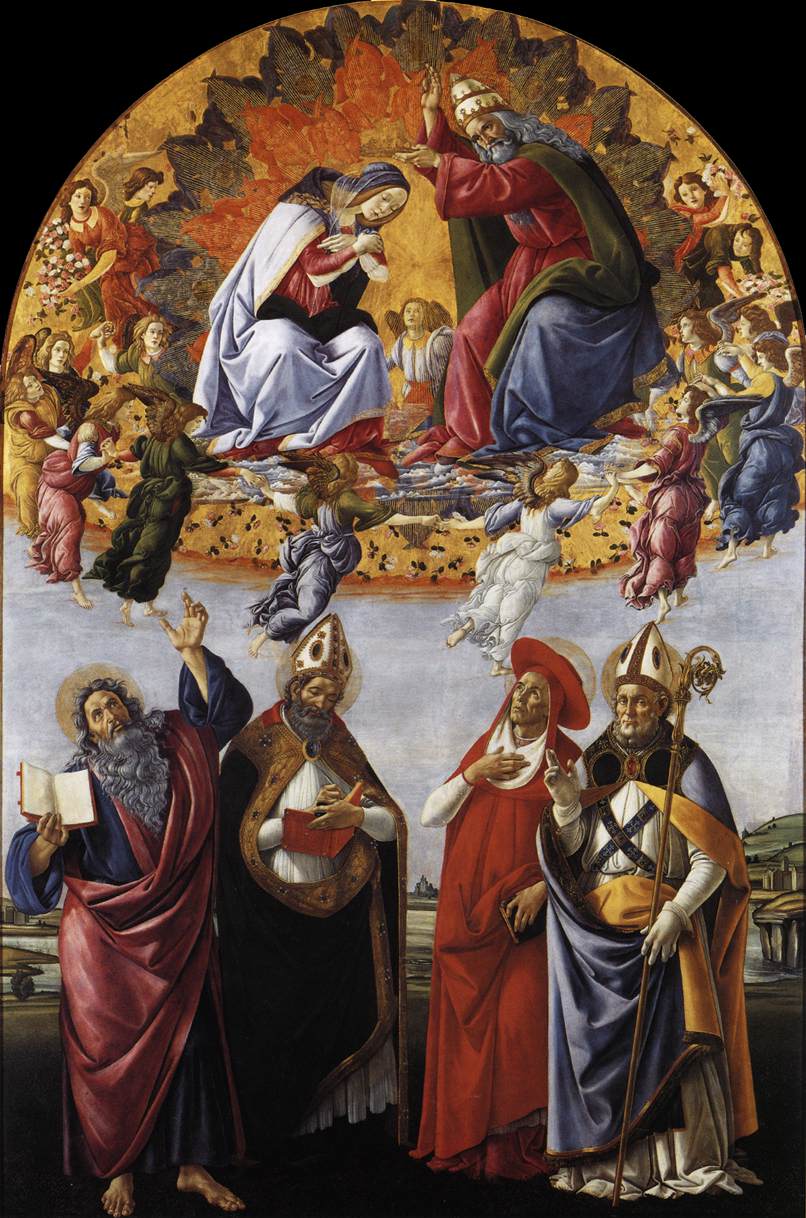
Angels scatter white and red roses and join hands in a ring dance while God the Father crowns Mary in a blaze of gold. Below, four saints stand in an empty land. Botticelli painted this tall altarpiece for the goldsmiths of Florence.
The story behind the painting
The altarpiece was commissioned around 1488 to 1490 by the Arte degli Orafi, the goldsmiths' guild, for the chapel of Sant'Alo in the basilica of San Marco in Florence. The French Wikipedia article dates it to about 1488 to 1492, while Wikidata gives 1488. It was an immediate success, cited by Albertini in 1510, by Antonio Billi, the Anonimo Gaddiano and Vasari. When the basilica was rebuilt by Giambologna, the panel moved to the convent's chapter house, and its original frame was probably lost at that time.
What to look for
The panel, about 378 by 258 cm, has two registers. Above, under a rounded top, God the Father, wearing a papal tiara, crowns the Virgin inside a mandorla of fourteen seraphim, while angels throw roses and others dance in a ring. Golden rays spread from the sacred pair and pass in front of a dancing angel, suggesting depth. Below stand Saint John the Evangelist, Augustine, Jerome in cardinal's robes and Eloi. John holds open a book that is still blank and points to the sky, Augustine writes, Jerome stares in amazement, and Eloi blesses the viewer.
Meaning and intent
The article calls the work one of the best known examples of the mystical crisis that struck Botticelli with the arrival of Girolamo Savonarola in Florence, turning him away from secular subjects toward older Florentine themes. The prominence of John, author of the Apocalypse, is linked to Savonarola's apocalyptic sermons, which shook the city shortly before the Medici were expelled in 1494. The contrast is deliberate: heaven is a profusion of glory, the earth a desert of bare rocks and water. The coronation scene seems inspired by Fra Angelico, yet with sharper light, fuller drapery and more varied poses.
Legacy
After the Napoleonic suppressions of 1808 the altarpiece went to the Galleria dell'Accademia for art students, and was restored in 1830. In 1919 it moved to the Uffizi, where in 1921 a restorer repainted the lost green robe of the third angel on the left. A careful restoration finished in 1990 stabilised the wooden support, which was lifting and flaking. Some doubt Botticelli painted every part, especially the saints' robes and the landscape, but the five-scene predella, with John on Patmos, Augustine in his study, the Annunciation, Jerome in the desert and a miracle of Eloi, is generally accepted as his.
豆知識
- Commissioned by the Florentine goldsmiths' guild around 1488 to 1490.
- Made for the chapel of Sant'Alo in San Marco, Florence.
- Linked to Botticelli's mystical crisis under Savonarola.
- In the Uffizi since 1919.
画家について
Sandro Botticelli (1445-1510)
宗教美術 · 女性 · 男性 · 聖母マリア · イエス・キリスト · Early Renaissance · ウフィツィ美術館 · 本
同じ画家の作品: Sandro Botticelli
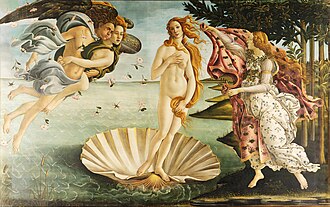 ヴィーナスの誕生 - Sandro Botticelli (c. 1485)
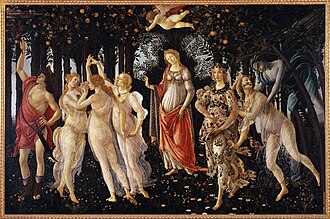 プリマヴェーラ - Sandro Botticelli (1480s)
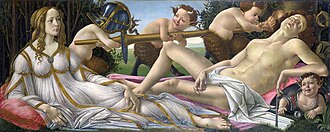 ヴィーナスとマルス - Sandro Botticelli (1485)
 東方三博士の礼拝 - Sandro Botticelli (1470s)
 マニフィカートの聖母 - Sandro Botticelli (1481)
 アペレスの誹謗 - Sandro Botticelli (1490s)
.jpg) パラスとケンタウロス - Sandro Botticelli (1482)
パラスとケンタウロス - Sandro Botticelli (1482)%20-%20Google%20Art%20Project.jpg) Idealized Portrait of a Lady - Sandro Botticelli (1480)
Idealized Portrait of a Lady - Sandro Botticelli (1480)
 モナ・リザ
モナ・リザ 白貂を抱く貴婦人
 受胎告知
受胎告知 東方三博士の礼拝