キリスト教の魂により見つめられるキリスト
Diego Velázquez · 1626
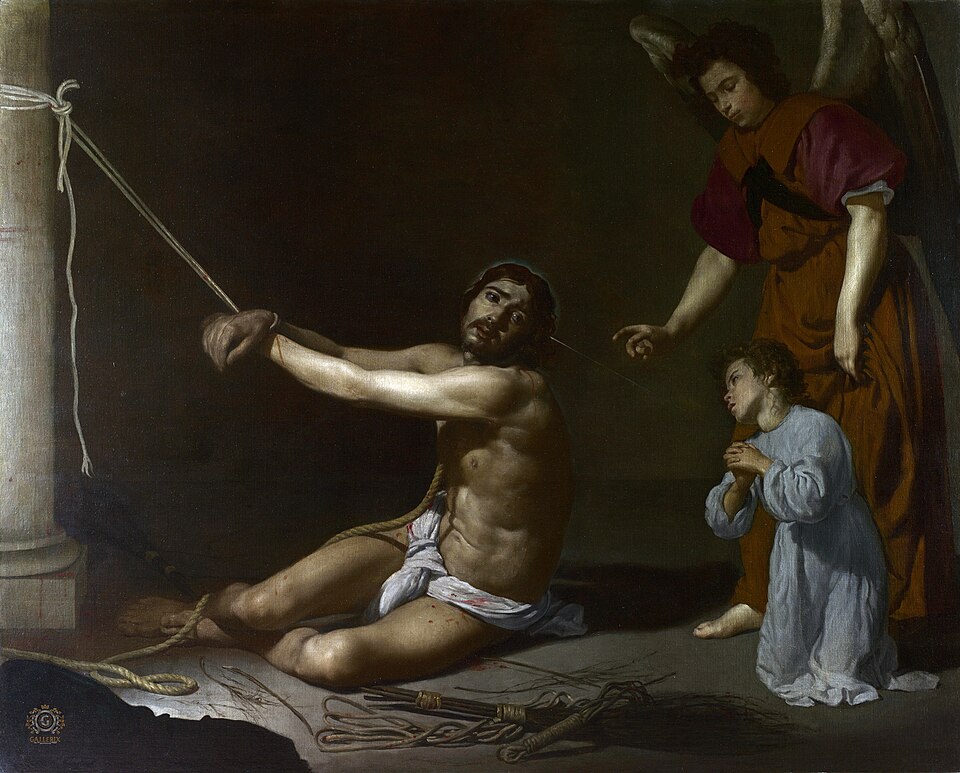
After the scourging, Christ sits bound to a column and turns his eyes towards a kneeling child, the Christian soul, while a guardian angel watches. Velázquez rarely painted such open emotion.
The story behind the painting
Nothing is known about this canvas before it was bought in Madrid in 1858 by John Savile Lumley, who bequeathed it to the National Gallery in London, where it has been since 1883. Critics agree unanimously that it is by Velázquez. José López-Rey thought it could date from 1626 to 1628, the date Wikidata follows, but most critics place it around 1632, after the painter's first journey to Italy. The rarity of the subject and its strong feeling led Carl Justi to suggest it may have been painted after the death of the artist's younger daughter, Ignacia.
What to look for
The canvas is about 165 by 206 cm. Three figures stand out against a neutral ground, lit so strongly that black shadows fall on the floor and the bodies seem fully three-dimensional. Christ, slumped, is tied to a column that is not shown in full, so we can imagine a large hall without it disturbing the view of his body. Whips and scattered twigs lie on the ground, painted with care. Only one garment, the seamless tunic, is shown. The wounds are restrained, gathered on the shoulder, where they spoil the figure least.
Meaning and intent
Velázquez followed advice from his father-in-law, the painter Francisco Pacheco, on how to show Christ after the scourging, including that Christ's gaze should go to the side, since meeting it has great effects. The child who embodies the Christian soul and the guardian angel come from devotional writing meant for meditation, by authors such as John of Avila and Luis de Granada. The central axis of the painting is the meeting of two gazes: the slumped Christ and the fragile kneeling child, hands turned towards him.
Legacy
Although these ideas were common in sermons and ascetic texts, the subject is extremely rare in painting. The only earlier canvases on it are two attributed to Juan de Roelas. On one of them Sánchez Cantón read an inscription, now invisible, in which Christ asks the soul for pity, since it put him in this state. The figure of Christ may echo classical models such as the Dying Gaul, and its anatomy is close to Michelangelo's Christ of the Minerva. A preparatory drawing of the angel, inscribed VELAZQUEZ, was destroyed in 1936.
豆知識
- At the National Gallery, London, since 1883.
- Bought in Madrid in 1858 by John Savile Lumley.
- Dated 1626-1628 by López-Rey and Wikidata, around 1632 by most critics.
- About 165 x 206 cm.
画家について
Diego Velázquez (1599-1660)
同じ画家の作品: Diego Velázquez
 ラス・メニーナス - Diego Velázquez (1656)
 ブレダの開城 - Diego Velázquez (1635)
 鏡のヴィーナス - Diego Velázquez (1644)
 アラクネの寓話 - Diego Velázquez
 インノケンティウス10世の肖像 - Diego Velázquez
 卵を調理する老女 - Diego Velázquez (1618)
 昼食 - Diego Velázquez (1617)
 バッカスの勝利 - Diego Velázquez (1628)
関連する画家の作品
 エマオの晩餐 - Caravaggio (1601)
 聖マタイの召命 - Caravaggio (1609)
 Saint Francis in Meditation - Francisco de Zurbarán (1639)
 The Immaculate Conception - Francisco de Zurbarán (1661)
 チャールズ1世の三面肖像画 - Anthony van Dyck (1635)
 馬上のチャールズ1世とサン・アントワーヌの領主の肖像 - Anthony van Dyck (1636)
 キリスト昇架 - Peter Paul Rubens (1609)
 レウキッポスの娘たちの略奪 - Peter Paul Rubens (1618)
 夜警 - Rembrandt van Rijn (1642)
 自画像 - Rembrandt van Rijn (1659)
 陽気な酒飲み - Frans Hals (1620s)
 微笑む騎士 - Frans Hals (1624)