バッカス
Caravaggio · 1593
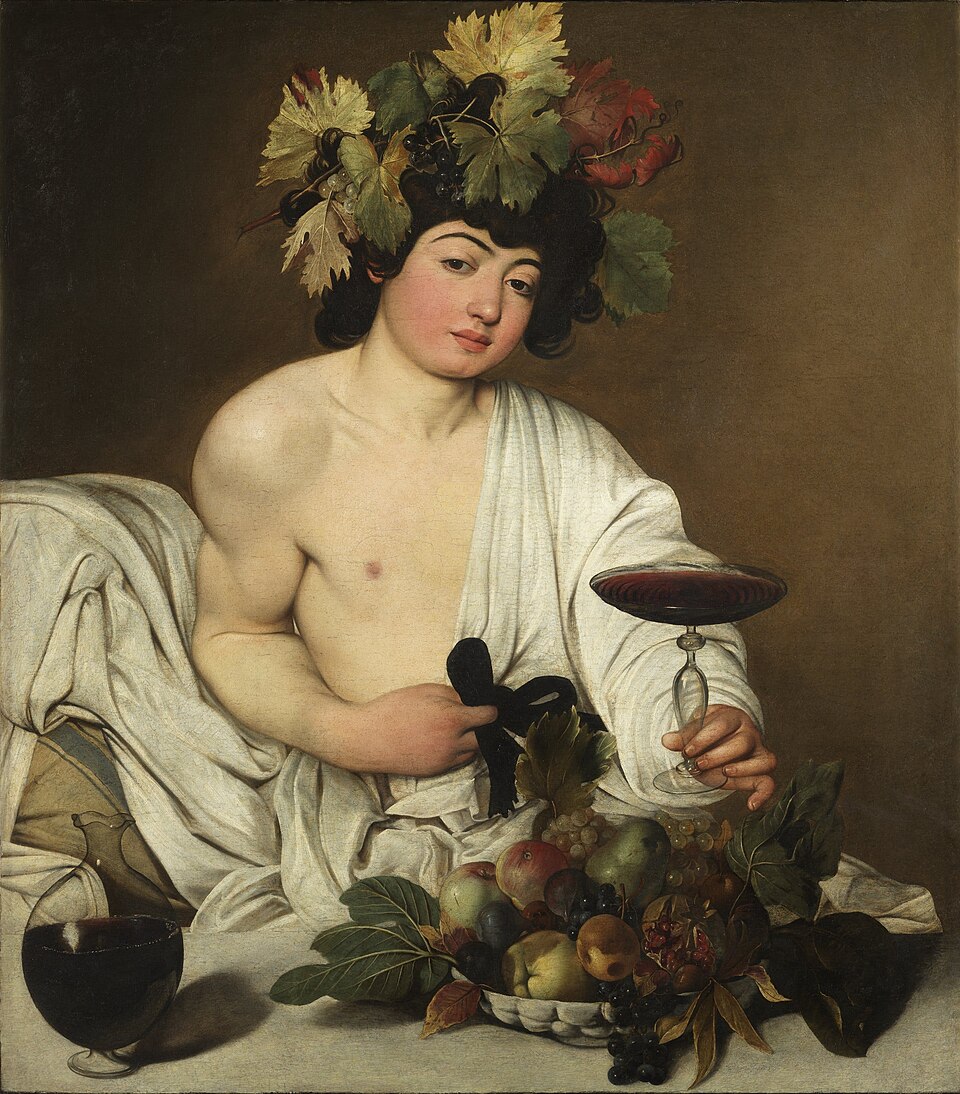
A young god of wine lounges at a stone table and holds out a glass to you, but in the fruit bowl before him, an apple is already beginning to rot.
The story behind the painting
Caravaggio painted Bacchus for Cardinal Francesco Maria del Monte, his first important patron, shortly after joining the Cardinal's household. Caravaggio moved into the Palazzo Madama in 1596 and stayed as del Monte's guest for five years. The Cardinal loved the arts and classical mythology, and used allegorical images to show his learning in art, music and theatre; the painting reflects the humanist interests of his educated circle. Dates differ between the sources: Wikidata gives 1593, while Wikipedia dates the work to around 1596 and elsewhere around 1595. The model may have been Caravaggio's pupil Mario Minniti, who posed for several of his works. Caravaggio was known for staging scenes with costumed models and painting them directly, without first sketching.
What to look for
A youthful Bacchus reclines in classical fashion, grapes and vine leaves in his hair, fingering the drawstring of a loosely draped robe. On the stone table in front of him sit a bowl of fruit and a large carafe of red wine. He holds out a shallow goblet of the same wine, as if inviting you to join him. Look closely at the fruit: a pomegranate bursts open, and an apple is rotting. Notice too which hand offers the glass. It is his left, and the gesture seems to cost the model visible effort, a detail that has led some to suggest Caravaggio worked with a mirror. The canvas measures 95 by 85 centimetres.
Meaning and intent
Caravaggio paints not only the god Bacchus but a boy dressed up as Bacchus, and the scene is openly sensual, the youth coaxing the viewer with a suggestive look as his robe slips. The fruit carries a darker note. Together, the bursting pomegranate and rotting apple hint at the Vanitas theme: youth and pleasure are fleeting, and everything succumbs to decay. The apple may also simply allude to fermentation, itself a kind of rot. Interpretations of the painting's homoeroticism vary. Some see it as Caravaggio's feelings for his model; the art historian Donald Posner thought it alluded instead to Cardinal del Monte's own circle. The rival painter Giovanni Baglione claimed the picture was a self-portrait made with a mirror.
Legacy
Cardinal del Monte gave Bacchus, together with Caravaggio's Medusa, to the Medici family, and the painting has remained in Florence ever since. Today it hangs in the Uffizi Gallery. Del Monte's early support brought Caravaggio wealth and recognition. The work also belongs to a small family of Bacchus images by the artist. The earlier Young Sick Bacchus, painted for the Borghese family, shows a figure with jaundiced skin turned away from the viewer against a dark background, an early sign of Caravaggio's interest in tenebrism. Where that picture dwells on the decay of the god himself, the Uffizi Bacchus turns its attention to the decay hidden within pleasure and plenty.
豆知識
- Commissioned by Cardinal Francesco Maria del Monte, Caravaggio's first important patron.
- Date conflict: Wikidata gives 1593; Wikipedia gives c. 1596 (and c. 1595 elsewhere).
- 95 × 85 cm; given by del Monte to the Medici, now in the Uffizi Gallery, Florence.
- The model may have been Mario Minniti; Giovanni Baglione claimed it was a self-portrait.
画家について
Caravaggio (1571-1610)
神話画 · バロック絵画 · ウフィツィ美術館 · バックス
同じ画家の作品: Caravaggio
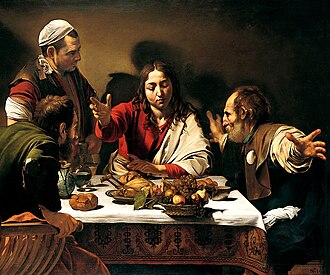 エマオの晩餐 - Caravaggio (1601)
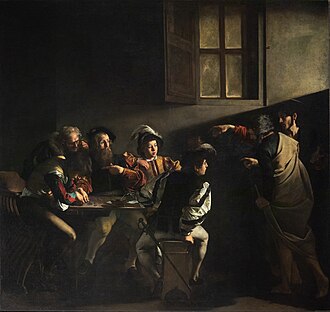 聖マタイの召命 - Caravaggio (1609)
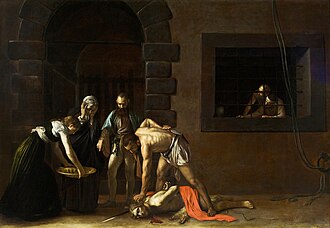 洗礼者聖ヨハネの斬首 - Caravaggio (1608)
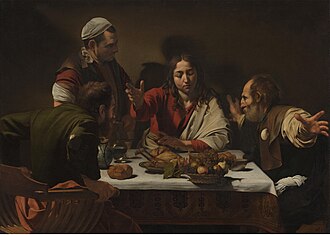 エマオの晩餐 - Caravaggio (1601)
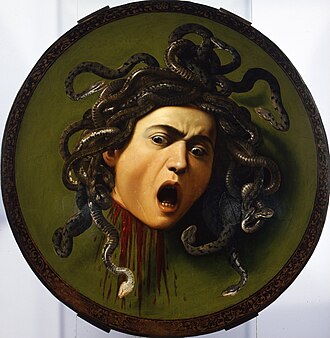 メドゥーサの首 - Caravaggio (1597)
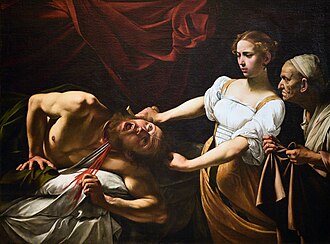 ホロフェルネスの首を斬るユーディット - Caravaggio (1598)
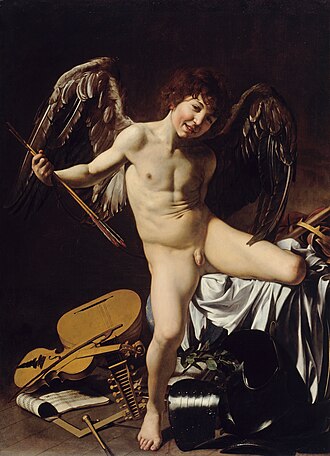 愛の勝利 - Caravaggio (1600s)
%2C%201595%20circa%2C%20534.jpg) 病めるバッカス - Caravaggio (1595)
病めるバッカス - Caravaggio (1595)
 ラス・メニーナス
 ブレダの開城
 夜警
夜警 自画像
自画像 真珠の耳飾りの少女
 牛乳を注ぐ女