軍隊に演説するアルフォンソ・ダヴァロス
ティツィアーノ・ヴェチェッリオ · 1540s
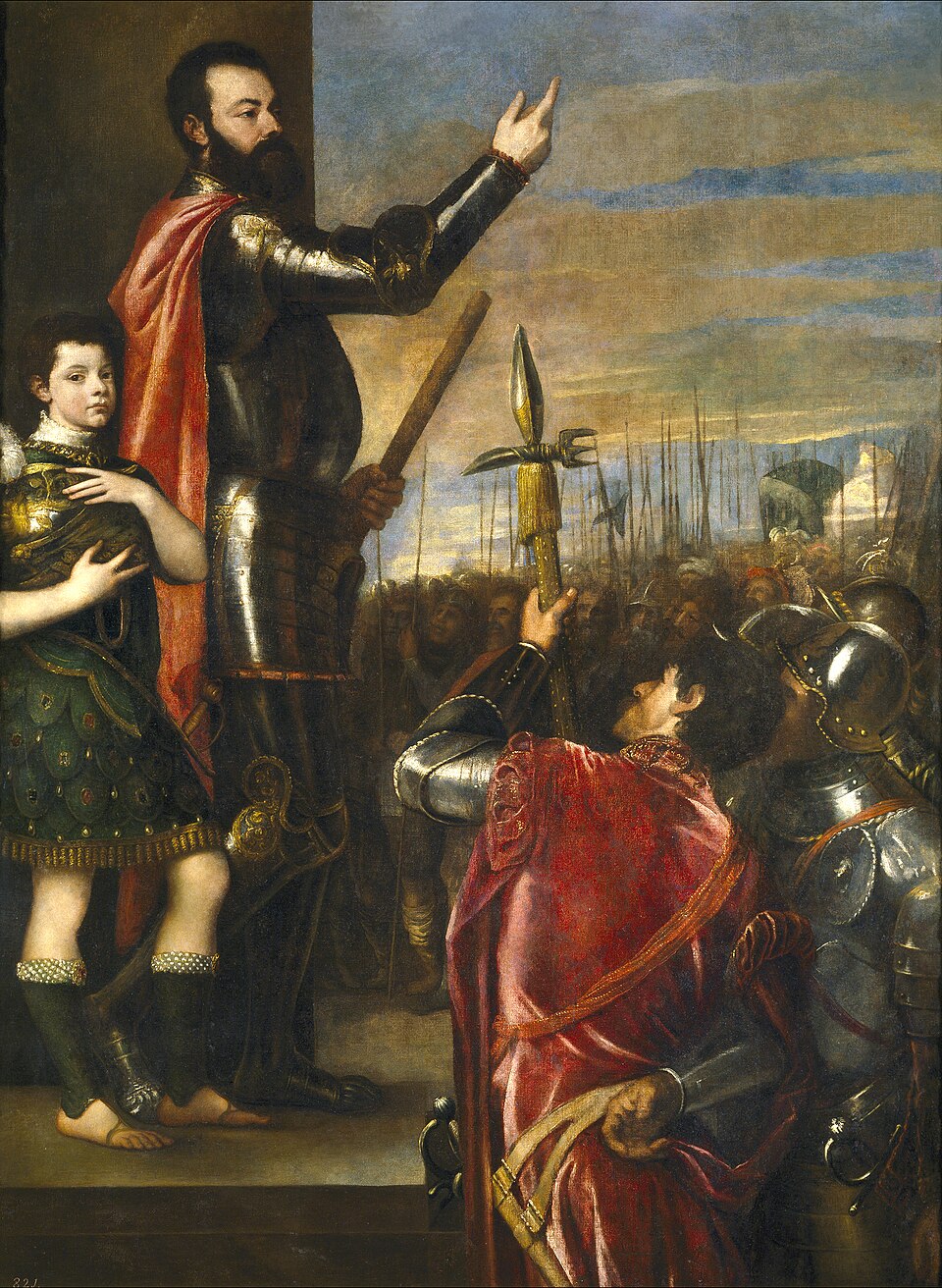
A general in armour raises his right arm to calm mutinous soldiers, and beside him a boy holds his helmet: his own son, left behind as a pledge. Titian made one man's speech into a portrait and a history painting at once.
The story behind the painting
Alfonso d'Avalos, Marquis del Vasto, was a Neapolitan noble of Castilian descent who fought at Pavia, took part in the conquest of Tunis in 1535 and became governor of Milan in 1538. In 1537 the Spanish troops in Milan began to mutiny because they had not been paid. The Marquis calmed them with an eloquent speech, promising their pay if they were patient. Having to leave on other business, he left his son with the troops as a guarantee. In 1539, on a trip to Venice, he commissioned Titian to paint the scene.
What to look for
The canvas is tall, about 223 by 165 cm. The general stands on a raised platform above his men, his right arm lifted as classical manuals on oratory advised for emphasis. Beside him his son, shown as a page, holds his helmet. Below, soldiers with spears listen. Titian based the composition on classical models such as the reliefs of the Arch of Constantine and many ancient coins, which often showed a commander addressing his army. Wikidata also lists Pietro Aretino among the subjects.
Meaning and intent
The picture is both a portrait of the Marquis and a history painting telling a real event. It presents him as the ideal leader, winning loyalty with words rather than force, and the boy at his side is a quiet reminder of what he staked on his promise. By borrowing the pose of Roman emperors, Titian gave a recent, rather awkward pay dispute the dignity of ancient history. It was praise, but praise built on a real moment.
Legacy
The painting was first shown publicly in Milan in 1541, during a visit by the Emperor Charles V, though the Marquis later fell out of favour after military failures. It passed to the Gonzaga dukes of Mantua and then to King Charles I of England. After his execution, his possessions were auctioned and the painting, like others from his collection, went to Philip IV of Spain. In 1828 Ferdinand VII ceded it to the Museo del Prado, where it hangs today. Wikipedia dates it around 1540, Wikidata to the 1540s.
豆知識
- Records a speech the Marquis del Vasto gave to mutinous troops in 1537.
- Commissioned by the Marquis in Venice in 1539.
- Owned by the Gonzagas, Charles I of England and Philip IV.
- In the Museo del Prado since 1828.
画家について
ティツィアーノ・ヴェチェッリオ (1488-1576)
プラド美術館 · ヴェネツィア派 · 歴史画 · 剣 · 鎧 · 槍 · 戦闘用ヘルメット
同じ画家の作品: ティツィアーノ・ヴェチェッリオ
 ウルビーノのヴィーナス - Titian (1538)
 聖母被昇天 - Titian (1510s)
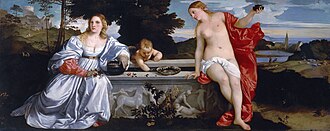 聖愛と俗愛 - Titian (1510s)
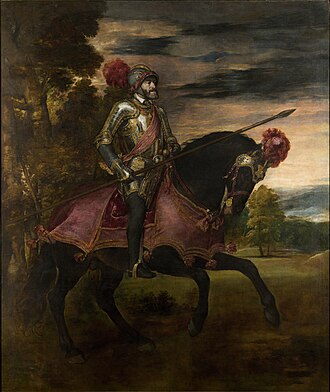 騎乗像 - Titian (1548)
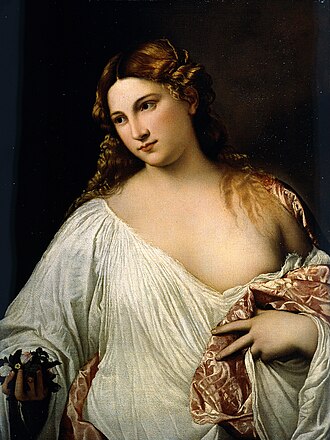 フローラ - Titian (1517)
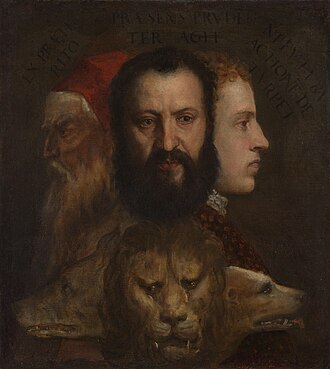 賢明の寓意 - Titian (1550)
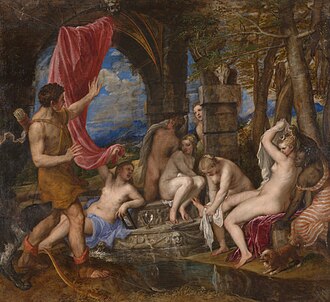 ディアナとアクタイオン - Titian (1550s)
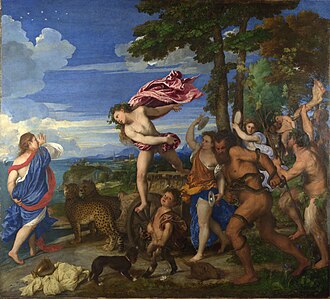 バッカスとアリアドネ - Titian (1520s)
関連する画家の作品
 最後の晩餐 - Jacopo Tintoretto (1563)
 奴隷を解放する聖マルコ - Jacopo Tintoretto (1540s)
 カナの婚礼 - Paolo Veronese (1560s)
 レヴィ家の饗宴 - Paolo Veronese (1573)