ドミニク・アングル
1780-1867
Jean-Auguste-Dominique Ingres wanted above all to be a painter of history, a guardian of classical tradition. Yet it is his portraits, painted and drawn with a flawless line, that became his greatest legacy, and his bold distortions of form later spoke to Matisse and Picasso.
Origins
Ingres was born on 29 August 1780 in Montauban, the first of seven children, five of whom survived infancy. His father, Jean-Marie-Joseph Ingres, was a jack-of-all-trades in the arts: miniature painter, sculptor, decorative stonemason and amateur musician. His mother, Anne Moulet, was the nearly illiterate daughter of a master wigmaker. His father taught him drawing and music, and his first known drawing, after an antique cast, dates from 1789. The Revolution closed his school in 1791, ending his conventional education, a gap that always left him insecure. That year he entered the Académie Royale in Toulouse, where Guillaume-Joseph Roques passed on his reverence for Raphael.
Life and turning points
In 1797 Ingres went to Paris and spent four years in the studio of Jacques-Louis David. In 1801 he won the Prix de Rome with The Ambassadors of Agamemnon in the tent of Achilles, though a lack of state funds delayed his departure until 1806. Just before leaving he became engaged to the painter and musician Julie Forestier. In Rome, then Florence, from 1806 to 1824, critics in Paris found his work bizarre and archaic, and he lived mainly from portraits and drawings. Recognition came at the Salon of 1824 with The Vow of Louis XIII, and he was hailed as leader of the Neoclassical school. Stung by criticism of The Martyrdom of Saint Symphorian, he went back to Italy and directed the French Academy in Rome from 1835, returning to Paris for good in 1841. He died on 14 January 1867.
Style and technique
Ingres borrowed freely from earlier art and was accused of plundering the past. He drew on Raphael, Etruscan vase painting and the outline engravings of John Flaxman, and in the Louvre studied Bronzino, Pontormo and the precision of Flemish painting such as the Ghent Altarpiece. His style was fully formed by 1806 and changed little afterward. Early portraits stand out for extreme precision in fabrics and small details, while the women's faces are softened, with large oval eyes and dreamlike expressions, set against plain backgrounds or sky. His expressive distortions of form and space make him an important forerunner of modern art.
Stories and anecdotes
Ingres was also a gifted violinist: from thirteen to sixteen he played second violin in the Orchestre du Capitole de Toulouse. A fellow student, Étienne-Jean Delécluze, remembered him as candid, studious and preferring to work alone. At the Salon of 1806 his Napoleon I on his Imperial Throne met a chilly reception; one critic praised his line yet accused him of trying to send art back four centuries. From Rome Ingres wrote that the scoundrels had waited until he was away to assassinate his reputation, and vowed never to exhibit at the Salon again. His refusal to return ended his engagement. Asked years later why she never married, Julie Forestier answered that once one has had the honour of being engaged to M. Ingres, one does not marry.
Legacy
Ingres saw himself as heir to Nicolas Poussin and David, and aspired to defend academic orthodoxy against the rising Romantic style. History has kept his portraits closest to its heart, both painted and drawn, which made him one of the most celebrated portraitists of the 19th century. In his later years he painted new versions of earlier compositions, designs for stained glass and several important portraits of women. He finished The Turkish Bath, the last of his Orientalist nudes, at the age of 83. His freedom with form influenced Henri Matisse, Pablo Picasso and other modernists.
豆知識
- His first known drawing, a study after an antique cast, was made in 1789.
- In 1803 he was one of five artists chosen to paint full-length portraits of Napoleon as First Consul.
- Many drawings of Roman monuments once given to him now appear to be by collaborators, especially François-Marius Granet.
- La Grande Baigneuse of 1808 is his first model shown wearing a turban, a detail borrowed from Raphael.
関連する画家
ジャック=ルイ・ダヴィッド · Francisco Goya
ドミニク・アングルの作品
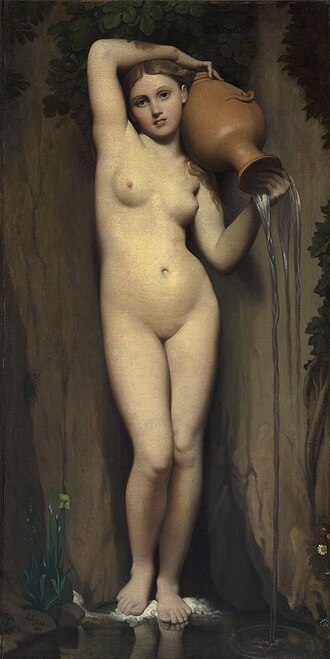 泉 - Jean-Auguste-Dominique Ingres (1856)
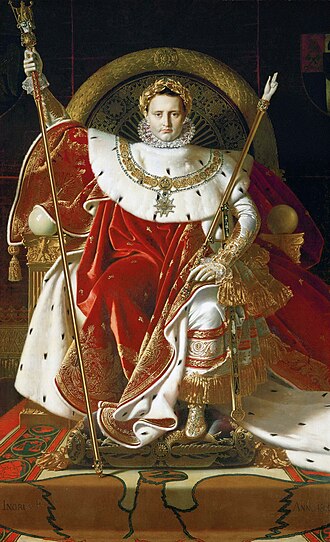 玉座のナポレオン - Jean-Auguste-Dominique Ingres (1806)
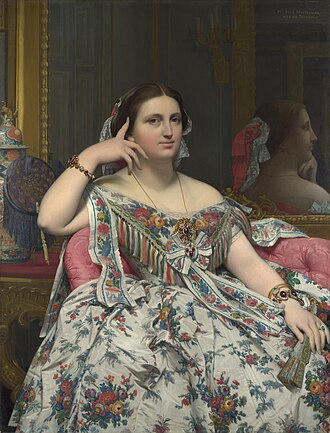 イネス・モワテシエ夫人の肖像 - Jean-Auguste-Dominique Ingres (1856)
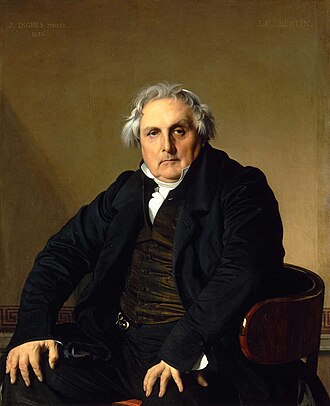 ルイ=フランソワ・ベルタン氏の肖像 - Jean-Auguste-Dominique Ingres (1832)
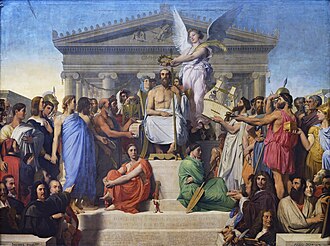 ホメーロスの神格化 - Jean-Auguste-Dominique Ingres (1827)
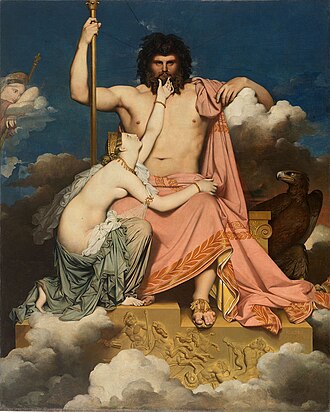 ユピテルとテティス - Jean-Auguste-Dominique Ingres (1811)
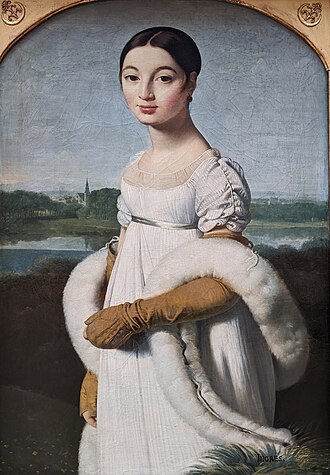 リヴィエール嬢の肖像 - Jean-Auguste-Dominique Ingres (1806)
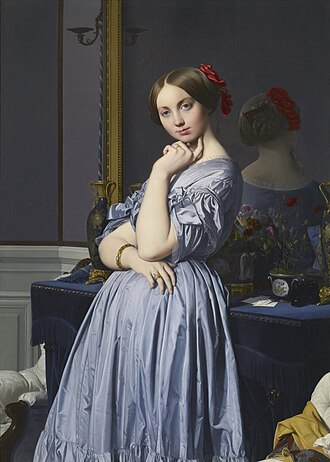 ドーソンヴィル伯爵夫人の肖像 - Jean-Auguste-Dominique Ingres (1845)
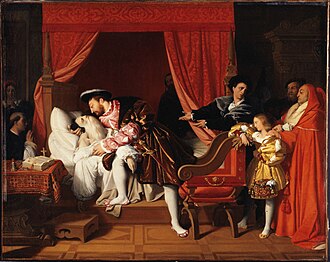 レオナルド・ダ・ヴィンチの死 - Jean-Auguste-Dominique Ingres (1818)
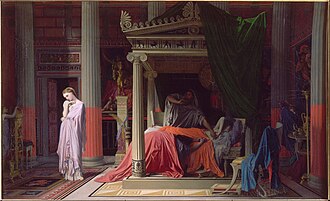 アンティオコスとストラトニケ - Jean-Auguste-Dominique Ingres (1840)
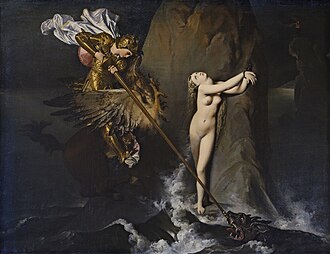 アンジェリカを救うルッジェーロ - Jean-Auguste-Dominique Ingres (1819)
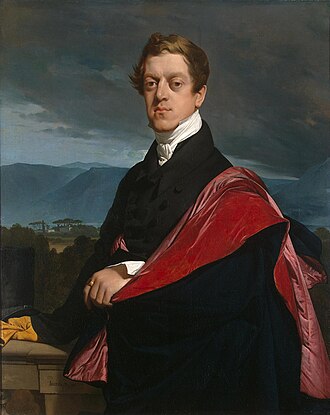 ニコライ・ドミトリエヴィチ・グーリエフ伯爵の肖像 - Jean-Auguste-Dominique Ingres (1821)
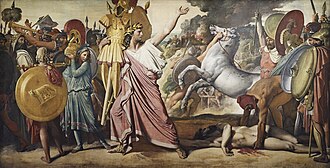 敗者アクロンの武具をユピテル神殿に運ぶロムルス - Jean-Auguste-Dominique Ingres (1812)
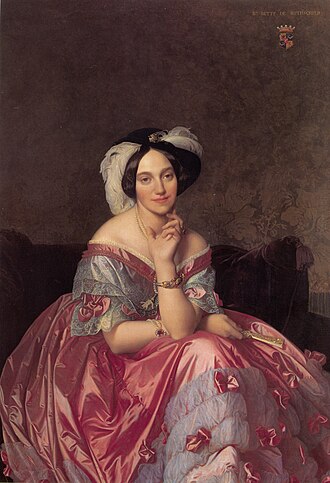 Baronne de Rothschild - Jean-Auguste-Dominique Ingres (1848)
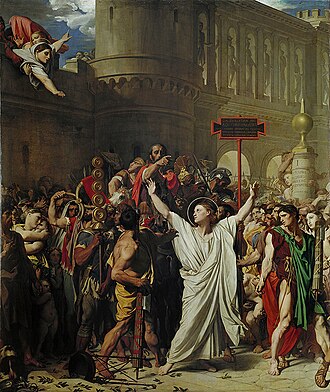 聖サンフォリアンの殉教 - Jean-Auguste-Dominique Ingres (1834)
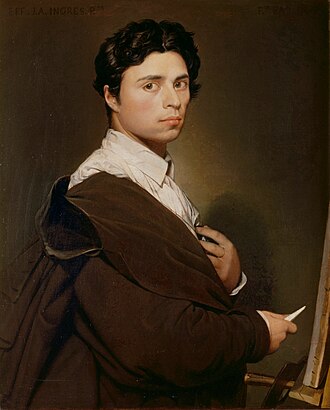 自画像 - Jean-Auguste-Dominique Ingres (1804)