ギュスターヴ・モロー
1826-1898
Gustave Moreau took myths worn thin by centuries and made them feel mysterious and new again. Called the Symbolist painter par excellence, he left behind more than 15,000 paintings, watercolours and drawings, and a whole house to hold them.
Origins
Gustave Moreau was born in Paris on 6 April 1826 into a cultured, upper-middle-class family. His father, Louis Jean Marie Moreau, was an architect who worked for the city of Paris, and his mother, Adele Pauline Desmoutier, was a musician. A frail child, he began drawing incessantly at about eight. When his older sister died at 13 in 1840, he was taken out of the Collège Rollin and lived a sheltered life at home, where his father insisted on a solid classical education: Greek, Latin and the books of a large family library. He also learned piano and sang as a very good tenor. A trip to Italy in 1841, filling a 60-page album with drawings, set him on the path of art.
Life and turning points
Moreau studied with François-Édouard Picot and entered the École des Beaux-Arts in 1846, but left after failing to reach the final rounds of the Prix de Rome in 1848 and 1849. He grew close to Théodore Chassériau, seven years his senior, and the older painter's death in 1856 hit him hard. From 1857 to 1859 he travelled in Italy, spending much of two months copying the Sistine Chapel ceiling for seven or eight hours a day, and came home with hundreds of studies. Oedipus and the Sphinx won a medal at the Salon of 1864 and made his name. After harsh press over Prometheus in 1869 he exhibited less and less, withdrawing from the Salon after 1880. From 1891 he taught at the École des Beaux-Arts. He died of cancer in 1898.
Style and technique
Moreau painted the biblical and mythological subjects favoured by the academies, yet he gave them a new language. J. K. Huysmans wrote that he had taken myths worn out by repetition and expressed them in a way both persuasive and lofty, mysterious and new. Oedipus and the Sphinx shows his close study of Carpaccio, Mantegna and Giovanni Bellini, with firm outlines and detailed modelling. In the 1870s, stung by talk that his work had become formulaic, he paused to renew himself, and Salome Dancing before Herod, completed in 1876, announced the more painterly manner of his later years. The women of myth and scripture he painted so often came to be seen as the archetypal Symbolist woman.
Stories and anecdotes
In Italy Moreau met a young Edgar Degas and became something of a mentor to him; Degas painted a small portrait of Moreau in 1860 that hung in his studio for the rest of his life. Later the two drifted apart, and when Moreau asked whether Degas meant to renew art through ballet, Degas replied by asking whether Moreau hoped to do it with jewelry. In old age Degas called him a hermit who knows what time the trains leave. Moreau never married, but later research revealed a discreet relationship of more than 30 years with Alexandrine Dureux; he designed her tombstone with their interlaced initials. He worked for decades on The Suitors, begun around 1852, adding strips of canvas, yet it was still unfinished at his death.
Legacy
Moreau excelled as a teacher, and Henri Matisse and Georges Rouault were among his pupils. He was often reluctant to sell and seldom exhibited, so he bequeathed his townhouse and studio at 14 rue de La Rochefoucauld to the State, with nearly 1,200 paintings and watercolours and over 10,000 drawings. The Musée Gustave Moreau opened in 1903 and remains by far the largest collection of his work. His art, like Symbolism in general, fell from favour in the early 20th century, but from the 1960s and 1970s he has come to be seen as one of the most important Symbolist painters. Art historian Robert Delevoy wrote that he brought Symbolist richness of meaning to its highest point in Jupiter and Semele.
豆知識
- He was made a Chevalier of the Légion d'honneur in 1875 and an Officier in 1883.
- He kept a personal library of over 1,600 volumes.
- For a series of La Fontaine fables commissioned by Anthony Roux, he completed 25 pieces, more than any other artist.
- In 1888 he turned down a professorship at the École des Beaux-Arts, taking over Élie Delaunay's studio only after Delaunay died in 1891.
関連する画家
ジャン=レオン・ジェローム · Édouard Manet · ギュスターヴ・クールベ · John Singer Sargent · ウジェーヌ・ドラクロワ · ジャック=ルイ・ダヴィッド · J. M. W. Turner
ギュスターヴ・モローの作品
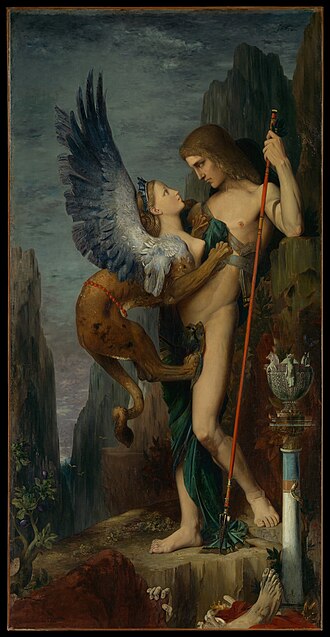 オイディプスとスフィンクス - Gustave Moreau (1864)
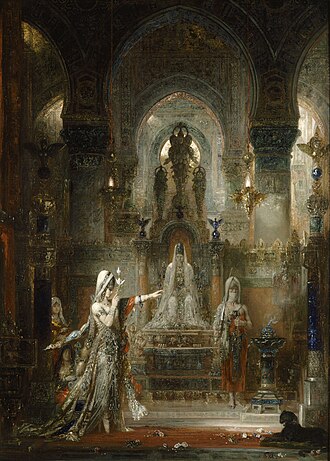 ヘロデ王の前で踊るサロメ - Gustave Moreau (1876)
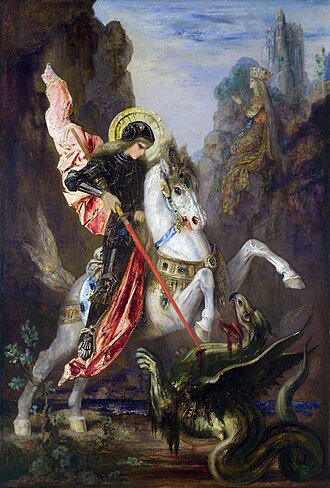 聖ゲオルギウスと竜 - Gustave Moreau (1880s)
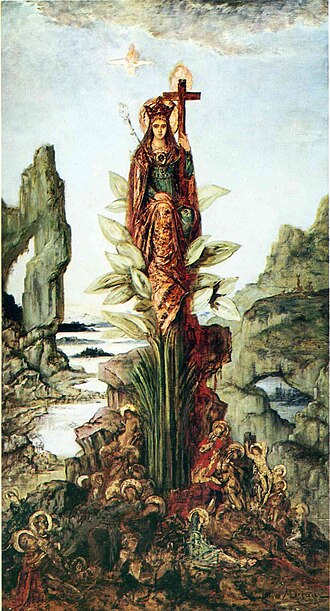 Mystic Flower - Gustave Moreau (1890)
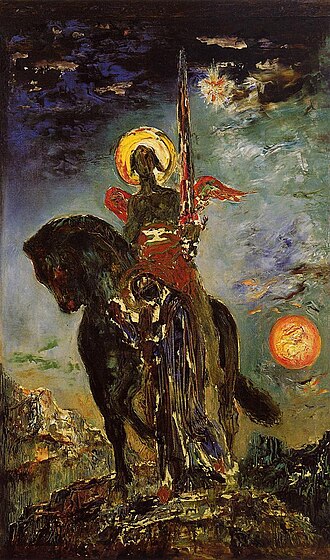 The Parca and the Angel of Death - Gustave Moreau (1890)
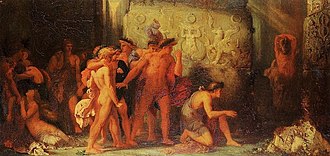 Athenians being Delivered to the Minotaur in the Cretan Labyrinth - Gustave Moreau (1855)
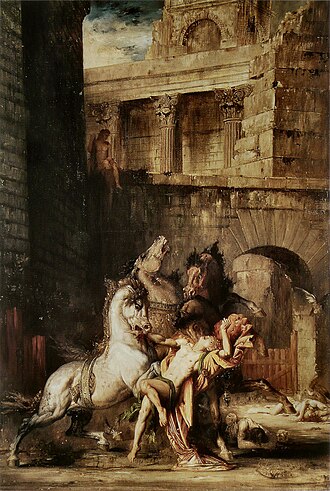 Diomede devoured by his horses - Gustave Moreau (1865)
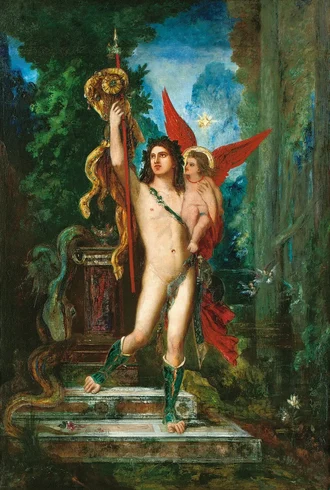 Jasón y Eros - Gustave Moreau (1891)
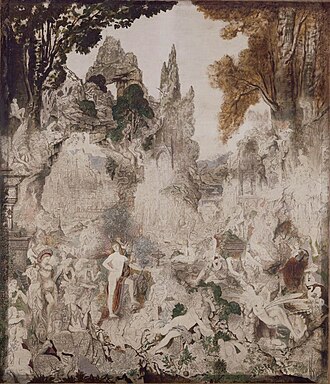 Les Chimères - Gustave Moreau (1884)
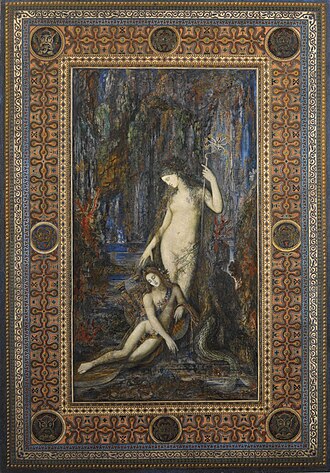 The Mermaid and the Poet - Gustave Moreau (1895)