The Suicide of Saul
Pieter Bruegel the Elder · 1562
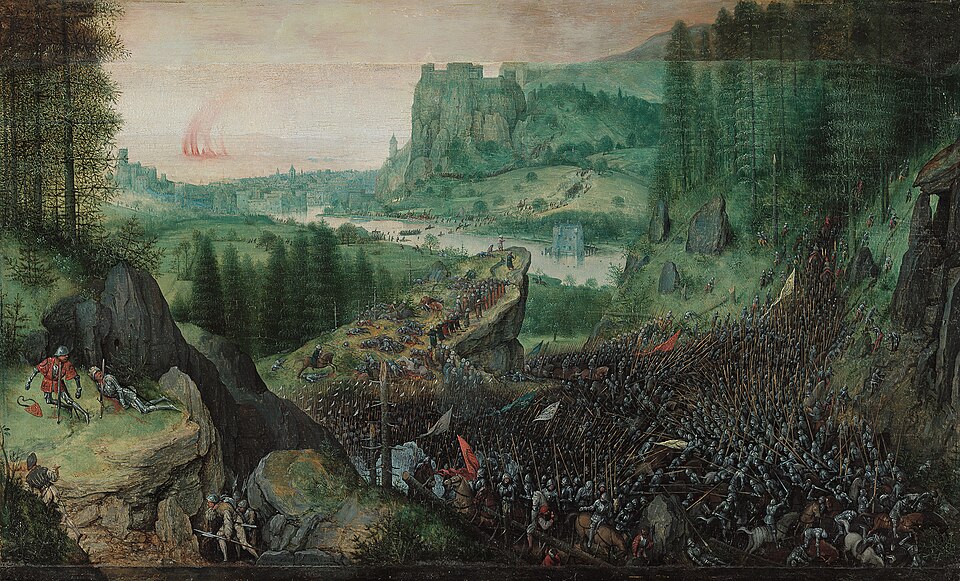
A king falls on his own sword on a rocky ledge while whole armies pour through the valley below. Bruegel packed an entire biblical battle into a panel barely wider than a sheet of paper.
The story behind the painting
Bruegel painted this small oil on panel in 1562, about 33.5 by 55 cm. An inscription on it names the subject, rarely shown in art: the death of Saul after his defeat by the Philistines on Mount Gilboa, told in 1 Samuel 31. Wounded by archers and with his sons killed, Saul begged his armour-bearer to kill him, and when the man refused out of fear, Saul fell on his own sword; the armour-bearer then did the same. This appears to be the first time the subject was put into a painting, though it had appeared before in other media such as manuscript miniatures.
What to look for
Look to the left, where Bruegel shows the dramatic moment of the armour-bearer's death beside the fallen king, just as the Philistines approach below the rock platform. The underdrawing included a third fallen figure that was never painted. Then let your eye travel across thousands of tiny soldiers, their armour sixteenth-century and some Philistine brigades dressed as Turks, with forests of lances. Behind them a distant world landscape glows through a shimmering haze. A jutting rock in the centre is a Mannerist device that returns in The Procession to Calvary. Thin strips at the top and bottom were cut off and later replaced with new wood; the join is still visible.
Meaning and intent
Saul's death was read as a punishment of pride: Dante meets Saul among the proud in Purgatory, alongside Nimrod, whom Bruegel painted in The Tower of Babel, and in 1563 he also painted The Fall of the Rebel Angels. Humanists in the circle of Erasmus valued Old Testament stories as allegories of universal meaning, and that may have been Bruegel's view too. Here an ancient battle becomes a contemporary one. The way he masses tiny figures owes much to Albrecht Altdorfer's Battle of Alexander at Issus, and he may also have looked at battle scenes by Jörg Breu the Younger and a lost work by Joachim Patinir.
Legacy
It is an early attempt by Bruegel to bring landscape and figures together, and it has been called an astonishingly dense and highly dramatic composition. Compared with a late work like The Magpie on the Gallows of 1568, foreground and background are not yet fully reconciled, yet the hazy distance marks a new stage in his naturalistic landscapes. Little is known of its history. A painting possibly matching it was in the collection of Rubens in Antwerp in 1640, though that entry describes a watercolour. By 1781 it had entered the Austrian imperial collection, and it is now in the Kunsthistorisches Museum in Vienna.
Lo sapevi?
- Oil on panel, 1562, about 33.5 x 55 cm.
- Apparently the first painting of Saul's suicide from 1 Samuel 31.
- Soldiers wear sixteenth-century armour; some Philistines appear as Turks.
- In the Austrian imperial collection by 1781, now in Vienna.
L'artista
Pieter Bruegel the Elder (1525-1569)
Kunsthistorisches Museum · battle painting
Altre opere di Pieter Bruegel the Elder
%20-%20Google%20Art%20Project.jpg) The Hunters in the Snow - Pieter Bruegel the Elder (1565)
The Hunters in the Snow - Pieter Bruegel the Elder (1565)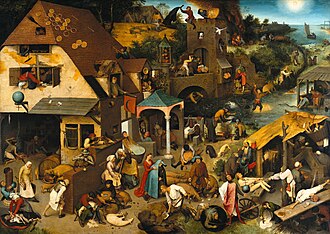 Netherlandish Proverbs - Pieter Bruegel the Elder (1551)
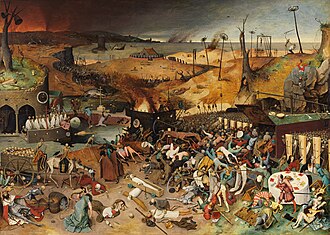 Il trionfo della morte - Pieter Bruegel the Elder (1560s)
%20-%20Blind%20leading%20the%20blind%20Google%20Art%20Project.jpeg) The Blind Leading the Blind - Pieter Bruegel the Elder (1568)
The Blind Leading the Blind - Pieter Bruegel the Elder (1568)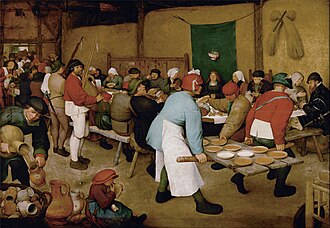 Matrimonio contadino - Pieter Bruegel the Elder (1560s)
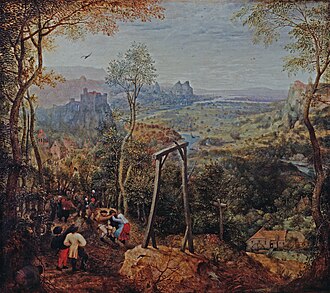 La gazza sulla forca - Pieter Bruegel the Elder (1568)
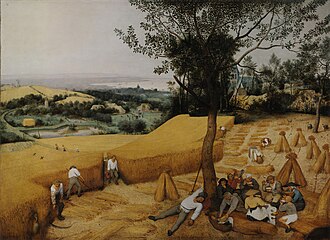 The Harvesters - Pieter Bruegel the Elder (1565)
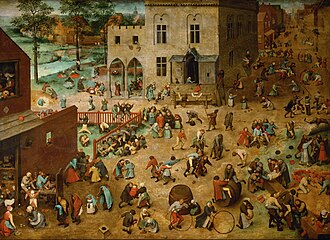 Children's Games - Pieter Bruegel the Elder (1560)
Dipinti di artisti collegati
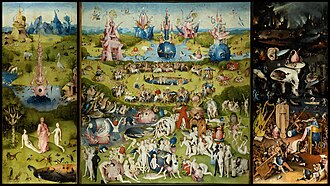 The Garden of Earthly Delights - Hieronymus Bosch
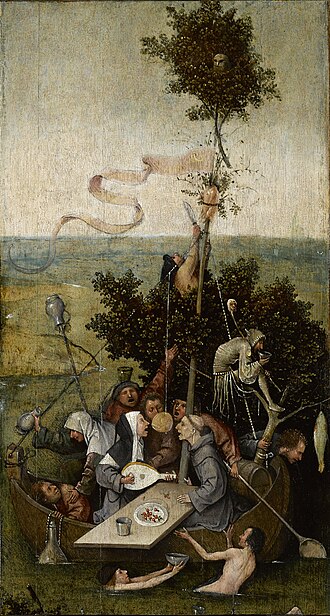 Ship of Fools - Hieronymus Bosch (1500s)