The Baptism of the Eunuch
Rembrandt van Rijn · 1626
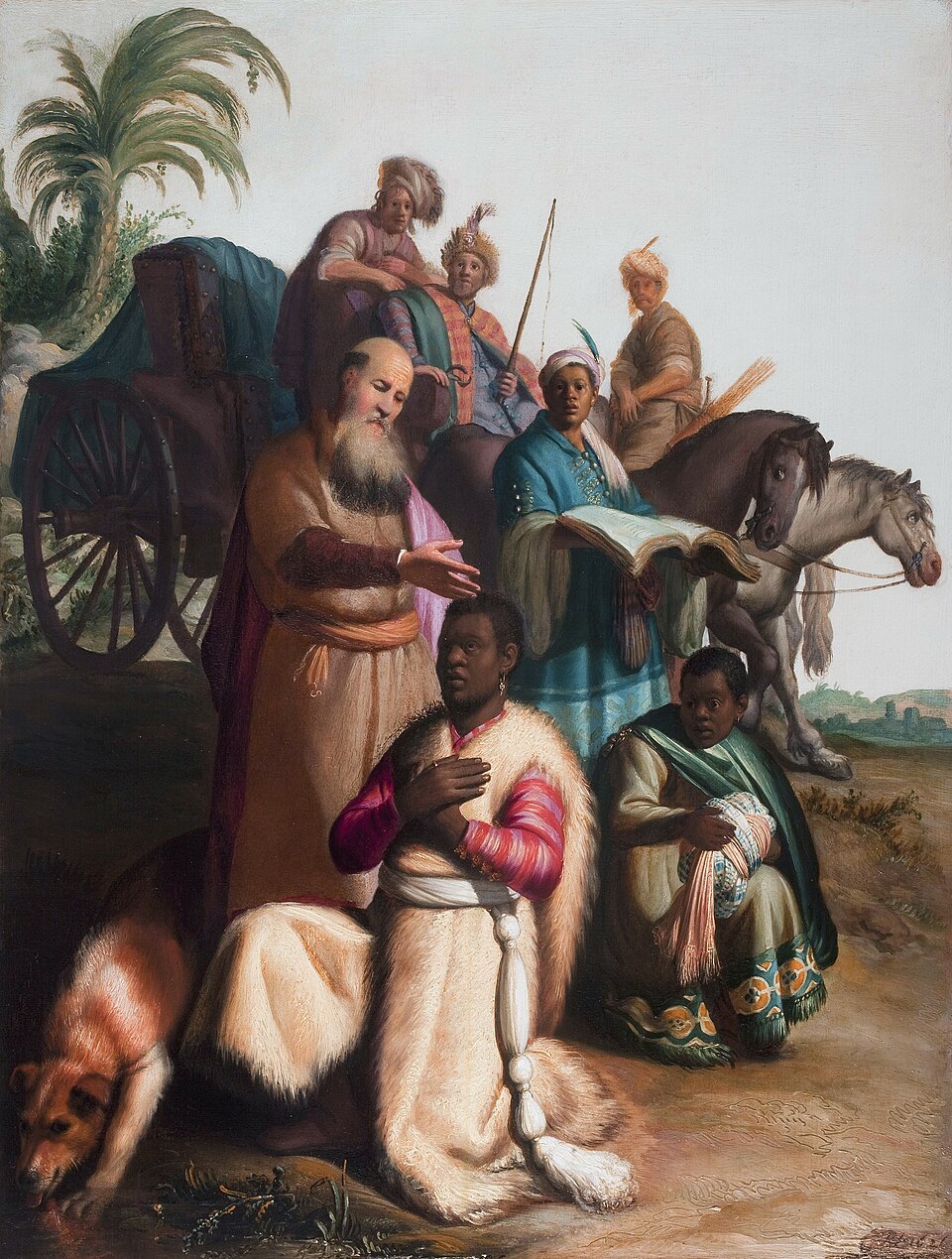
At the very start of his career, Rembrandt signed this crowded roadside baptism RH 1626. At its centre kneels an Ethiopian official in ermine, hands crossed on his chest, while a dog drinks from the river below.
The story behind the painting
The painting tells a story from the Acts of the Apostles, chapter 8, verses 26 to 39. On the road from Jerusalem to Gaza, Philip the Evangelist meets an Ethiopian man, a eunuch, and baptises him by the water. The moment is traditionally seen as the start of the Ethiopian Church. Rembrandt painted it in 1626, at the very beginning of his career, and signed it with a monogram and the date RH 1626 in the lower right corner, a signature that matches others he made that year.
What to look for
In the middle of the foreground the Ethiopian kneels, the first of seven figures staggered one behind the other. He wears an ermine cloak over a purple robe with a white waistband, a gold pendant in his left ear and a gold ring on his right thumb, his hands crossed in front of his chest. Philip, tall with a long grey beard, raises his right hand in blessing. A young black woman squats behind, holding her master's blue and red turban on her knees. A man in a white and purple headdress with a feather holds a large open book and looks straight at us.
Meaning and intent
The picture stages a meeting between worlds. Behind the kneeling man come his attendants: an open carriage with two horses and drivers in oriental dress, and a rider with a quiver of arrows on his saddle, several of them turning to look at the viewer as if inviting us into the scene. A palm tree rises to the top edge on the left, while on the right the view opens onto dark rocks or the outline of a town before two hills. The quiet focus remains the bowed head of the Ethiopian, placed at the very centre of the picture, under the blessing hand.
Legacy
Even small details show a young painter testing his means. In the left foreground a large brown and white dog comes out from behind Philip to drink at the river, and some herbs grow beside it. The right foreground is left empty, and there Rembrandt scratched an irregular texture into the wet paint with the wooden end of his brush. The panel, about 64 by 47.5 cm, has belonged to the Museum Catharijneconvent in Utrecht since 1976, where it can be seen as an early witness of the artist who would become Rembrandt.
Lo sapevi?
- Signed and dated RH 1626.
- Illustrates Acts 8:26-39, the baptism by Philip on the road to Gaza.
- Owned by the Museum Catharijneconvent in Utrecht since 1976.
- Rembrandt scratched texture into the paint with the end of his brush.
L'artista
Rembrandt van Rijn (1606-1669)
religious art · Dutch Golden Age painting
Altre opere di Rembrandt van Rijn
 The Night Watch - Rembrandt van Rijn (1642)
 Self-Portrait - Rembrandt van Rijn (1659)
 La lezione di anatomia del dottor Nicolaes Tulp - Rembrandt van Rijn (1632)
 La sposa ebrea - Rembrandt van Rijn (1660s)
 The Storm on the Sea of Galilee - Rembrandt van Rijn (1633)
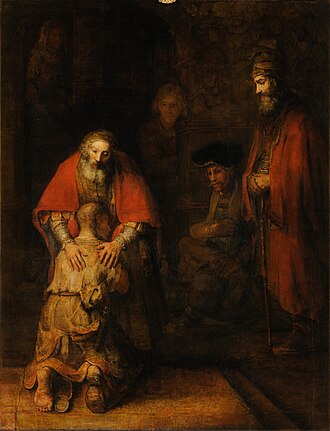 Il ritorno del figliol prodigo - Rembrandt van Rijn (1668)
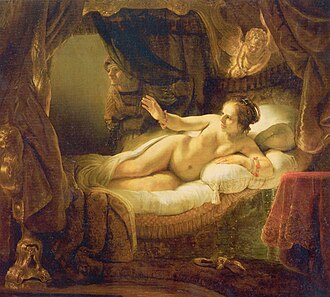 Danae - Rembrandt van Rijn (1636)
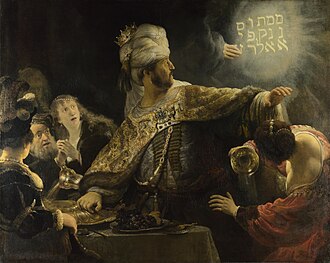 Banchetto di Baldassarre - Rembrandt van Rijn (1636)
Dipinti di artisti collegati
 Girl with a Pearl Earring - Johannes Vermeer (1665)
 The Milkmaid - Johannes Vermeer (c. 1658)
 The Feast of Saint Nicholas - Jan Steen (1660s)
 Girl eating oysters - Jan Steen (1658)
 A Militiaman Holding a Berkemeyer, Known as the ‘Merry Drinker’ - Frans Hals (1620s)
 Laughing Cavalier - Frans Hals (1624)
 The Windmill at Wijk bij Duurstede - Jacob van Ruisdael (1670)
 The Jewish Cemetery - Jacob van Ruisdael (1650s)
 The Courtyard of a House in Delft - Pieter de Hooch (1658)
 A Woman Peeling Apples - Pieter de Hooch (1663)