Banchetto di Baldassarre
Rembrandt van Rijn · 1636
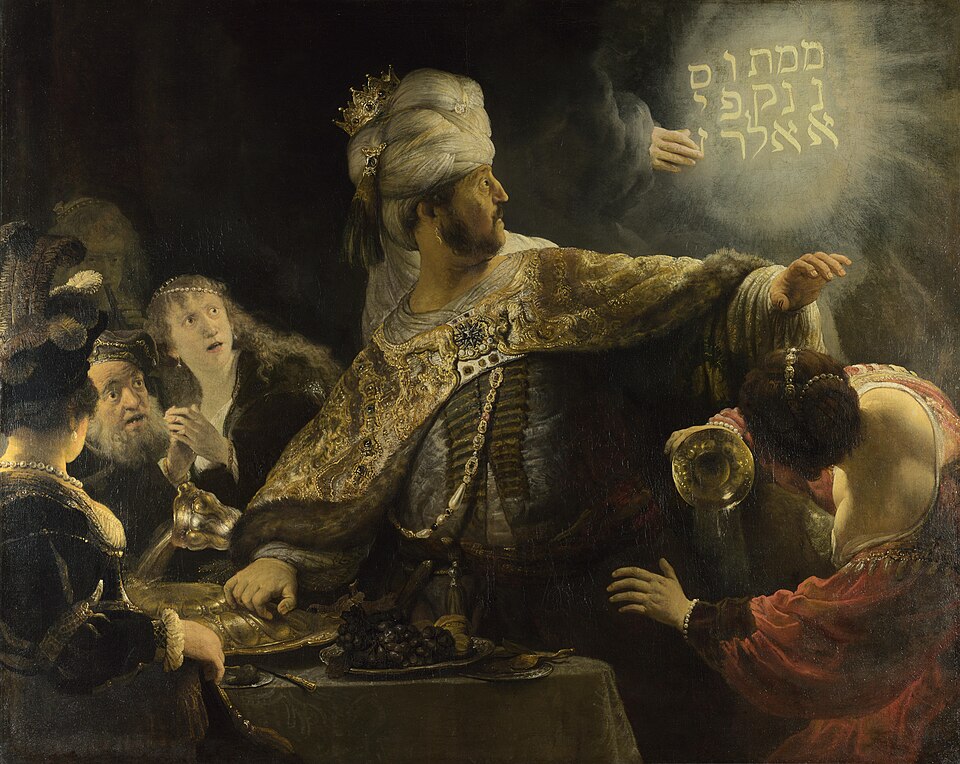
In the middle of a royal banquet, a glowing hand writes on the wall, and a king in a turban turns in terror as wine spills from sacred cups. Rembrandt froze the exact second when power learns it is finished.
The story behind the painting
Belshazzar's Feast was Rembrandt's bid to establish himself as a painter of large, dramatic Baroque history paintings. Its exact date is unknown, but most sources place it between 1635 and 1638, when the young artist was building his career in Amsterdam. The subject comes from the Old Testament Book of Daniel. The Babylonian king Nebuchadnezzar had looted the Temple in Jerusalem and taken its sacred golden vessels. His son Belshazzar used those cups at a great feast, and in the midst of it a hand appeared and wrote a message on the wall announcing the end of his reign. Rembrandt lived in the Jewish Quarter of Amsterdam, and for the inscription he drew on a book by his friend, the learned rabbi and printer Menasseh ben Israel.
What to look for
Everything turns on a burst of light. On the left, a hand emerges from the darkness and traces glowing letters on the wall. Belshazzar, in a richly decorated turban, twists toward it, his body caught mid-movement, while around him guests recoil and vessels tip, spilling their contents. Notice the jewels and pearls, the gleam of gold, and the startled faces at the table. The colour is unusually rich for Rembrandt: studies of the painting have found vermilion, smalt, lead-tin yellow, yellow and red lakes, ochres and azurite, and his handling of these materials is considered exceptional among his works. Then look closely at the inscription itself. The Hebrew characters are arranged in vertical columns instead of in right-to-left rows, and one character is mistranscribed.
Meaning and intent
The words on the wall, mene, mene, tekel, u-farsin, are understood by biblical scholars to mean that God has numbered the days of the kingdom and ended it, that the king has been weighed in the balances and found wanting, and that his realm will be given to the Medes and Persians. Rembrandt's painting is about judgment arriving at the height of pride: the king is drinking from stolen sacred cups when the warning appears. The unusual column arrangement of the letters may be deliberate. Read in the normal row order, the text becomes garbled, which could explain why the Babylonian wise men in the story could not decipher it. This idea agrees with an opinion recorded in the Babylonian Talmud. Light, gesture and a puzzle of letters combine into one moment of revelation.
Legacy
For a long time the painting was not regarded as a masterpiece. It belonged to the Earls of Derby at Knowsley Hall from 1736 and was little known outside England. When it was shown at the Art Treasures Exhibition in Manchester in 1857, the curator George Scharf dismissed it as tame and inadequate in execution, and John Martin's grand version of the same subject enjoyed far greater fame. Opinion changed in the second half of the twentieth century, as Rembrandt's history paintings were reassessed. The National Gallery in London acquired it in 1964, and it soon became one of the gallery's most popular images. Today it is admired as a thrilling piece of Baroque storytelling, and its phrase, the writing on the wall, still lives in everyday speech.
Lo sapevi?
- Rembrandt took the form of the Hebrew letters from a book by his friend, Rabbi Menasseh ben Israel.
- The letters are arranged in columns rather than right-to-left rows, possibly to explain why no one could read them.
- In 1857 a curator called the painting tame; today it is a favourite at the National Gallery.
- Its palette includes unusually rich pigments such as vermilion, smalt and azurite.
L'artista
Rembrandt van Rijn (1606-1669)
religious art · Dutch Golden Age painting · National Gallery
Altre opere di Rembrandt van Rijn
 The Night Watch - Rembrandt van Rijn (1642)
 Self-Portrait - Rembrandt van Rijn (1659)
 La lezione di anatomia del dottor Nicolaes Tulp - Rembrandt van Rijn (1632)
 La sposa ebrea - Rembrandt van Rijn (1660s)
 The Storm on the Sea of Galilee - Rembrandt van Rijn (1633)
 Il ritorno del figliol prodigo - Rembrandt van Rijn (1668)
 Danae - Rembrandt van Rijn (1636)
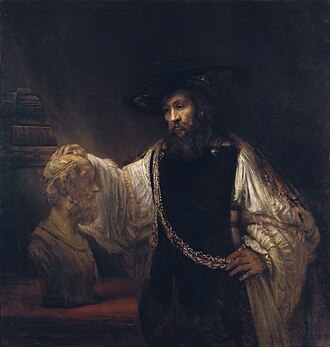 Aristotele con il busto di Omero - Rembrandt van Rijn (1653)
Dipinti di artisti collegati
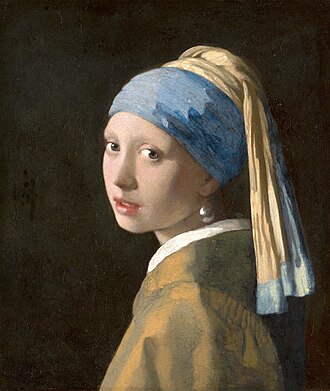 Girl with a Pearl Earring - Johannes Vermeer (1665)
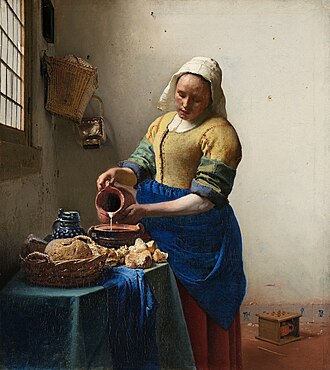 The Milkmaid - Johannes Vermeer (c. 1658)
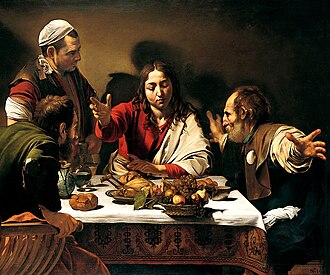 Supper at Emmaus - Caravaggio (1601)
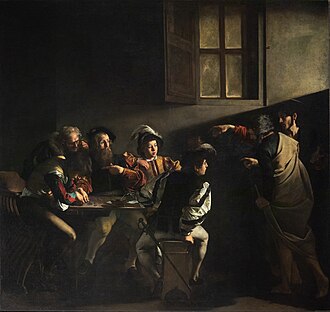 La vocazione di San Matteo - Caravaggio (1609)
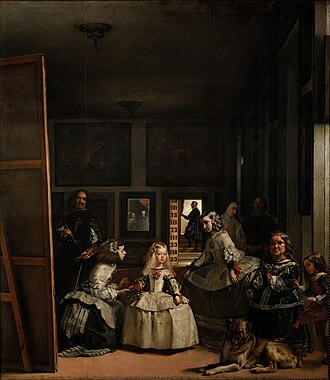 Las Meninas - Diego Velázquez (1656)
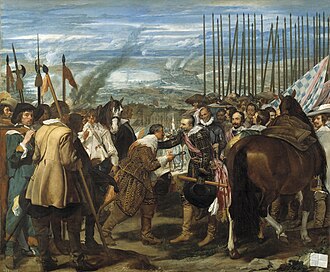 The Surrender of Brea - Diego Velázquez (1635)