Portrait of a Man with a Blue Chaperon
Jan van Eyck · 1430s
.jpg)
A man in a blazing blue headdress holds out a ring toward us. The panel is barely larger than a hand, and for nearly a century scholars argued over whether Jan van Eyck painted it at all.
The story behind the painting
This very small oil on panel, 22.5 by 16.6 cm with its frame, shows an unidentified man and was made around 1430. Painters of the Northern Renaissance did not title their works, so it has carried many names. Because of the ring in his right hand it was long called Portrait of a Jeweller or Man with a Ring. More recently the ring has been read as a sign of betrothal, and the titles now describe the blue chaperon instead. The attribution to van Eyck was repeatedly challenged until a 1991 cleaning settled the question.
What to look for
The man is turned in three-quarter view, his face sharply lit from the left so that light and shadow pull our eyes to it. He has brown eyes and an impassive expression, with a hint of melancholy in the downturned mouth. He wears a fur-lined brown jacket over a black undershirt. The chaperon hangs in two wings over his shoulders, its edges shredded, coloured with ultramarine from costly lapis lazuli. Notice the stubble of a day or two, and how the hand with the ring seems to push out of the picture while his left fingers rest on a painted parapet.
Meaning and intent
Was he a jeweller, as was thought until Erwin Panofsky's analysis, or a man sending his likeness to a bride's family? The tiny size supports the second idea, since such a panel could be packed and carried easily. Till-Holger Borchert praises the stubble recorded with painstaking precision, nothing idealised. Carol Richardson observes that this unidealised truth would have been a striking novelty, and that together with the painter's evident skill it gave the sitter weight and credibility. The headdress went out of fashion by the mid 1430s, which helps date the panel before then.
Legacy
The panel bears a fake Albrecht Dürer AD monogram and was once dated 1492, both later additions by an unknown hand. It was given to van Eyck in the late 19th century and shown as his in Bruges in 1902, but Karl Voll and later Panofsky doubted it, while Max J. Friedländer and Georges Hulin de Loo defended it. Infrared photography during the 1991 restoration revealed underdrawing and paint handling like his signed works. Owned by Samuel von Brukenthal, it was seized by the Communist regime in 1948, sent to Bucharest, and returned to Sibiu at the end of 2006.
Lo sapevi?
- Oil on panel, about 19 by 13 cm, made around 1430.
- The ring may signal a betrothal rather than a jeweller's trade.
- Attribution to van Eyck confirmed by infrared study in 1991.
- Taken to Bucharest in 1948, returned to the Brukenthal Museum in 2006.
L'artista
Jan van Eyck (1390-1441)
portrait · man · Early Netherlandish painting · ring
Altre opere di Jan van Eyck
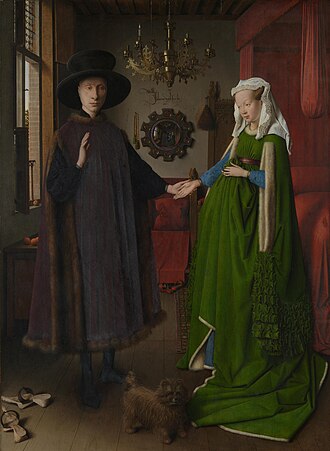 Arnolfini Portrait - Jan van Eyck (1434)
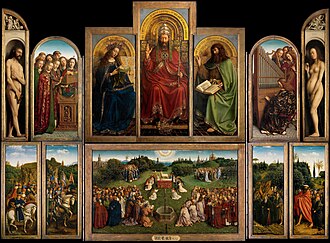 Ghent Altarpiece - Jan van Eyck (1432)
.webp) Madonna of Chancellor Rolin - Jan van Eyck
Madonna of Chancellor Rolin - Jan van Eyck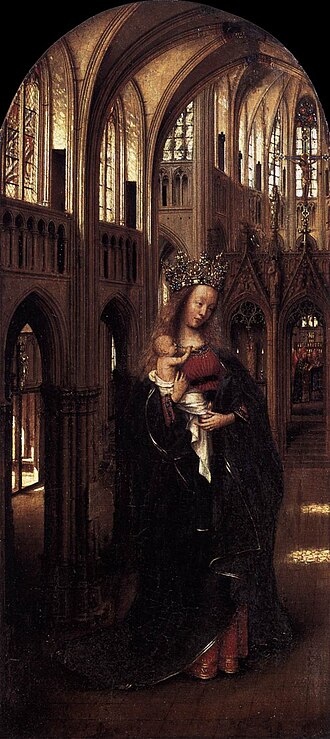 The Madonna in the Church - Jan van Eyck (1440)
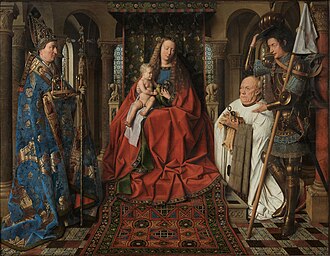 Madonna with Canon Joris van der Paele - Jan van Eyck (1436)
.png) Lucca Madonna - Jan van Eyck (1437)
Lucca Madonna - Jan van Eyck (1437)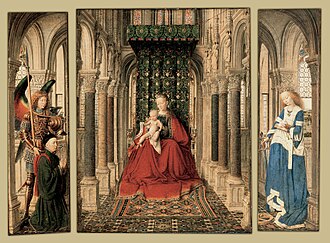 Dresden Triptych - Jan van Eyck (1437)
%201433.jpg) Portrait of a Man - Jan van Eyck (1433)
Portrait of a Man - Jan van Eyck (1433)
Dipinti di artisti collegati
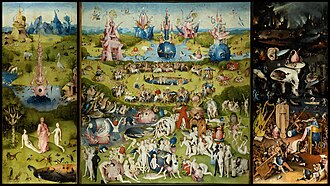 The Garden of Earthly Delights - Hieronymus Bosch
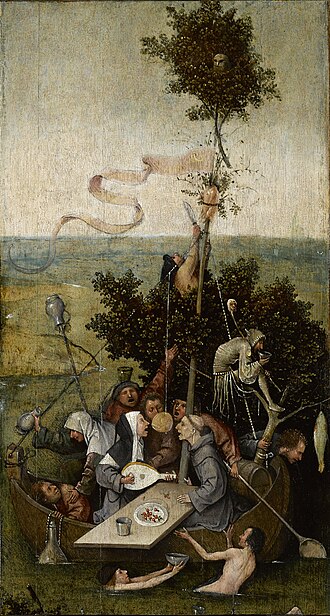 Ship of Fools - Hieronymus Bosch (1500s)
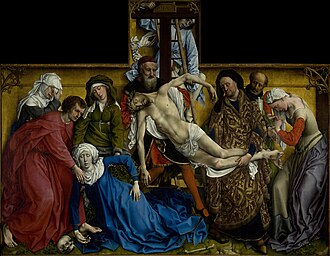 The Descent from the Cross - Rogier van der Weyden (1440s)
 Portrait of a Lady - Rogier van der Weyden (1460)
%20-%20Google%20Art%20Project.jpg) The Hunters in the Snow - Pieter Bruegel the Elder (1565)
The Hunters in the Snow - Pieter Bruegel the Elder (1565) Netherlandish Proverbs - Pieter Bruegel the Elder (1551)