Madonna of Chancellor Rolin
.webp)
The most powerful man in Burgundy kneels face to face with the Virgin, as tall as she is, while behind them a whole river city glitters in miniature. Look closer, and his sins are hidden in the stonework.
The story behind the painting
Jan van Eyck painted this oil around 1435 for Nicolas Rolin, chancellor of the Duchy of Burgundy, then about sixty. Rolin commissioned it for his parish church, Notre-Dame-du-Chastel in Autun, where it stayed until the church burned in 1793. After a period in Autun Cathedral, it went to the Louvre in 1805, where, after conservation, it was the focus of an exhibition in 2024. It may be connected with the appointment in 1436 of Rolin's son Jean as Bishop of Autun. The panel measures about 66 by 62 cm.
What to look for
Rolin kneels on the left in a fur-lined garment before an open Book of Hours. Opposite, the Virgin in a red mantle presents the infant Jesus, who holds a cross-bearing orb and blesses, while an angel hovers to crown her. They sit in a loggia of columns and reliefs. Beyond lies a garden of lilies, irises, peonies and roses, two men in chaperons peering over a parapet near magpies and peacocks, and a vast landscape of a river city, probably Autun, fading into hazy mountains. Comparing the floor tiles shows the figures are only about six feet from the columns.
Meaning and intent
Remarkably, the Virgin is the same size as Rolin, a novelty compared with Gothic tradition. The setting seems at once an imaginary building in Autun and the heavenly Jerusalem. On Rolin's side, the reliefs show the Expulsion from Paradise, Cain killing Abel and the Drunkenness of Noah, and lion heads and tiny squashed rabbits may stand for Anger and Lust, suggesting a hidden series of deadly sins; nothing similar appears on the divine side. Infrared shows a large purse at Rolin's belt was painted out, perhaps because he had grown very rich in office.
Legacy
The painting is described as one of the finest examples of van Eyck's perfectionist rendering of detail: the capitals, the chequered pavement, the goldwork of the crown, the garments. Its complex lighting, from the portico and side windows, is typical of him. Some scholars speculate that the two small men on the terrace are van Eyck and an assistant, the one in a red chaperon recalling a probable self-portrait. Old descriptions record a lost wooden frame painted with illusionistic inscriptions.
Lo sapevi?
- Dated around 1435 (Wikipedia).
- Made for Notre-Dame-du-Chastel in Autun; in the Louvre since 1805.
- Infrared reveals a purse at Rolin's belt that was painted out.
- Size: 66 x 62 cm (Wikidata).
L'artista
Jan van Eyck (1390-1441)
religious art · Mary · Christ Child · Department of Paintings of the Louvre · waist-length hair · Early Netherlandish painting · angel · blond hair · overcoat · crown
Altre opere di Jan van Eyck
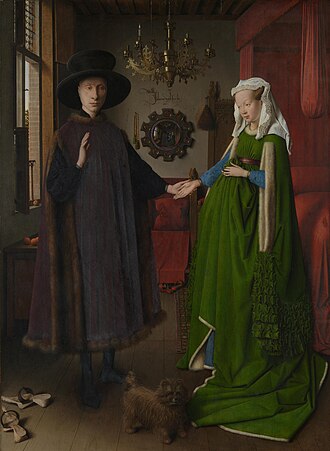 Arnolfini Portrait - Jan van Eyck (1434)
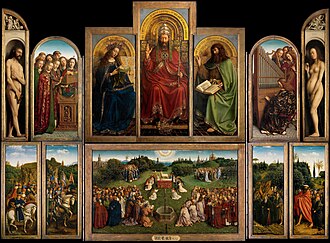 Ghent Altarpiece - Jan van Eyck (1432)
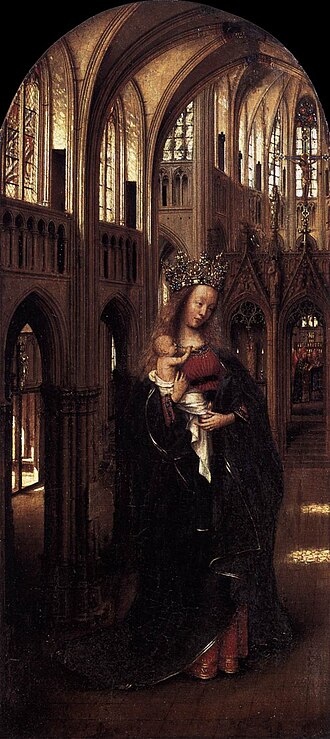 The Madonna in the Church - Jan van Eyck (1440)
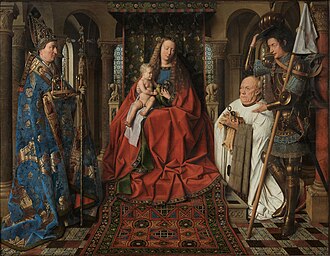 Madonna with Canon Joris van der Paele - Jan van Eyck (1436)
.png) Lucca Madonna - Jan van Eyck (1437)
Lucca Madonna - Jan van Eyck (1437)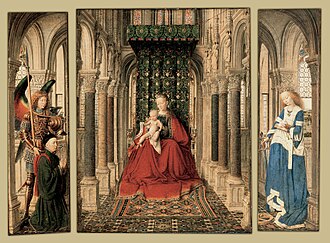 Dresden Triptych - Jan van Eyck (1437)
%201433.jpg) Portrait of a Man - Jan van Eyck (1433)
Portrait of a Man - Jan van Eyck (1433)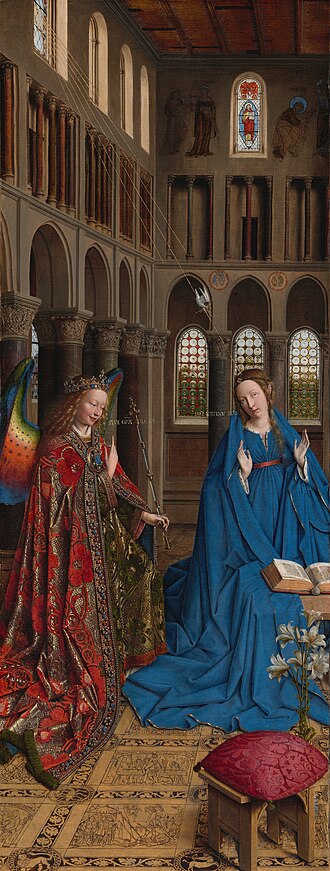 Annunciation - Jan van Eyck (1430s)
Dipinti di artisti collegati
 The Garden of Earthly Delights - Hieronymus Bosch
 Ship of Fools - Hieronymus Bosch (1500s)
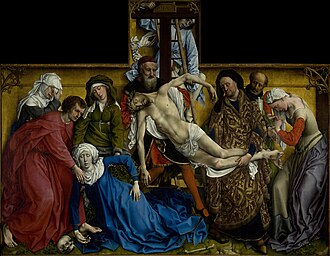 The Descent from the Cross - Rogier van der Weyden (1440s)
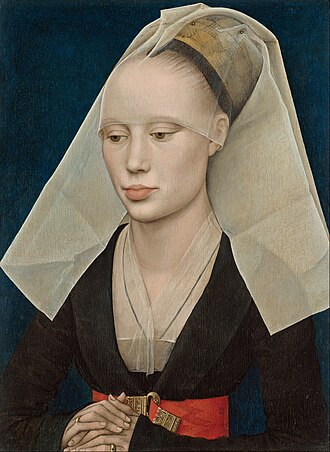 Portrait of a Lady - Rogier van der Weyden (1460)
%20-%20Google%20Art%20Project.jpg) The Hunters in the Snow - Pieter Bruegel the Elder (1565)
The Hunters in the Snow - Pieter Bruegel the Elder (1565)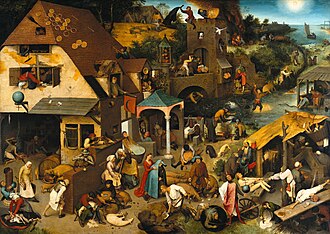 Netherlandish Proverbs - Pieter Bruegel the Elder (1551)