Naval Battle in the Gulf of Naples
Pieter Bruegel the Elder · 1556
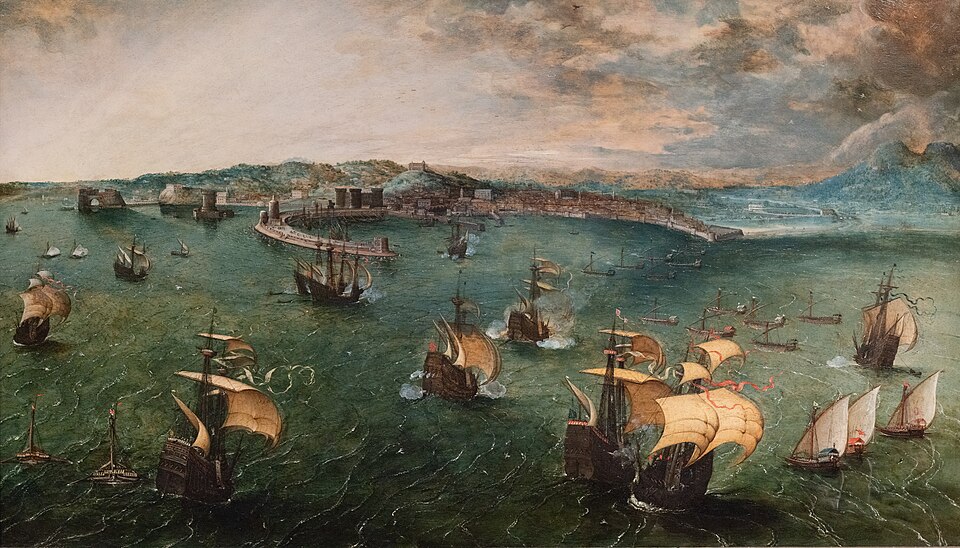
Galleys and sailing ships clash in puffs of smoke while Vesuvius rises over a wide bay. Bruegel painted Naples from memory and imagination, and even gave its harbour a shape it never had.
The story behind the painting
In 1551 and 1553 Pieter Bruegel the Elder travelled through the Italian Peninsula with the geographer Abraham Ortelius, stopping in Rome, Naples and Messina. He made many drawings on the way, including one of a naval clash in the Straits of Messina that Frans Huys turned into an engraving. This panel grew out of those Italian memories. Its date is disputed: Wikipedia describes it as painted from 1558 to 1562, while Wikidata gives 1556. Scholars do agree on one thing, that the volcano and its placement seem to reflect Bruegel's neoplatonic pantheism.
What to look for
In the foreground several vessels, sailing ships, galleys and smaller rowing boats, move amid puffs of smoke and barely legible trails of cannonballs. It is hard to say for sure what is happening; a battle is perhaps taking place. Behind them opens the Gulf of Naples, with Mount Vesuvius on the right. The horizon is raised above half the picture, a habit of Flemish artists that gives the view a very broad sweep. On the left you can pick out the remains of Castel dell'Ovo, the Castel Nuovo, the lost Torre San Vincenzo and the semicircular piers.
Meaning and intent
This is a veduta, a view, that takes historical and topographical liberties. No such battle happened in exactly this setting, and the harbour does not look like Bruegel's version. Maps of the time show a rectangular port, so the curved piers are the artist's invention, perhaps a softening meant to make the view more elegant and dynamic. The result is less a record of a real event than a composed vision, in which the sea, the city and the smoking volcano are arranged to be seen all at once from high above.
Legacy
The panel is small, about 42 by 71 cm, painted in oil on wood, and it is one of the works that carry the memory of Bruegel's Italian journey. It is kept today in Rome, in the Galleria Doria Pamphilj. The drawing of the Straits of Messina, engraved by Frans Huys, shows that sea battles in Italian waters were a subject he returned to after his travels, while this painting adds the broad Flemish panorama, the recognisable monuments of Naples and the volcano that dominates the bay.
Lo sapevi?
- Inspired by Bruegel's journeys in Italy with Abraham Ortelius in 1551 and 1553.
- Dated 1558-1562 by Wikipedia, 1556 by Wikidata.
- The curved harbour piers are the artist's invention.
- Now in the Galleria Doria Pamphilj, Rome.
L'artista
Pieter Bruegel the Elder (1525-1569)
marine art · Galleria Doria Pamphilj
Altre opere di Pieter Bruegel the Elder
 The Hunters in the Snow - Pieter Bruegel the Elder (1565)
 Netherlandish Proverbs - Pieter Bruegel the Elder (1551)
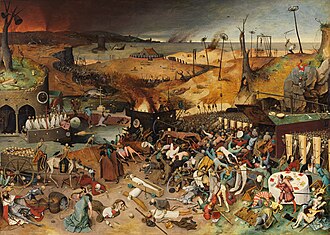 Il trionfo della morte - Pieter Bruegel the Elder (1560s)
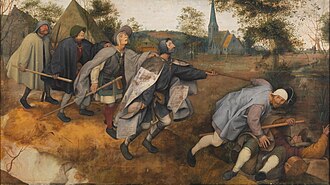 The Blind Leading the Blind - Pieter Bruegel the Elder (1568)
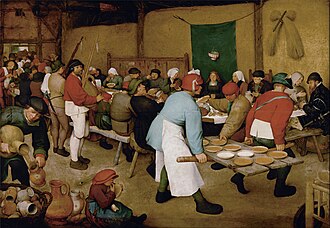 Matrimonio contadino - Pieter Bruegel the Elder (1560s)
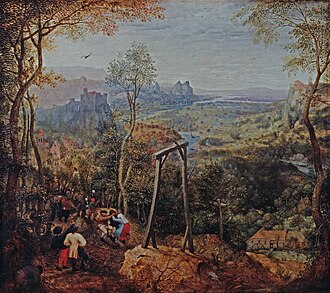 La gazza sulla forca - Pieter Bruegel the Elder (1568)
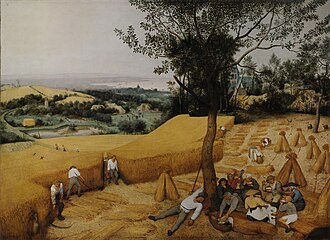 The Harvesters - Pieter Bruegel the Elder (1565)
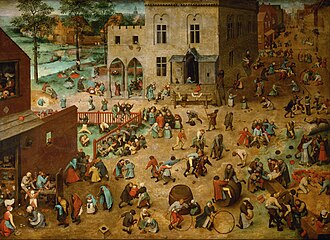 Children's Games - Pieter Bruegel the Elder (1560)
Dipinti di artisti collegati
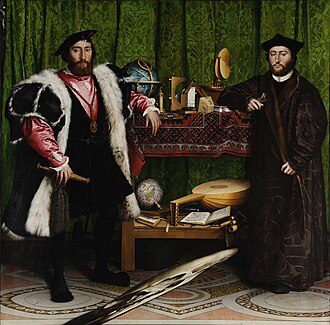 The Ambassadors - Hans Holbein the Younger (1533)
 The Body of the Dead Christ in the Tomb - Hans Holbein the Younger (1520s)
 The Garden of Earthly Delights - Hieronymus Bosch
 Ship of Fools - Hieronymus Bosch (1500s)
 Arnolfini Portrait - Jan van Eyck (1434)
 Ghent Altarpiece - Jan van Eyck (1432)