Léal Souvenir
Jan van Eyck · 1432
%20-%20National%20Gallery%2C%20London.jpg)
A plain-faced man looks out from behind a cracked stone ledge carved with the words Loyal Memory. Nobody knows who he was, yet Jan van Eyck made him unforgettable in 1432.
The story behind the painting
Léal Souvenir, also called Timotheus or Portrait of a Man, is a small oil-on-oak panel, about 34.5 by 19 cm, dated 1432. It was only van Eyck's second known portrait. The sitter has never been identified, but his distinctive features suggest a real person rather than an ideal type. He was apparently important enough in the circle of Philip the Good, Duke of Burgundy, for the duke's court painter to portray him. The French words on the stone, Leal Souvenir, Loyal Memory, suggest the portrait was made in remembrance of someone who had died.
What to look for
The man sits against a flat black background behind a worn painted parapet. He wears Burgundian fashion: a red robe and a green wool chaperon trimmed with fur, its end hanging forward. He seems bald, with faint traces of fair hair; his eyelashes are thought to have been added by a 19th-century restorer. Light falls from the left. Van Eyck records his narrow shoulders, pursed lips and even the moisture in his blue eyes. He holds a scroll with six lines of illegible writing. The head is large for the body, which some historians put down to the painter's inexperience. The chipped stone, carved to look like a Roman funerary memorial, shows off van Eyck's skill.
Meaning and intent
This is one of the earliest surviving secular portraits in medieval European art and one of the earliest unidealised ones. Scholars are moved by the contrast between the plain looks and the deep expression. Meiss called him plain and rustic yet found an almost Rembrandtesque warmth; Panofsky saw a pensive, lonely nature, the face of one who feels rather than dissects. Elisabeth Dhanens read the cracked parapet as the fragility of life or of memory itself. The Greek inscription at the top, read as TYM.OTHEOS, is disputed: Eastlake read it in 1857 as the name Timotheos, while others suggest Honour God, and Dhanens proposed Time Deum, Fear God, a motto of the Vilain family.
Legacy
The name Timotheus led Fierens-Gevaert and Panofsky to the Greek musician Timotheus of Miletus, and Panofsky thought the sitter might be a leading musician at Philip's court, possibly Gilles Binchois. More recent research focuses on the legal wording in one inscription and suggests a link to the legal profession or to the duke's service. The third line carries van Eyck's signature and the date. The panel was acquired by the National Gallery in London in 1857 and is on permanent display there. Because van Eyck did not fully master Greek or Latin, readings of the letters still differ, and the man's name remains a quiet mystery.
Lo sapevi?
- Dated 1432; oil on oak, about 34.5 x 19 cm.
- Leal Souvenir means Loyal Memory.
- One of the earliest surviving secular, unidealised portraits in Europe.
- In the National Gallery, London, since 1857.
L'artista
Jan van Eyck (1390-1441)
portrait · man · National Gallery · Early Netherlandish painting
Altre opere di Jan van Eyck
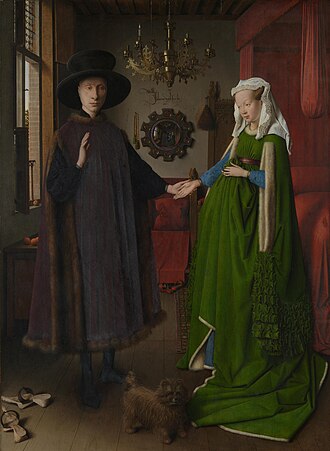 Arnolfini Portrait - Jan van Eyck (1434)
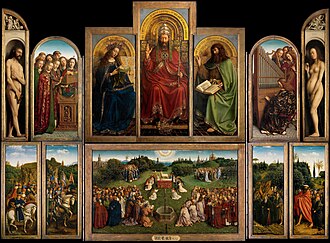 Ghent Altarpiece - Jan van Eyck (1432)
.webp) Madonna of Chancellor Rolin - Jan van Eyck
Madonna of Chancellor Rolin - Jan van Eyck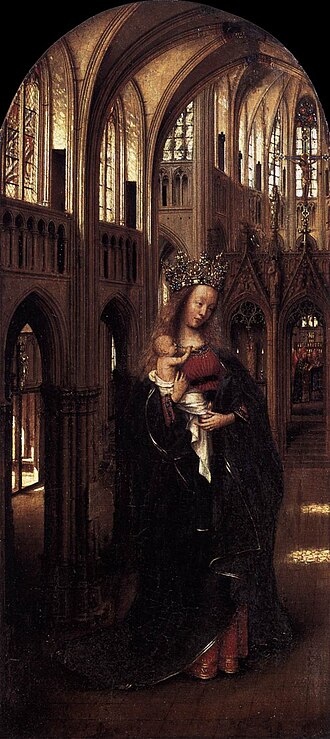 The Madonna in the Church - Jan van Eyck (1440)
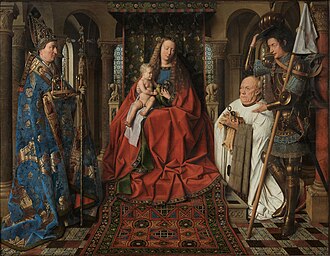 Madonna with Canon Joris van der Paele - Jan van Eyck (1436)
.png) Lucca Madonna - Jan van Eyck (1437)
Lucca Madonna - Jan van Eyck (1437)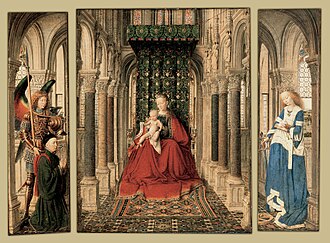 Dresden Triptych - Jan van Eyck (1437)
%201433.jpg) Portrait of a Man - Jan van Eyck (1433)
Portrait of a Man - Jan van Eyck (1433)
Dipinti di artisti collegati
 The Garden of Earthly Delights - Hieronymus Bosch
 Ship of Fools - Hieronymus Bosch (1500s)
 The Descent from the Cross - Rogier van der Weyden (1440s)
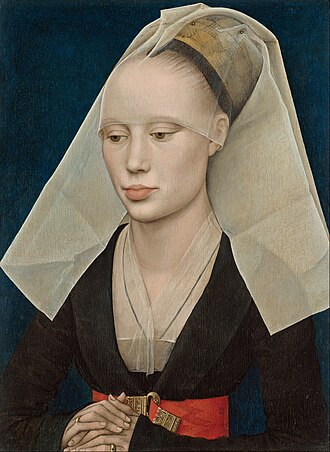 Portrait of a Lady - Rogier van der Weyden (1460)
%20-%20Google%20Art%20Project.jpg) The Hunters in the Snow - Pieter Bruegel the Elder (1565)
The Hunters in the Snow - Pieter Bruegel the Elder (1565)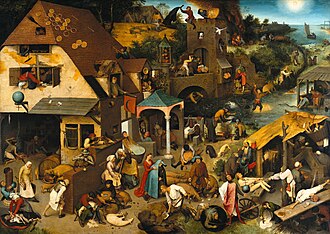 Netherlandish Proverbs - Pieter Bruegel the Elder (1551)