The Psyche mirror
Berthe Morisot · 1876
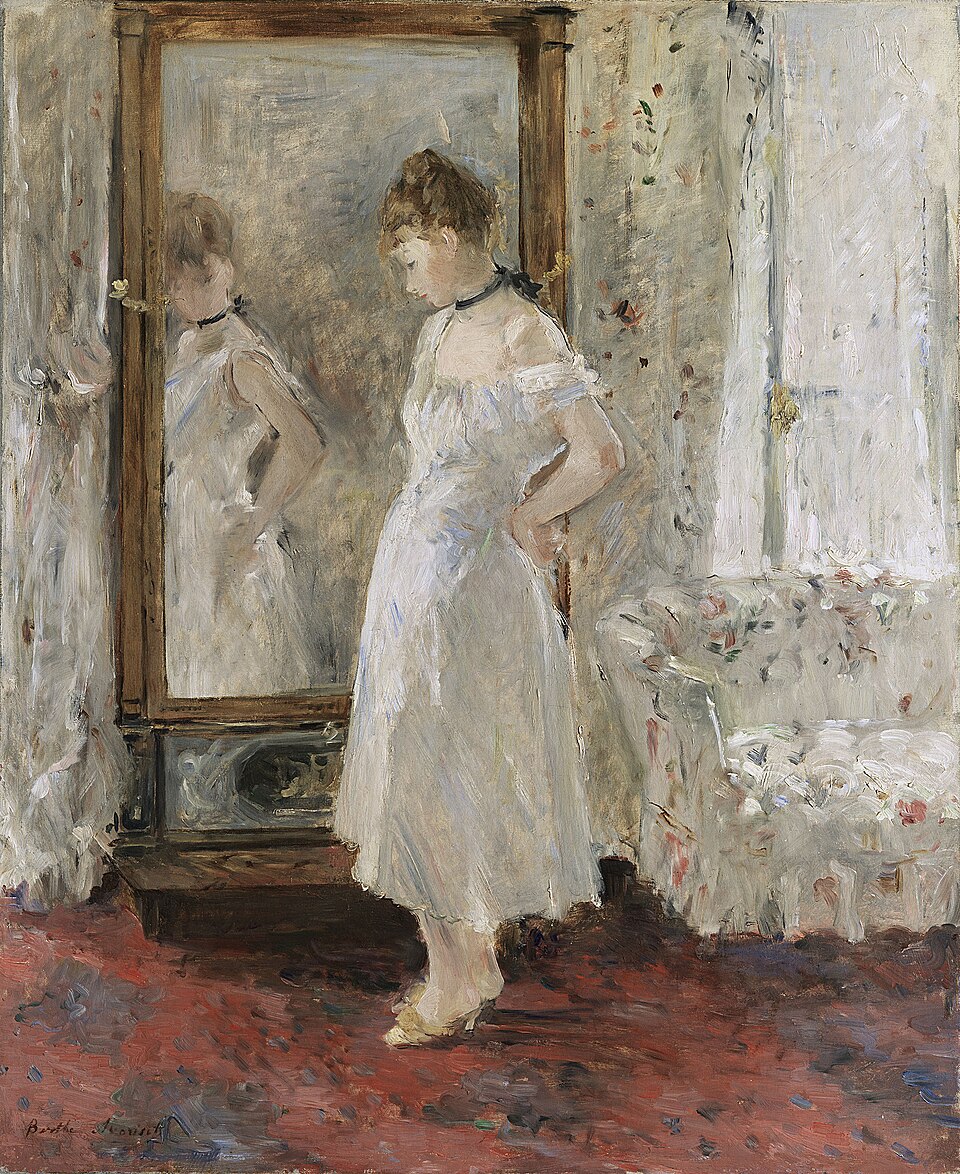
A young woman stands before a tall mirror between two windows, so absorbed in her own reflection that she seems unaware of us, one sleeve already slipping from her shoulder. Morisot painted it in 1876, two years into her marriage, and called it Psyche.
The story behind the painting
Women at their toilette were a frequent subject for Berthe Morisot: four of the eight paintings she made in 1876 took up that theme, including this one. Its French title, La Psyché, names the tall tilting dressing mirror known as a psyche, and also links the scene to the Greek myth of Psyche. Morisot showed it at the third Impressionist exhibition in 1877, together with Young Woman Powdering Her Face, which the collector Ernest Hoschedé bought during the show and which Mary Cassatt, who felt a strong affinity with Morisot, later bought at auction.
What to look for
The young woman looks at herself in a large psyche mirror placed between two windows, and the whole room is bathed in light. She seems to be undressing, undoing a fastening at the back of her corset, one sleeve already slipping over her shoulder. As always, Morisot's brushstrokes are very loose: stripes and specks make the pattern of the carpet, and the mirror and the sofa on the right are out of focus. The mirror's tall frame, cut off by the top edge, reads like a painting within the painting, with a vagueness that recalls Degas's ballerinas.
Meaning and intent
At first the link with the myth seems far-fetched: the woman is not mythological and there is no Cupid. But Morisot had married Eugène Manet, Édouard Manet's younger brother, in 1874, and was beginning to reconcile life as a wife, and later a mother, with being an artist, at great effort. She wanted to reach the deeper female psyche and believed women artists could do it better; in 1890 she wrote that women's strength lay in feeling, intuition and a more delicate gaze. Whitney Chadwick called the painting a daring, sympathetic portrayal of female self-awareness, not the usual image of vanity.
Legacy
Art historian Wu Hung adds that Morisot took over the old template of a woman before a mirror but dropped its voyeuristic point of view, replacing it with the woman's own subjectivity. That reading has made The Psyche Mirror one of the works through which Morisot's place in Impressionism is discussed today. The painting, about 65 by 54 cm, is held at the Thyssen-Bornemisza Museum in Madrid, where visitors meet the same light-filled room and the same private moment of looking.
Lo sapevi?
- Painted in 1876, one of four toilette scenes Morisot made that year.
- Shown at the third Impressionist exhibition in 1877.
- Seen as a portrayal of female self-awareness rather than vanity.
- Held at the Thyssen-Bornemisza Museum, Madrid.
L'artista
Berthe Morisot (1841-1895)
woman · Impressionism · window · Thyssen-Bornemisza Museum · carpet · chestnut hair · couch · specular reflection
Altre opere di Berthe Morisot
 The Cradle - Berthe Morisot (1872)
 Summer's Day - Berthe Morisot (1879)
 The Port at Lorient - Berthe Morisot (1869)
 The Mother and Sister of the Artist - Berthe Morisot
 Eugène Manet on Isle of Wight - Berthe Morisot (1875)
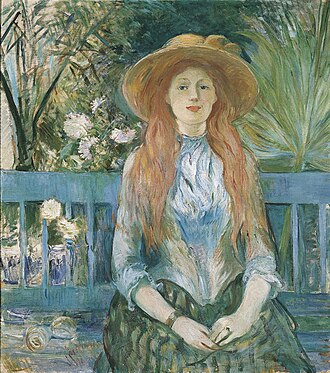 Young girl in a park - Berthe Morisot (1893)
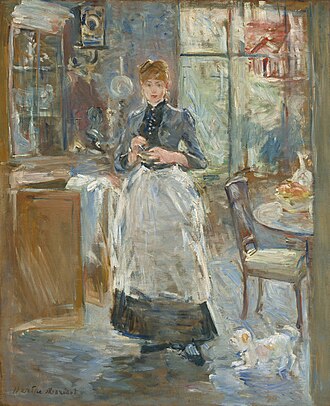 In the Dining Room - Berthe Morisot (1886)
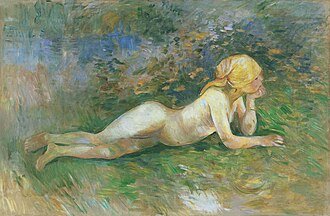 Reclining Nude Shepherdess - Berthe Morisot (1891)
Dipinti di artisti collegati
 Impression, Sunrise - Claude Monet (1872)
 Water Lilies - Claude Monet (1906)
 Luncheon on the Grass - Édouard Manet (1863)
 Olympia - Édouard Manet (1863)
 Dance at Le Moulin de la Galette - Pierre-Auguste Renoir (1876)
 Luncheon of the Boating Party - Pierre-Auguste Renoir (1881)
 L'Absinthe - Edgar Degas (1875)
 The Bellelli Family - Edgar Degas (1858)
 The Canal du Loing at Moret - Alfred Sisley (1892)
 The Watering Pond at Marly with Hoarfrost - Alfred Sisley (1876)
 Paris Street; Rainy Day - Gustave Caillebotte (1877)
 Les raboteurs de parquet - Gustave Caillebotte (1875)