Le Déluge
Michel-Ange Buronarroti · 1508
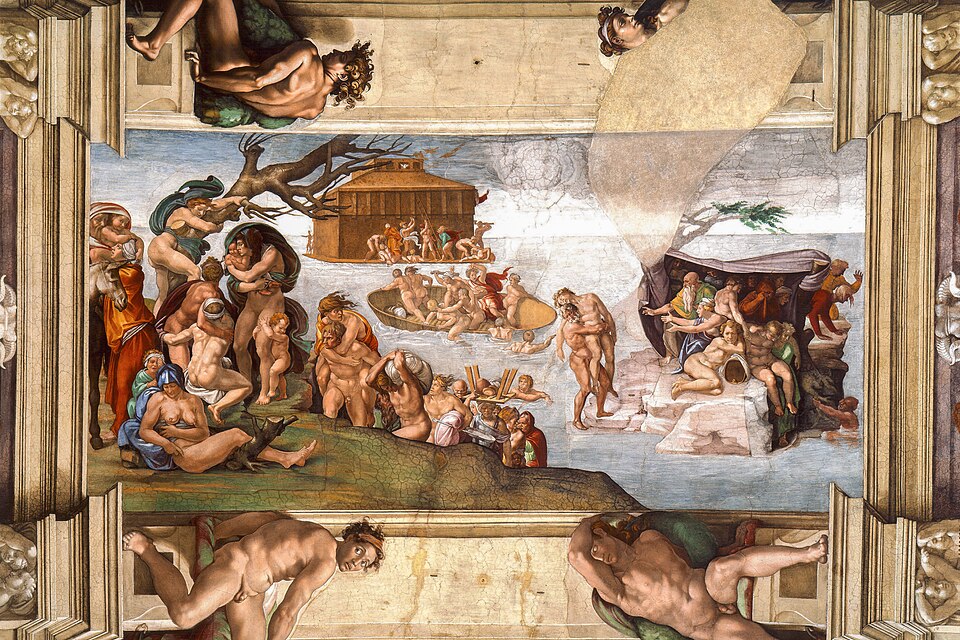
Families climb rocks with their children on their backs, an old man carries his exhausted son, and in the distance the ark floats untouched. The Deluge was the first story Michelangelo painted on the Sistine ceiling.
The story behind the painting
The Deluge is a fresco by Michelangelo, about 280 by 560 cm, dated around 1508-1510, on the Sistine Chapel ceiling commissioned by Pope Julius II. According to Ascanio Condivi it was the very first scene painted on the ceiling, which Mancinelli's restoration confirmed in 1993. The start was hard: badly mixed plaster caused mould, and assistants worked on the early days. Of twenty-nine working days, the first five covered the figures on the right-hand island. After that there seem to have been quarrels, the assistants were dismissed, and Michelangelo went on alone in true fresco.
What to look for
Unlike the later scenes, it holds some sixty relatively small figures, often nude, grouped along diagonals that deepen the space. In the foreground people seek dry land carrying their belongings, climbing trees, carrying children or relatives on their backs. On the island at right an old man lifts the exhausted body of his son with a huge effort. In the boat at centre people fight to keep others from climbing aboard, and another group attacks the ark with a ladder and a hatchet. The great ark, like a citadel, stands calm, with the dove already on its roof. A strip of sky of a different colour marks where plaster fell.
Meaning and intent
The source reads the scene through Hugh of Saint Victor, who divided humanity into three groups: the just, saved in the ark, meaning the Church; the wicked who attack it; and those not evil but lost through attachment to worldly things. In the chapel's scheme the flood also stands for the baptism of Christ, since water washes away sin, and the wooden ark recalls the wood of the Cross. Rather than dwelling on divine punishment, Michelangelo stresses human helplessness and despair, and the small acts of care between people.
Legacy
From the first unveiling the Deluge was singled out. Vasari wrote of people facing death with terror and abandonment, yet also acts of pity, one pulling another up a rock, one embracing a half-dead man to save him. Paolo Uccello's Deluge in Florence is the best-known earlier version, but Michelangelo treated it differently. The fresco suffered losses and many cracks, notably when the powder magazine of Castel Sant'Angelo exploded in 1791. Wikidata dates it 1508 and gives no size; the size here comes from the French Wikipedia article.
Le saviez-vous ?
- Fresco about 280 x 560 cm, around 1508-1510.
- The first scene painted on the Sistine ceiling, per Condivi.
- About sixty figures, painted over twenty-nine working days.
- Damaged by the 1791 explosion at Castel Sant'Angelo.
À propos de l'artiste
Michel-Ange Buronarroti (1475-1564)
art religieux · Haute Renaissance · chapelle Sixtine
Autres œuvres de Michel-Ange Buronarroti
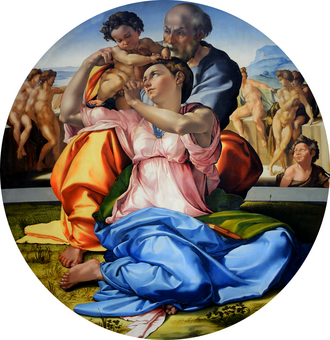 Tondo Doni - Michelangelo (1500s)
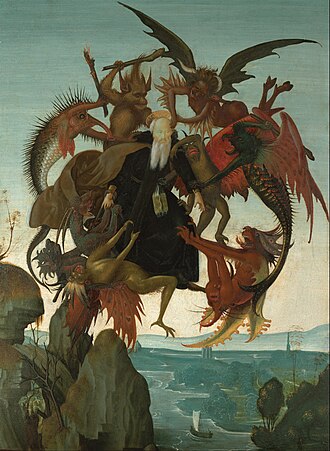 Le Tourment de saint Antoine - Michelangelo (1487)
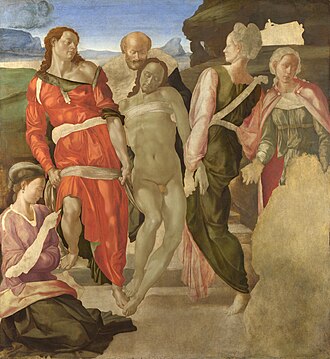 La Mise au tombeau - Michelangelo (1500s)
 Léda - Michelangelo (1530)
 Le Sacrifice de Noé - Michelangelo (1508)
 La Séparation de la lumière et des ténèbres - Michelangelo (1512)
 La Création d'Ève - Michelangelo (1511)
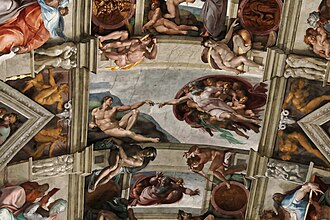 La Séparation des terres et des eaux - Michelangelo (1511)
Œuvres d'artistes liés
.jpg) Vénus d'Urbin - Titian (1538)
Vénus d'Urbin - Titian (1538) L'Assomption de la Vierge - Titian (1510s)
 La Madone Sixtine - Raphael (1510s)
.jpg) La Fornarina - Raphael
La Fornarina - Raphael La Joconde - Leonardo da Vinci (1503-1519)
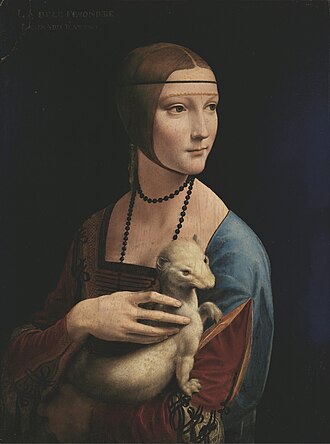 La Dame à l'hermine - Leonardo da Vinci (1490)
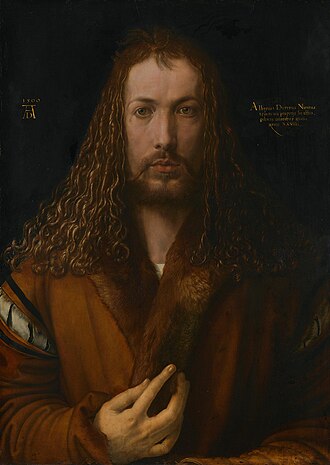 Autoportrait - Albrecht Dürer (1500)
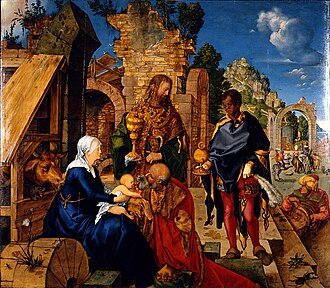 Adoration des mages - Albrecht Dürer (1504)
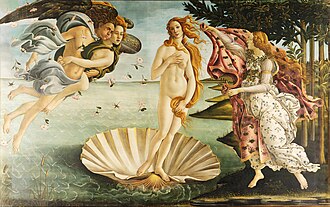 La Naissance de Vénus - Sandro Botticelli (c. 1485)
 Le Printemps - Sandro Botticelli (1480s)
 Le Jardin des délices - Hieronymus Bosch
 La Nef des fous - Hieronymus Bosch (1500s)