Le Jeune Saint Jean-Baptiste au bélier
Caravaggio · 1602
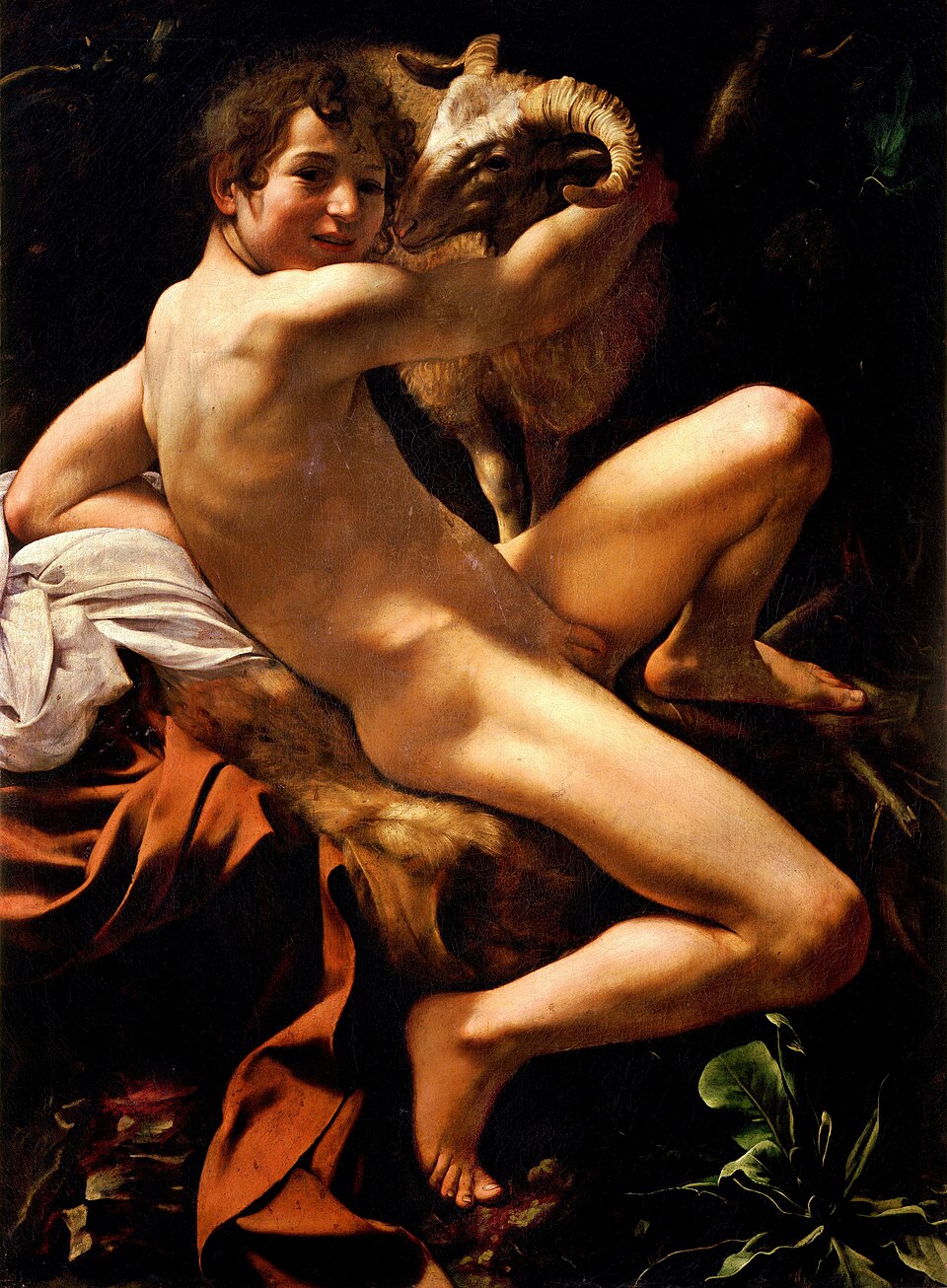
A naked boy sprawls on a red cloak, arm around a ram, and grins at us. This is meant to be John the Baptist. Caravaggio's playful saint was copied eleven times and still puzzles viewers.
The story behind the painting
Caravaggio painted this John the Baptist around 1602 for the Roman Ciriaco Mattei, in whose palace he lived and worked in 1601 to 1602. After his success with the Saint Matthew paintings in the Contarelli Chapel, private commissions poured in, one of the most productive times of his career. Mattei's account books record two payments, in July and December, marking the start and end of the work. In the same period Caravaggio painted the Supper at Emmaus for Mattei and The Taking of Christ, and each work raised his fame among collectors.
What to look for
The pose comes straight from Michelangelo's ignudi on the Sistine Chapel ceiling, especially the one near the Erythraean Sibyl. Caravaggio replaces the athlete with a boy from the poor quarters of Rome: John is shown as a very young man, half reclining, his arm around a ram's neck, his head turned toward the viewer with a mischievous smile. There is almost nothing to identify the desert prophet, no cross, no leather belt, only a scrap of camel skin among the broad folds of the red cloak. The canvas is about 129 by 95 cm.
Meaning and intent
The work is typical of Caravaggio's art between the sacred and the profane, as a cardinal put it. The usual lamb, symbol of Christ, becomes a ram, which can suggest lust as easily as sacrifice, like the smiling nude youth, though Hilaire sees a reference to Christ. The model may be Cecco, Caravaggio's servant and perhaps pupil, who posed for Amor Victorious. Setting him in the pose of Michelangelo's noble witnesses of Creation was likely an irony knowing collectors understood. Friedlander saw it as teasing aimed at Michelangelo.
Legacy
Neither the Church nor any religious order commissioned work from Caravaggio at that time. In the strict climate of the Counter-Reformation, this crypto-pagan John was surely not acceptable. Yet the picture was a great success: eleven copies are known, and one in the Doria Pamphilj Gallery in Rome is accepted as Caravaggio's own. The original passed to Cardinal Pio, Pope Benedict XIV and the Capitoline Museums, then its trace was lost in the early twentieth century. It was found in the office of the mayor of Rome in the 1950s and returned to the museum.
Le saviez-vous ?
- Painted around 1602 for Ciriaco Mattei.
- The pose borrows from Michelangelo's Sistine ignudi.
- Eleven copies are known; one is by Caravaggio himself.
- Rediscovered in the Rome mayor's office in the 1950s.
À propos de l'artiste
Caravaggio (1571-1610)
art religieux · nu · nudité · Jean le Baptiste · Peinture baroque italienne · drapé
Autres œuvres de Caravaggio
 Le Souper à Emmaüs - Caravaggio (1601)
 La Vocation de saint Matthieu - Caravaggio (1609)
 La Décollation de saint Jean-Baptiste - Caravaggio (1608)
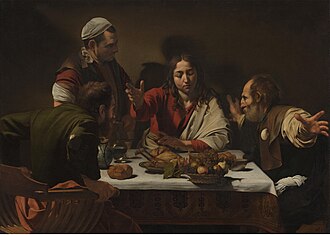 Le Souper à Emmaüs - Caravaggio (1601)
 Méduse - Caravaggio (1597)
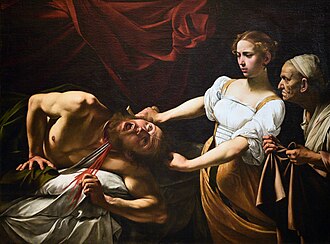 Judith décapitant Holopherne - Caravaggio (1598)
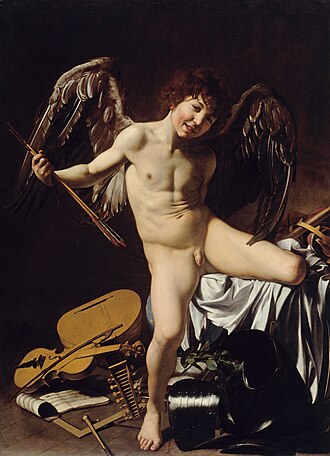 L'Amour victorieux - Caravaggio (1600s)
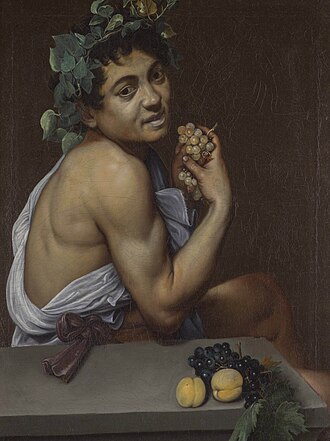 Le Petit Bacchus malade - Caravaggio (1595)
Œuvres d'artistes liés
 Les Ménines - Diego Velázquez (1656)
 La Reddition de Bréda - Diego Velázquez (1635)
 Saint Francis in Meditation - Francisco de Zurbarán (1639)
 The Immaculate Conception - Francisco de Zurbarán (1661)
 Triple portrait de Charles Ier - Anthony van Dyck (1635)
 Charles Ier à cheval avec Monsieur de Saint Antoine - Anthony van Dyck (1636)
 L'Érection de la croix - Peter Paul Rubens (1609)
 L'Enlèvement des filles de Leucippe - Peter Paul Rubens (1618)
 La Ronde de nuit - Rembrandt van Rijn (1642)
 Autoportrait - Rembrandt van Rijn (1659)
 Le Joyeux Buveur - Frans Hals (1620s)
 Le Cavalier riant - Frans Hals (1624)