La Femme au luth
Johannes Vermeer · 1662
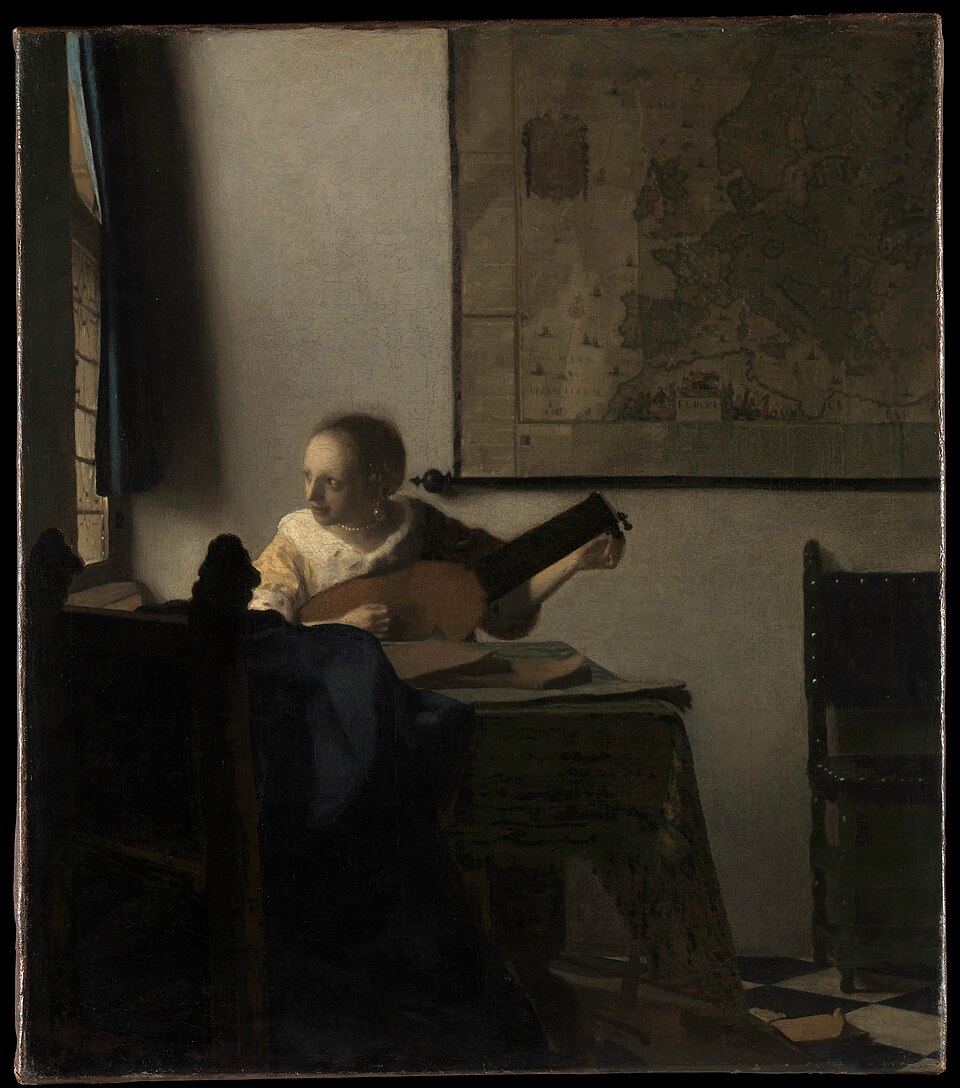
A young woman tunes her lute and looks eagerly toward the window, as if someone is about to arrive. Vermeer turned a moment of waiting into a quiet music of light and shadow.
The story behind the painting
Vermeer painted Woman with a Lute, also called Woman with a Lute Near a Window, around 1662 to 1663; Wikidata gives 1662. It was likely made shortly after Young Woman with a Water Pitcher, and it shares with that painting the framing of the figure within rectangular shapes. The canvas, 51.4 by 45.7 cm, was almost certainly cut from the same bolt of cloth as the one used for Lady Writing a Letter with her Maid. Such small facts let us glimpse the painter's studio, where works grew side by side from the same materials and ideas.
What to look for
A young woman sits by a window, wearing an ermine-trimmed jacket and enormous pearl earrings. She holds a lute and looks eagerly out of the window. In the foreground a viola da gamba lies on the floor, and songbooks flow across the tabletop and down onto the floor. Compared with the Water Pitcher, the tones are more muted, and Vermeer uses shadows and soft contours. Today the objects in the foreground have darkened with age, and the paint surface is worn in the same area, which somewhat weakens the impression of space and atmosphere there.
Meaning and intent
The scene suggests a musical courtship. According to the Metropolitan Museum of Art, the viola da gamba on the floor and the stream of songbooks hint at a duet to come, and the woman seems to be expecting a male visitor. Yet the lute adds another layer: contemporary viewers recognised the tuning of a lute as a symbol of the virtue of temperance. Longing and restraint sit together in the same quiet gesture. The softer shadows, part of a shift in Vermeer's painting in the mid to late 1660s, deepen the feeling of intimacy.
Legacy
The painting was given to the Metropolitan Museum of Art in New York in 1900, through the bequest of the railroad industrialist Collis P. Huntington, and it remains there today. The damage to the foreground reminds us that even Vermeer's carefully balanced pictures change with time. Still, the light falling from the window across her face and the eager turn of her head keep the moment alive. Its close ties to Young Woman with a Water Pitcher, in the same museum, and to Lady Writing a Letter with her Maid, show it as part of a connected group of works.
Le saviez-vous ?
- Painted around 1662-1663.
- The canvas came from the same bolt as Lady Writing a Letter with her Maid.
- Tuning a lute was read as a symbol of temperance.
- Bequeathed to the Metropolitan Museum of Art by Collis P. Huntington in 1900.
À propos de l'artiste
Johannes Vermeer (1632-1675)
femme · scène de genre · Metropolitan Museum of Art · âge d'or de la peinture néerlandaise · fenêtre · musicien ou musicienne · luth · carte géographique
Autres œuvres de Johannes Vermeer
 La Jeune Fille à la perle - Johannes Vermeer (1665)
 La Laitière - Johannes Vermeer (c. 1658)
 Vue de Delft - Johannes Vermeer (1660s)
 L'Astronome - Johannes Vermeer (1664)
 L'Art de la peinture - Johannes Vermeer (1660s)
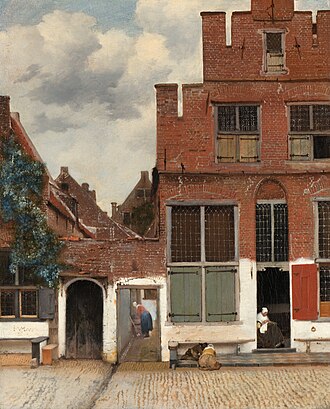 La Ruelle - Johannes Vermeer (1658)
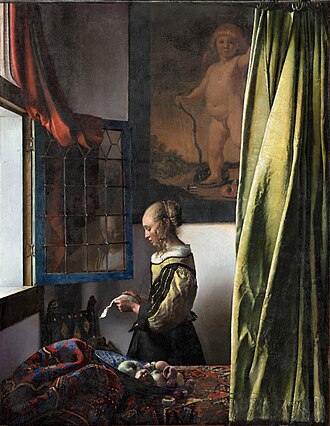 La Liseuse à la fenêtre - Johannes Vermeer (1650s)
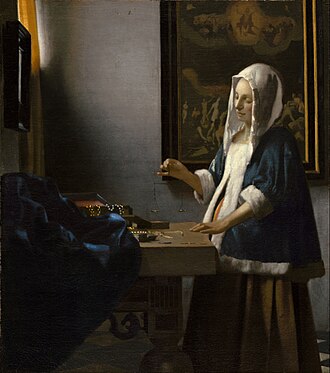 La Femme à la balance - Johannes Vermeer (1665)
Œuvres d'artistes liés
 La Ronde de nuit - Rembrandt van Rijn (1642)
 Autoportrait - Rembrandt van Rijn (1659)
 La Fête de la Saint-Nicolas - Jan Steen (1660s)
 La Mangeuse d'huîtres - Jan Steen (1658)
 Le Joyeux Buveur - Frans Hals (1620s)
 Le Cavalier riant - Frans Hals (1624)
 Le Moulin près de Wijk bij Duurstede - Jacob van Ruisdael (1670)
 Le Cimetière juif - Jacob van Ruisdael (1650s)
 La Cour d'une maison à Delft - Pieter de Hooch (1658)
 La Peleuse de pommes - Pieter de Hooch (1663)