La Femme en bleu lisant une lettre
Johannes Vermeer · 1664
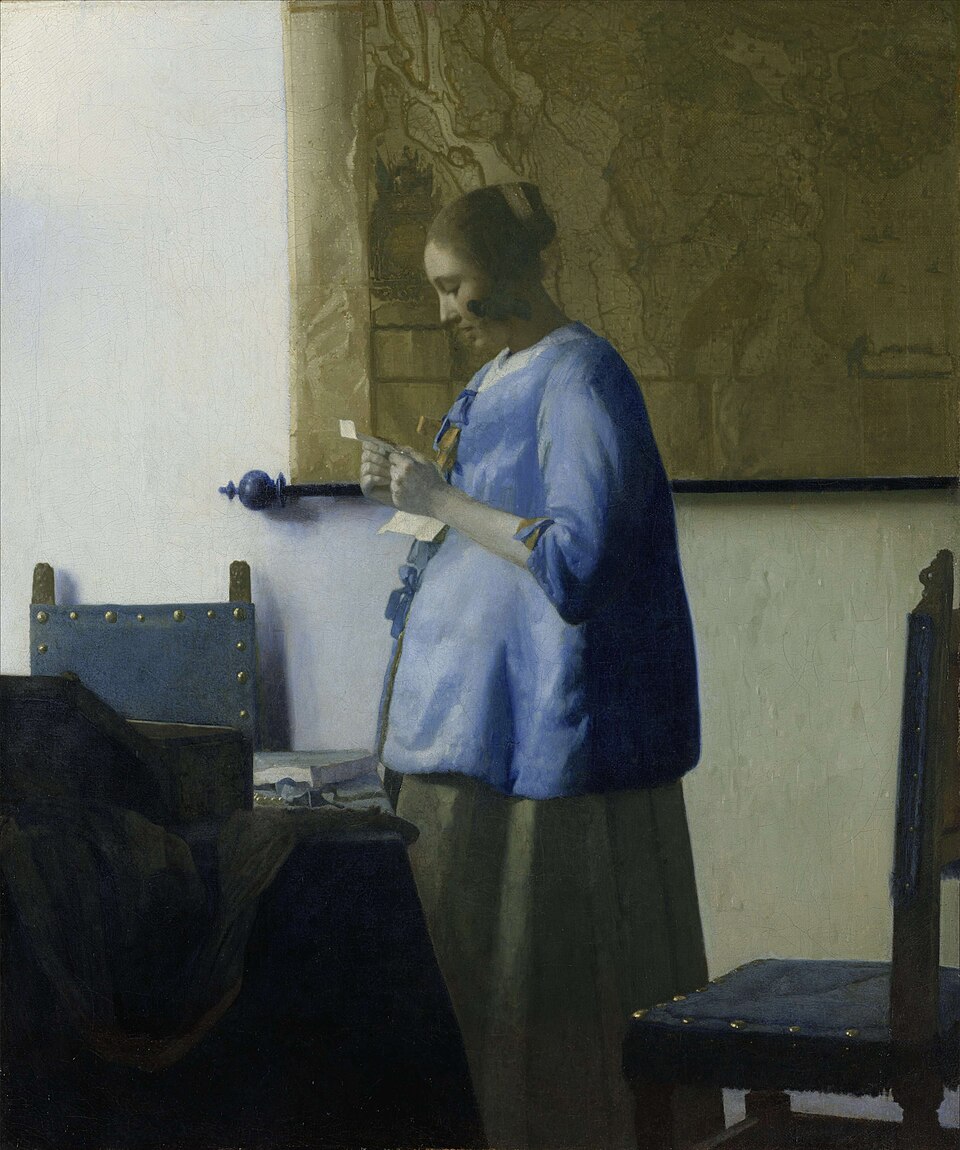
A woman in blue stands absorbed in a letter, the light falling on her from a window we never see. What the letter says, Vermeer keeps to himself.
The story behind the painting
Johannes Vermeer painted Woman in Blue Reading a Letter in the Dutch Golden Age. Wikipedia places it around 1663, while Wikidata gives 1664. It is an intimate canvas, 46.6 by 39.1 centimetres. The picture belongs to a group of works with a close family likeness. Its composition and figure recall Vermeer's earlier Girl Reading a Letter at an Open Window of 1657-59, and it shares much with his similarly dated Woman with a Pearl Necklace and Woman Holding a Balance. Here he returned to a theme that runs through his art: an ordinary private moment, such as reading a letter, that quietly reveals something of the human condition.
What to look for
Let your eye settle on the woman in blue at the centre, standing before a window that lies just outside the picture, the letter held close in both hands. Behind her, a large map spreads across the wall: the County of Holland and West Friesland, drawn by Balthasar Florisz. van Berckenrode, published in 1620 and reprinted by Willem Blaeu in 1621. Vermeer shows it here as a monochrome print. On the table in front of her, a box of pearls is barely visible. Notice, too, what is missing. This painting is unique among Vermeer's interiors in that no fragment of a corner, a floor or a ceiling can be seen, so the room seems to close softly around her.
Meaning and intent
We never see a word of the letter, yet the room offers clues. The map behind her has been interpreted as a hint that the letter comes from a husband who is away travelling. The pearls, sometimes a symbol of vanity, have led others to imagine a lover instead. Her rounded figure has prompted debate as well. She appears to be pregnant, and her loose clothing may suggest it, but many have argued that the shape simply reflects the fashions of the day, and pregnancy was very rarely depicted in art of this period. Vermeer leaves all of these possibilities open, letting a single still moment hold its secret.
Legacy
The painting entered the collection of the City of Amsterdam through the Van der Hoop bequest in 1854. When the Rijksmuseum opened in 1885, it went on view there and became the first Vermeer the museum acquired; Wikidata lists both the Amsterdam Museum and the Rijksmuseum among its holders. The map on its wall has a life of its own. The same map appears, in colour, in Vermeer's Officer and Laughing Girl, and a real monochrome copy survives in the Westfries Museum at Hoorn, proving that Vermeer painted an object that truly existed. Today, visitors to the Rijksmuseum can stand where the light falls and wonder, as people have for centuries, what news she is reading.
Le saviez-vous ?
- Dated c. 1663 by Wikipedia and 1664 by Wikidata
- The only Vermeer interior showing no corner, floor or ceiling
- The wall map of Holland and West Friesland was published in 1620; a monochrome copy survives at the Westfries Museum, Hoorn
- The Rijksmuseum's first Vermeer, on view since 1885; 46.6 × 39.1 cm
À propos de l'artiste
Johannes Vermeer (1632-1675)
femme · scène de genre · âge d'or de la peinture néerlandaise · Rijksmuseum · musée d'Amsterdam · lettre
Autres œuvres de Johannes Vermeer
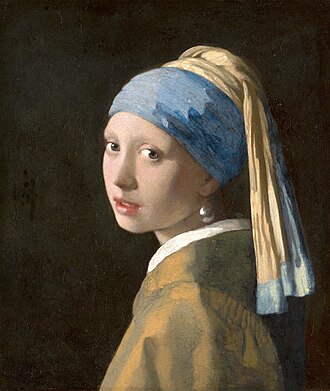 La Jeune Fille à la perle - Johannes Vermeer (1665)
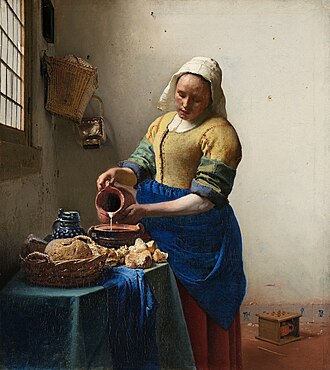 La Laitière - Johannes Vermeer (c. 1658)
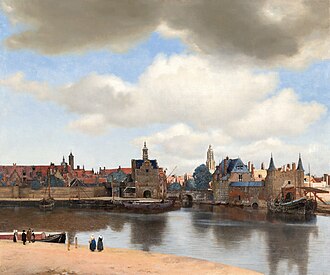 Vue de Delft - Johannes Vermeer (1660s)
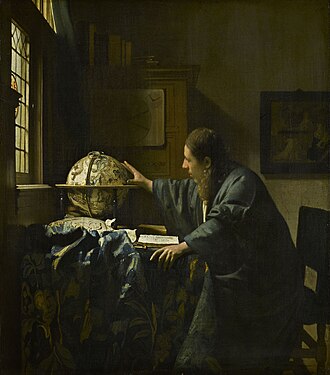 L'Astronome - Johannes Vermeer (1664)
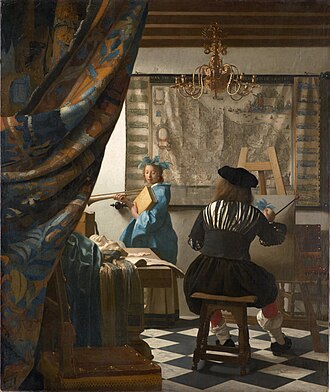 L'Art de la peinture - Johannes Vermeer (1660s)
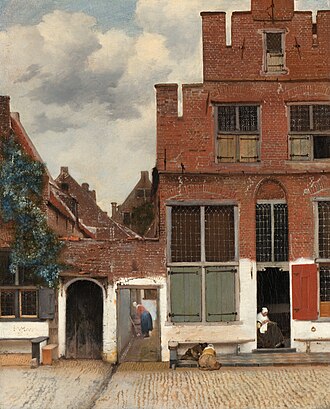 La Ruelle - Johannes Vermeer (1658)
.jpg) La Liseuse à la fenêtre - Johannes Vermeer (1650s)
La Liseuse à la fenêtre - Johannes Vermeer (1650s)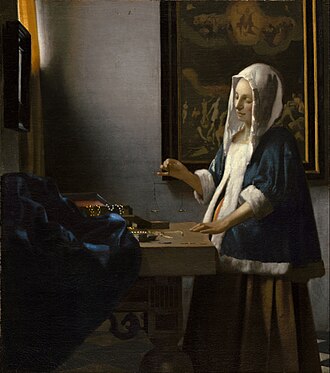 La Femme à la balance - Johannes Vermeer (1665)
Œuvres d'artistes liés
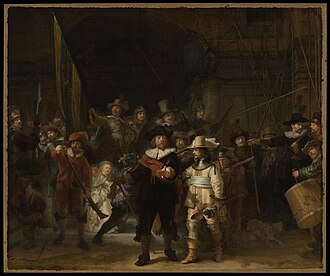 La Ronde de nuit - Rembrandt van Rijn (1642)
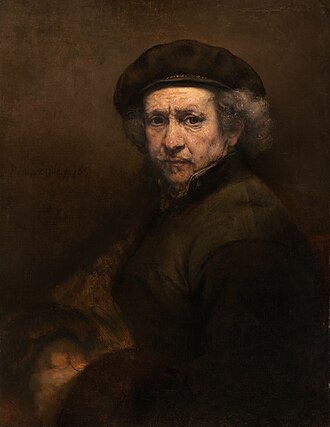 Autoportrait - Rembrandt van Rijn (1659)
 Le Souper à Emmaüs - Caravaggio (1601)
 La Vocation de saint Matthieu - Caravaggio (1609)
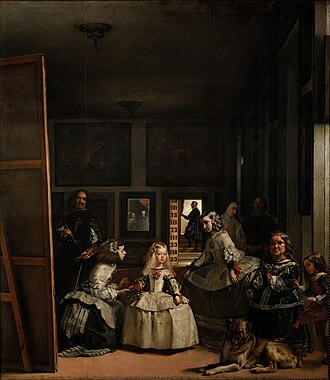 Les Ménines - Diego Velázquez (1656)
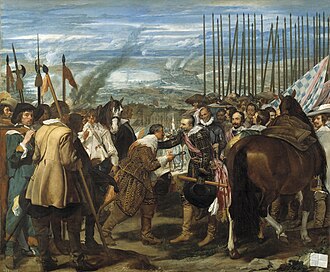 La Reddition de Bréda - Diego Velázquez (1635)