Vierge à l'Enfant avec saint Antoine et un donateur
Hans Memling · 1472
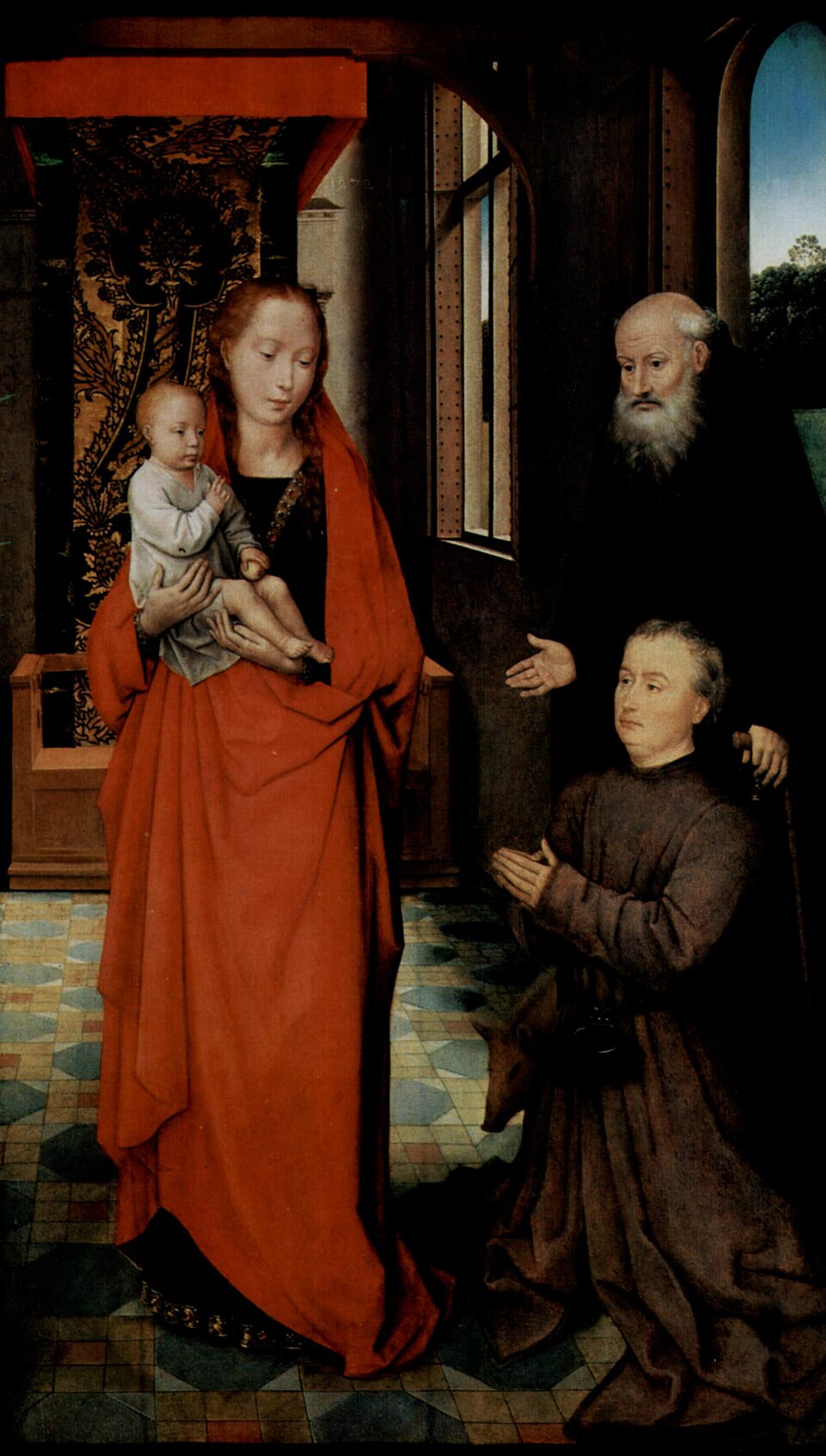
The Virgin has risen from her throne and stepped toward a kneeling man, while Saint Anthony and his pig look on. In 1472, Memling let heaven walk across the room.
The story behind the painting
Hans Memling painted this panel in 1472, quite early in his career, borrowing and reworking themes from Jan van Eyck in particular. Its purpose is unknown. Its shape and composition rule out its belonging to a triptych or diptych, and it may have served as an epitaph or a votive offering, like van Eyck's Virgin of Jan Vos in the Frick Collection. One scholar, Faggin, thinks the date in the background was not added by Memling but copied from a lost original frame.
What to look for
The Virgin stands with the Child before the donor, who kneels in adoration, introduced by Saint Anthony, recognised by the pig at his side. Memling splits the room in two. On the right, a window and an open door lead outside, the world of the donor. On the left, a bench before a fireplace under a brocade canopy forms Mary's throne, the divine world. The light comes from a window at the back, as in van Eyck's Arnolfini Portrait, and the Child's pose comes from van Eyck's Virgin of Chancellor Rolin, slightly turned toward the donor.
Meaning and intent
What makes the picture touching is that Mary has left her throne to come closer to the donor. She stands off the central axis of the canopy, following the diagonals of the floor tiles. It is one of the rare paintings in which the Virgin and the donor are placed asymmetrically. The donor's portrait is built clearly from a torso and a head, and the handling is less smooth than in Memling's early bust portraits.
Legacy
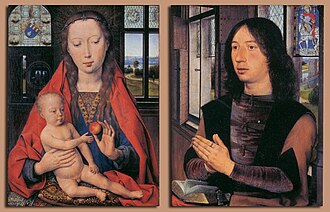
This model is typical of Bruges and rarely found elsewhere, but the panel is an adaptation of an older scheme, not a copy. Memling later took up and expanded the composition in his Diptych of Maarten van Nieuwenhove. The painting may once have belonged to Letizia Bonaparte. It passed to the Earl of Shrewsbury in 1828, to Friedrich Jakob Gsell, then to the Princes of Liechtenstein, from whom the National Gallery of Canada in Ottawa acquired it in 1954.
Le saviez-vous ?
- Painted by Hans Memling in 1472.
- Saint Anthony is recognised by his pig.
- One of the rare works with Virgin and donor placed asymmetrically.
- In the National Gallery of Canada since 1954.
À propos de l'artiste
Hans Memling (1435-1494)
art religieux · Marie · Enfant Jésus · Primitifs flamands · Antoine le Grand
Autres œuvres de Hans Memling
 L'Annonciation - Hans Memling (1480s)
 Scènes de la Passion du Christ - Hans Memling (1470)
 Diptyque de Maarten van Nieuwenhove - Hans Memling (1487)
 Le Mariage mystique de sainte Catherine - Hans Memling (1479)
 Portrait de Maria Portinari - Hans Memling (1470)
 Retable de Santa María la Real de Nájera - Hans Memling (1480s)
 Triptyque Moreel - Hans Memling (1484)
 La Vierge à l'Enfant entre saint Jacques et saint Dominique - Hans Memling (1485)
Œuvres d'artistes liés
 La Descente de Croix - Rogier van der Weyden (1440s)
 Portrait d'une dame - Rogier van der Weyden (1460)
 Les Époux Arnolfini - Jan van Eyck (1434)
 L'Agneau mystique - Jan van Eyck (1432)
 Le Jardin des délices - Hieronymus Bosch
 La Nef des fous - Hieronymus Bosch (1500s)
 Les Chasseurs dans la neige - Pieter Bruegel the Elder (1565)
 Les Proverbes flamands - Pieter Bruegel the Elder (1551)