La Vierge à l'Enfant entre saint Jacques et saint Dominique
Hans Memling · 1485
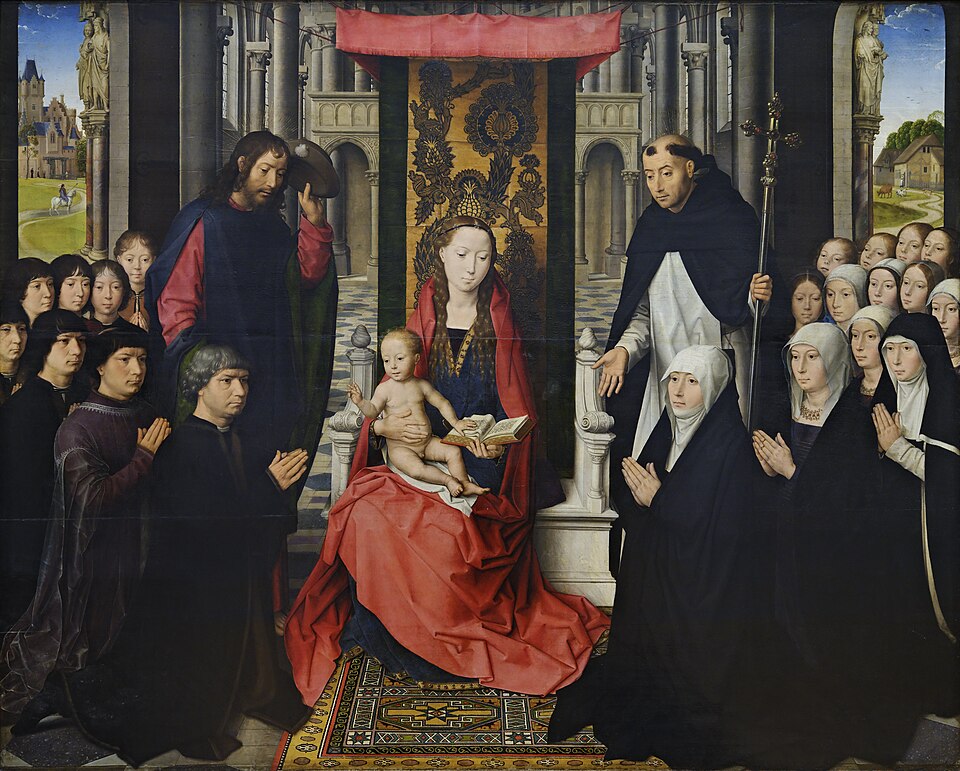
A Bruges spice merchant kneels with his sons on one side, his wife and daughters on the other, all gathered round the Virgin and Child. But his wife already wears a widow's dress: the man who ordered this painting probably never saw it finished.
The story behind the painting
Jacob Floreins, called Jacques Florence in French, was a spice merchant in Bruges who commissioned this panel from Hans Memling for his family chapel. He died in Bruges in 1488. The painting was very probably completed after his death, since his wife is shown dressed as a widow. Wikipedia dates it about 1485 to 1490; Wikidata gives 1485. Saint James was Jacob's name saint, and Saint Dominic was probably chosen because one of his daughters had become a Dominican nun, and she appears in her habit.
What to look for
The Virgin and Child sit at the centre, with Saint James and Saint Dominic presenting the donors and their family, the husband and wife facing each other with their children. The scene is set inside a church, as sometimes in Jan van Eyck's work, but unlike van Eyck, Memling opens it to the outside. The background is divided into three parts: to the left a street and a cityscape, to the right a more rural landscape. The single panel, about 130 by 160 cm, has none of the side wings usual in northern painting of the time.
Meaning and intent
Memling adopted the sacred conversation, a theme then popular in northern Italy but rare in Northern European art, gathering holy figures and a living family into one space. Each saint carries a personal link: James for the father's name, Dominic for the daughter in religious life. The widow's dress turns a family portrait into a memorial, so the painting records both devotion and loss. Its arrangement of husband and wife facing each other with their children has been compared to the Funk family epitaph attributed to Bernhard Strigel, which lacks the saints and the Madonna.
Legacy
The work may have inspired Hans Holbein the Younger's Darmstadt Madonna. It seems to have gone to Spain at the wish of Floreins' Spanish widow, whose family was based in Burgos. In 1808, during the French occupation of Spain, General Jean Barthélemy Darmagnac, stationed in Burgos, looted it. Count Duchâtel acquired it from him, and in 1878 Countess Duchâtel left it to the Louvre, where it hangs today. From a Bruges chapel to Burgos, then to Paris, the family's prayer travelled far from home.
Le saviez-vous ?
- Commissioned by the Bruges spice merchant Jacob Floreins.
- Probably finished after his death in 1488.
- Looted in Burgos in 1808 by General Darmagnac.
- Left to the Louvre in 1878 by Countess Duchâtel.
À propos de l'artiste
Hans Memling (1435-1494)
art religieux · femme · homme · Marie · Enfant Jésus · département des peintures du musée du Louvre · Jésus-Christ · Primitifs flamands · Dominique de Guzmán · Jacques de Zébédée
Autres œuvres de Hans Memling
 L'Annonciation - Hans Memling (1480s)
 Scènes de la Passion du Christ - Hans Memling (1470)
 Diptyque de Maarten van Nieuwenhove - Hans Memling (1487)
 Le Mariage mystique de sainte Catherine - Hans Memling (1479)
 Portrait de Maria Portinari - Hans Memling (1470)
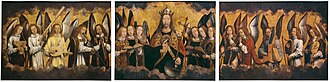 Retable de Santa María la Real de Nájera - Hans Memling (1480s)
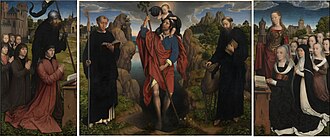 Triptyque Moreel - Hans Memling (1484)
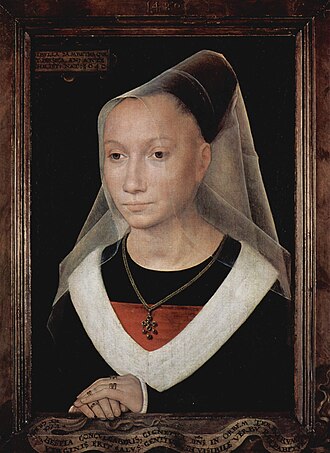 Sibylle Sambetha - Hans Memling (1480)
Œuvres d'artistes liés
 La Descente de Croix - Rogier van der Weyden (1440s)
 Portrait d'une dame - Rogier van der Weyden (1460)
 Les Époux Arnolfini - Jan van Eyck (1434)
 L'Agneau mystique - Jan van Eyck (1432)
 Le Jardin des délices - Hieronymus Bosch
 La Nef des fous - Hieronymus Bosch (1500s)
 Les Chasseurs dans la neige - Pieter Bruegel the Elder (1565)
 Les Proverbes flamands - Pieter Bruegel the Elder (1551)