Vierge et enfant avec sainte Catherine d'Alexandrie et Barbara
Hans Memling · 1479
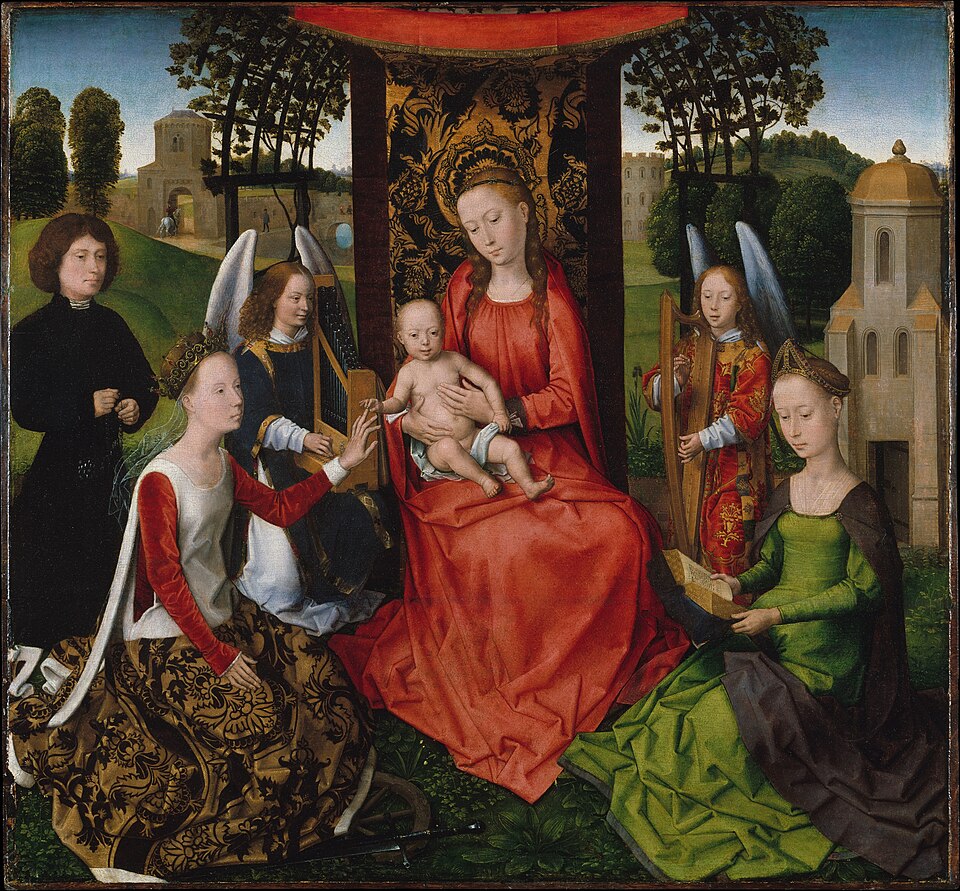
In a garden under a brocade canopy, the Christ Child slips a ring onto Saint Catherine's finger. Memling paints the moment with perfect calm, as if heaven never hurries.
The story behind the painting
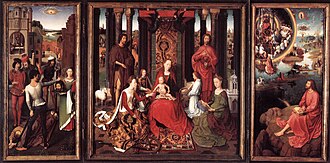
Hans Memling painted this oil on oak panel around 1480, a date that tree ring analysis makes probable. It is also called The Mystic Marriage of St. Catherine. The composition is almost an exact replica of the central panel of his St John Altarpiece, but where the altarpiece shows the two Saints John, here a single donor stands to the left. Nothing is known about him beyond the prayer beads in his hands, and the painting's original purpose is unknown.
What to look for
Mary sits beneath a rich brocade canopy with the Child in her lap. An angel to the left plays a portable organ, another to the right a harp. Saint Catherine kneels at left, crowned, in a white tabard, red velvet sleeves and patterned brocade, her wheel and sword peeking from her ermine-lined skirt as she holds out her hand for the ring. Opposite, Saint Barbara reads, before her tower shaped like a monstrance with three windows for the Trinity. The iris in the garden is Mary's emblem. The grape arbor overhead was added later.
Meaning and intent
The garden mixes three traditions: the enclosed garden, a sign of the Virgin's purity, the sacred conversation, and the Virgo inter Virgines, which always pairs Mary with virgin saints, almost always Catherine and Barbara. James Snyder notes that, typically for Memling, the drama of the moment is not reflected in the faces. Ainsworth describes his female type: graceful oval faces, wide eyes, narrow chins and gentle acceptance. In 1910 James Weale suggested Catherine may be an early portrait of Mary of Burgundy and Barbara of Margaret of York.
Legacy
Technical study shows that the grape arbor differs from Memling's hand in pigment and brushwork and is absent from the underdrawing. An early 16th century copy in Florence has a similar motif, so it was probably added during his lifetime or soon after, perhaps at the donor's request, as grapes signified the blood of Christ, a theme especially meaningful in Bruges. The panel is now in the Metropolitan Museum of Art, New York. Wikipedia dates it about 1480, while Wikidata gives 1479.
Le saviez-vous ?
- Oil on oak, around 1480.
- Almost a replica of the central panel of Memling's St John Altarpiece.
- The grape arbor was added later by another hand.
- Now in the Metropolitan Museum of Art, New York.
À propos de l'artiste
Hans Memling (1435-1494)
art religieux · homme · Marie · Enfant Jésus · Metropolitan Museum of Art · Primitifs flamands · Vierge à l'Enfant · Catherine d'Alexandrie · lecture · instrument de musique · Barbe la grande martyre
Autres œuvres de Hans Memling
 L'Annonciation - Hans Memling (1480s)
 Scènes de la Passion du Christ - Hans Memling (1470)
 Diptyque de Maarten van Nieuwenhove - Hans Memling (1487)
 Le Mariage mystique de sainte Catherine - Hans Memling (1479)
 Portrait de Maria Portinari - Hans Memling (1470)
 Retable de Santa María la Real de Nájera - Hans Memling (1480s)
 Triptyque Moreel - Hans Memling (1484)
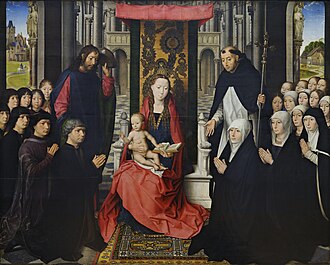 La Vierge à l'Enfant entre saint Jacques et saint Dominique - Hans Memling (1485)
Œuvres d'artistes liés
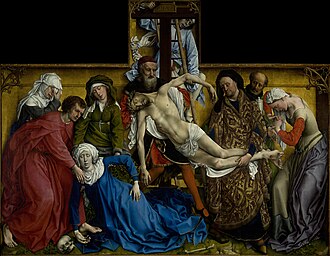 La Descente de Croix - Rogier van der Weyden (1440s)
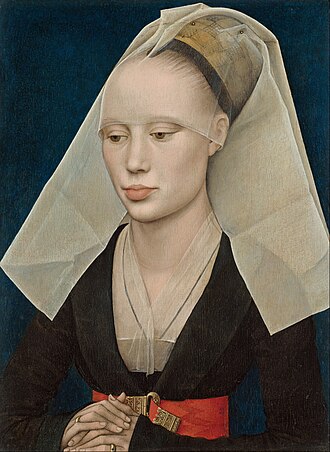 Portrait d'une dame - Rogier van der Weyden (1460)
 Les Époux Arnolfini - Jan van Eyck (1434)
 L'Agneau mystique - Jan van Eyck (1432)
 Le Jardin des délices - Hieronymus Bosch
 La Nef des fous - Hieronymus Bosch (1500s)
 Les Chasseurs dans la neige - Pieter Bruegel the Elder (1565)
 Les Proverbes flamands - Pieter Bruegel the Elder (1551)