Les Trois Âges de l'Homme
Titien · 1510s
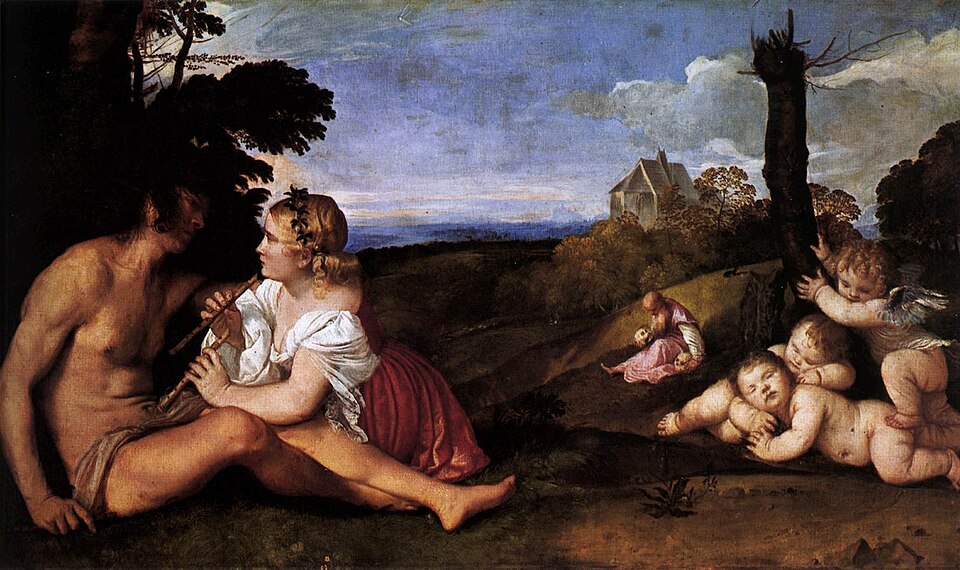
Babies asleep under a tree, two young lovers on bright grass, an old man brooding over skulls. In one pastoral landscape Titian laid out a whole human life, and the brief sweetness of love inside it.
The story behind the painting
The Three Ages of Man is one of Titian's most famous works, about 90 by 151 cm, now in the Scottish National Gallery in Edinburgh. Wikipedia dates it between 1512 and 1514, Wikidata to the 1510s. Giorgio Vasari wrote that Titian painted it after returning to Venice, for the father-in-law of the gem engraver Giovanni Bernardi at Faenza, a commission dated to 1515. Critics place it slightly earlier, because the three sleeping putti on the right seem modelled on Romanino's Santa Giustina altarpiece of 1513. The young Titian was deeply marked by Giorgione's landscapes and nudes, and was known to have finished some of Giorgione's works after Giorgione died of the plague in 1510, aged 33.
What to look for
Read the picture from right to left. On the right Cupid clambers playfully over two sleeping putti: infancy. On the far left, nearest to us, young lovers are about to embrace, sitting on the healthiest, most vibrant grass in the landscape. In the middle distance an old man, looking much like the penitent Saint Jerome, contemplates a pair of skulls, perhaps of former lovers. A church rises in the background. X-rays show many changes of mind, even by Titian's standards: the woman's head first turned slightly toward us before he set her in pure profile, absorbed in her lover, and more skulls once surrounded the old man before he painted them out.
Meaning and intent
The gallery calls the painting a poetic meditation on the transience of human life and love, set in a pastoral landscape, in tune with Italian poetry of the time. Titian breaks the chronological order on purpose. By placing the lovers furthest left and closest to the viewer, he lifts them out as the most perfect phase of life, still on flat ground, not yet begun on their inevitable descent toward the foot of the hill where the old man sits. The art historian Judith Dundas saw the old man as an image of old age, loss and the vanity of earthly existence. The church may remind viewers of the Christian promise of salvation and eternal life.
Legacy
The painting travelled far. From Bernardi it passed to Cardinal Otto Truchsess von Waldburg, then to Matthaus Hopfer in Augsburg and the Ebert family. The first firm record dates from 1662, in the collection of Queen Christina of Sweden in Rome; Joachim von Sandrart says she bought it in Augsburg from a Herr von Waldburg. Prince Livio Odescalchi acquired it in 1692, Philippe II, Duke of Orleans in 1720, and it stayed in the Orleans Collection until 1798, when it went to Francis Egerton, 3rd Duke of Bridgewater, whose descendants placed the collection with the National Gallery of Scotland. Several copies exist, notably one attributed to Sassoferrato in Rome's Doria Pamphilj Gallery.
Le saviez-vous ?
- Dated 1512 to 1514 by Wikipedia; Vasari's account points to 1515.
- X-rays reveal many changes, including painted-over skulls.
- Once owned by Queen Christina of Sweden and the Orleans Collection.
- Now in the Scottish National Gallery, Edinburgh.
À propos de l'artiste
Titien (1488-1576)
Haute Renaissance · École vénitienne · allégorie · Galeries nationales d'Écosse
Autres œuvres de Titien
.jpg) Vénus d'Urbin - Titian (1538)
Vénus d'Urbin - Titian (1538)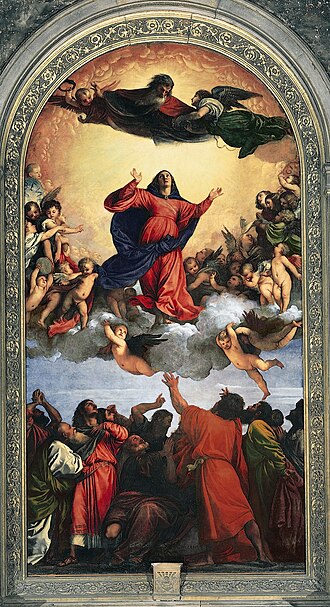 L'Assomption de la Vierge - Titian (1510s)
FXD.jpg) Amour sacré et Amour profane - Titian (1510s)
Amour sacré et Amour profane - Titian (1510s)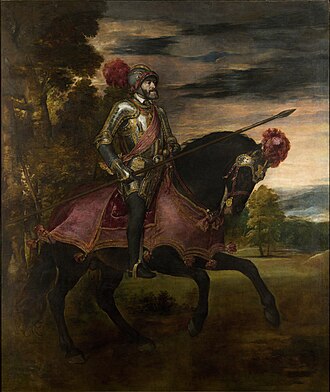 Charles Quint à cheval à Mühlberg - Titian (1548)
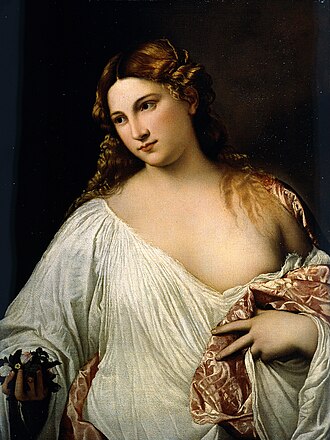 Flore - Titian (1517)
 Allégorie du Temps gouverné par la Prudence - Titian (1550)
 Bacchus et Ariane - Titian (1520s)
%20nave%20left%20-%20Altar%20of%20Madona%20di%20Ca'Pesaro.jpg) Madonna di Ca' Pesaro - Titian
Madonna di Ca' Pesaro - Titian