La Mer de glace
Caspar David Friedrich · 1820s
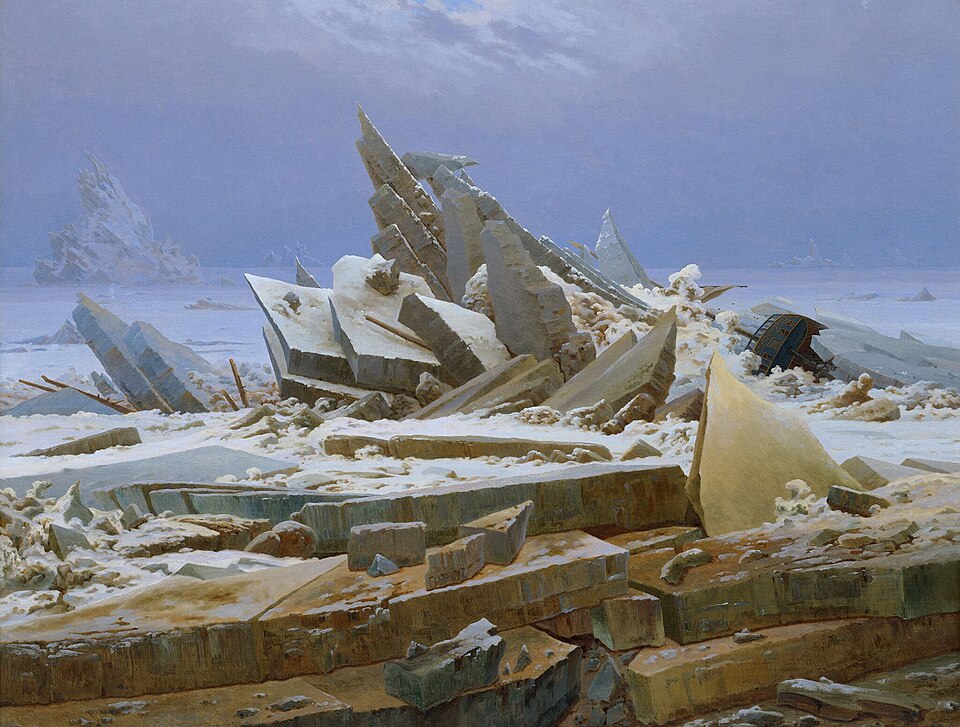
Slabs of ice rise like a broken staircase toward a jagged tower, and only when you look closely do you find the wreck of a ship almost swallowed by it. Caspar David Friedrich painted an Arctic he had never seen, and made it unforgettable.
The story behind the painting
The Sea of Ice began with a commission. The collector Johann Gottlob von Quandt wanted two pictures, one of southern and one of northern nature. Johann Martin von Rohden took the south; the north, in its terrifying beauty, fell to Friedrich. In a letter of 1821 the poet Vasily Zhukovsky reported that Friedrich himself did not yet know what he would paint, and waited for inspiration that sometimes came in a dream. Friedrich, born in Greifswald in 1774 and settled in Dresden, had never been to the Arctic. Accounts of polar expeditions were circulating, probably including William Edward Parry's search for the Northwest Passage, and in the winter of 1820-21 he made oil studies of ice floes on the river Elbe near Dresden. Wikipedia dates the painting to 1823-1824; Wikidata gives simply the 1820s.
What to look for
Begin in the foreground, where flat plates of ice lie stacked on one another, so regular that they almost read as steps leading you into the picture. Let your eye climb them toward the back, where much larger blocks have been crushed together into a towering, pointed mass. The scale of that ice suggests that something terrible has happened here. Now search beside the great tower for a tiny detail that is easy to miss: the wreck of a ship, half buried and dwarfed by what surrounds it. Friedrich does not make the wreck the subject. He lets the ice speak first, and the human disaster only whispers. The canvas measures about 97 by 127 centimetres.
Meaning and intent
Many read the wreck as a statement that nature will always prove stronger than people, and that the ice is a place of death for anyone who intrudes. Scholars have also linked the picture to Friedrich's childhood: in December 1787 his brother Johann Christoffer fell through ice and died, and some speculate that this loss shaped the work. Another theory sees a comment on Germany, frozen politically like the trapped ship. Comparisons are often made with Théodore Géricault's The Raft of the Medusa, but Friedrich's vision is bleaker, blaming human pride in trying to master nature. Critics still debate whether the painting belongs to the sublime, that mix of horror and pleasure, since the shards of ice are dangerous and yet beautiful.
Legacy
The radical composition met with incomprehension. It was first shown at the Prague Academy exhibition of 1824, and the painting remained unsold when Friedrich died in 1840. Its titles shifted over time, from The Polar Sea to the estate catalogue's Ice Picture, and it was sometimes confused with a lost work called The Wreck of Hope. Visiting Dresden in 1834, the sculptor David d'Angers was deeply impressed. Today it is counted among Friedrich's masterpieces and hangs in the Hamburger Kunsthalle. Critic Russell Potter calls it a key example of the Arctic Sublime; it inspired Paul Nash's Totes Meer of 1941, and Monica Bonvicini's floating sculpture She Lies, installed in the Oslo fjord in 2010, reinterprets it in three dimensions.
Le saviez-vous ?
- Commissioned by the collector Johann Gottlob von Quandt as an image of northern nature.
- Friedrich made oil studies of ice floes on the Elbe in the winter of 1820-21.
- First exhibited in Prague in 1824; still unsold when Friedrich died in 1840.
- Held by the Hamburger Kunsthalle; about 96.7 × 126.9 cm.
Autres œuvres de Caspar David Friedrich
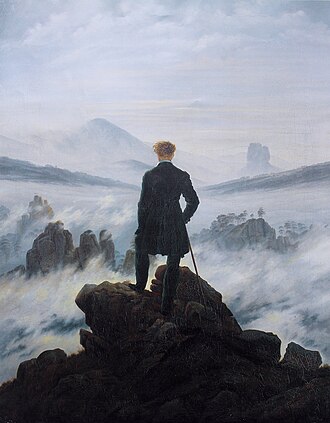 Le Voyageur contemplant une mer de nuages - Caspar David Friedrich (c. 1818)
 L'Abbaye dans une forêt de chênes - Caspar David Friedrich (1800s)
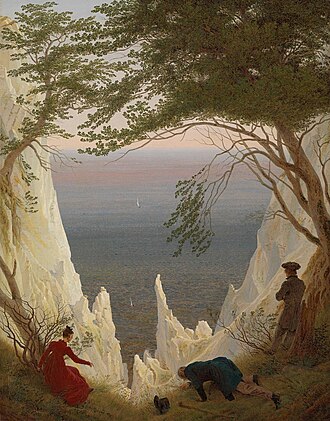 Falaises de craie sur l'île de Rügen - Caspar David Friedrich (1818)
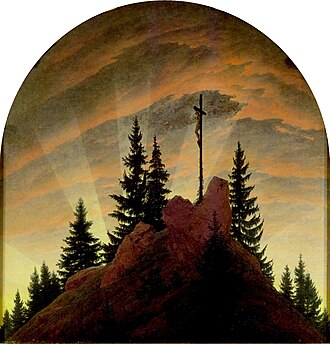 Le Retable de Tetschen - Caspar David Friedrich (1807)
Œuvres d'artistes liés
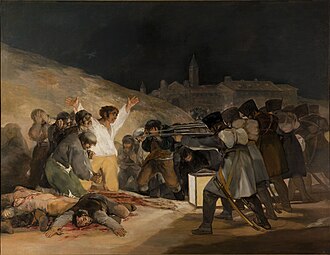 Tres de Mayo - Francisco Goya (1814)
.jpg) La Maja nue - Francisco Goya (1800)
La Maja nue - Francisco Goya (1800)