Le Retable de Tetschen
Caspar David Friedrich · 1807
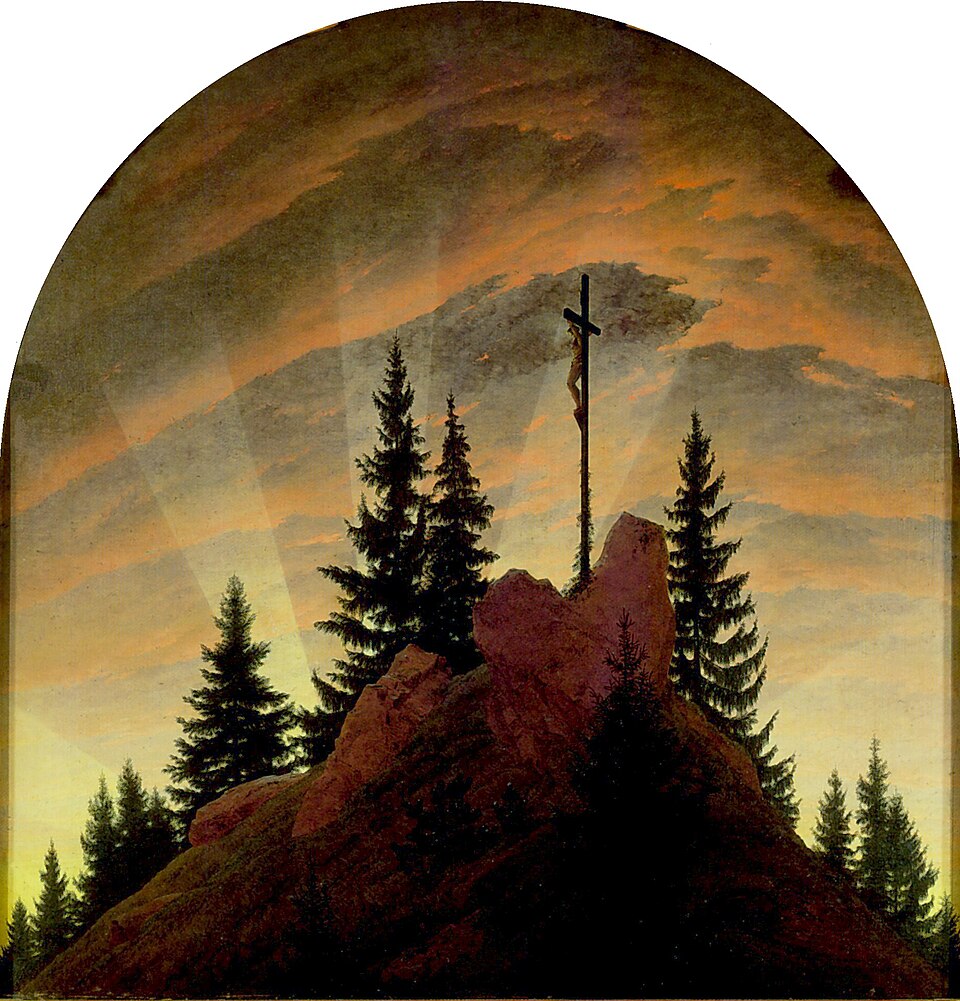
A golden cross stands on a mountain peak against a setting or rising sun. With this altarpiece Friedrich dared to make landscape carry a sacred message, and set off one of the great art quarrels of German Romanticism.
The story behind the painting
Cross in the Mountains, also called the Tetschen Altar, is among Caspar David Friedrich's first major works. Wikipedia dates it 1808, while Wikidata gives 1807. For decades the accepted story, from Friedrich's friend August Otto Ruhle von Lilienstern, was that Countess Theresia von Thun-Hohenstein commissioned it for her family chapel in Tetschen, Bohemia, after seeing a similar sepia drawing. Research in 1977 found instead that Friedrich had conceived the painting before the commission and meant to dedicate it to King Gustav IV Adolf of Sweden, a plan that ended when the king was deposed in 1808. The countess's mother objected to the format, and the picture hung in the countess's bedroom rather than the chapel.
What to look for
A gilded crucifix, Christ seen in profile, rises from a rock on the summit among fir trees. The cross reaches the highest point of the picture but is shown obliquely and from far away, and with no foreground the scene feels distant and very high. Light comes from behind, darkening the mountain; five stylised rays climb the sky, one glinting on Christ like metal. Ivy grows at the foot of the cross. The critic Ramdohr noted that every twig, every fir needle and every spot on the cliff is exact. The frame, designed by Friedrich and carved by Christian Gottlieb Kuhn, shows the Eye of God, wheat and vine, Gothic columns, palm branches and five angels.
Meaning and intent
In the hierarchy of genres, religious painting stood highest, so using landscape to carry a spiritual message was controversial. The art historian Linda Siegel suggests a mystical light besides the sun must be present. Because of the planned dedication, Norbert Wolf called the work first of all political propaganda, taking up the liberation ideology of the Swedish monarchy, whose symbol may be the midnight sun. Koerner and Wolf argue that once that allegory lapsed, the reading shifted easily to a purely religious one, in line with the Romantic search for a direct, inward union with God.
Legacy
On Christmas Day 1808 Friedrich showed the work in his studio, lowering the lights and placing it on a table covered in black cloth to recall a chapel. It was coldly received but became his first widely publicised painting. The critic Basilius von Ramdohr attacked it, writing that it was presumption when landscape tried to slink into the church and creep onto the altars. The quarrel, called the Ramdohrstreit, grew into a debate between Enlightenment taste and the new Romanticism. The altar stayed at Tetschen Castle from 1809 to 1921 and is now in the Staatliche Kunstsammlungen Dresden.
Le saviez-vous ?
- Also known as the Tetschen Altar.
- Dated 1808 by Wikipedia and 1807 by Wikidata.
- Its frame was designed by Friedrich himself.
- It provoked the Ramdohrstreit, a public debate about Romantic art.
paysage · peinture mythologique · arbre · Jésus-Christ · ciel · nuage · Collections d'Art d'État de Dresde
Autres œuvres de Caspar David Friedrich
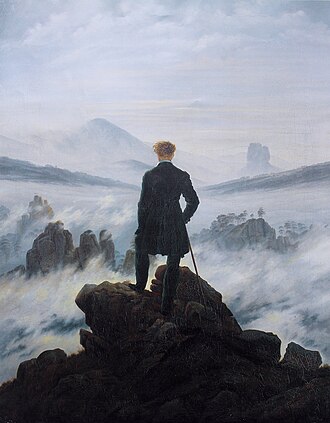 Le Voyageur contemplant une mer de nuages - Caspar David Friedrich (c. 1818)
 L'Abbaye dans une forêt de chênes - Caspar David Friedrich (1800s)
 La Mer de glace - Caspar David Friedrich (1820s)
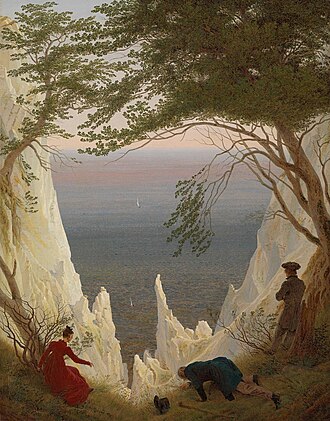 Falaises de craie sur l'île de Rügen - Caspar David Friedrich (1818)
Œuvres d'artistes liés
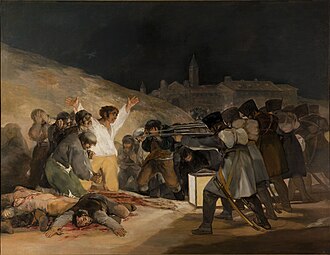 Tres de Mayo - Francisco Goya (1814)
.jpg) La Maja nue - Francisco Goya (1800)
La Maja nue - Francisco Goya (1800)