La Dentellière
Johannes Vermeer · 1669
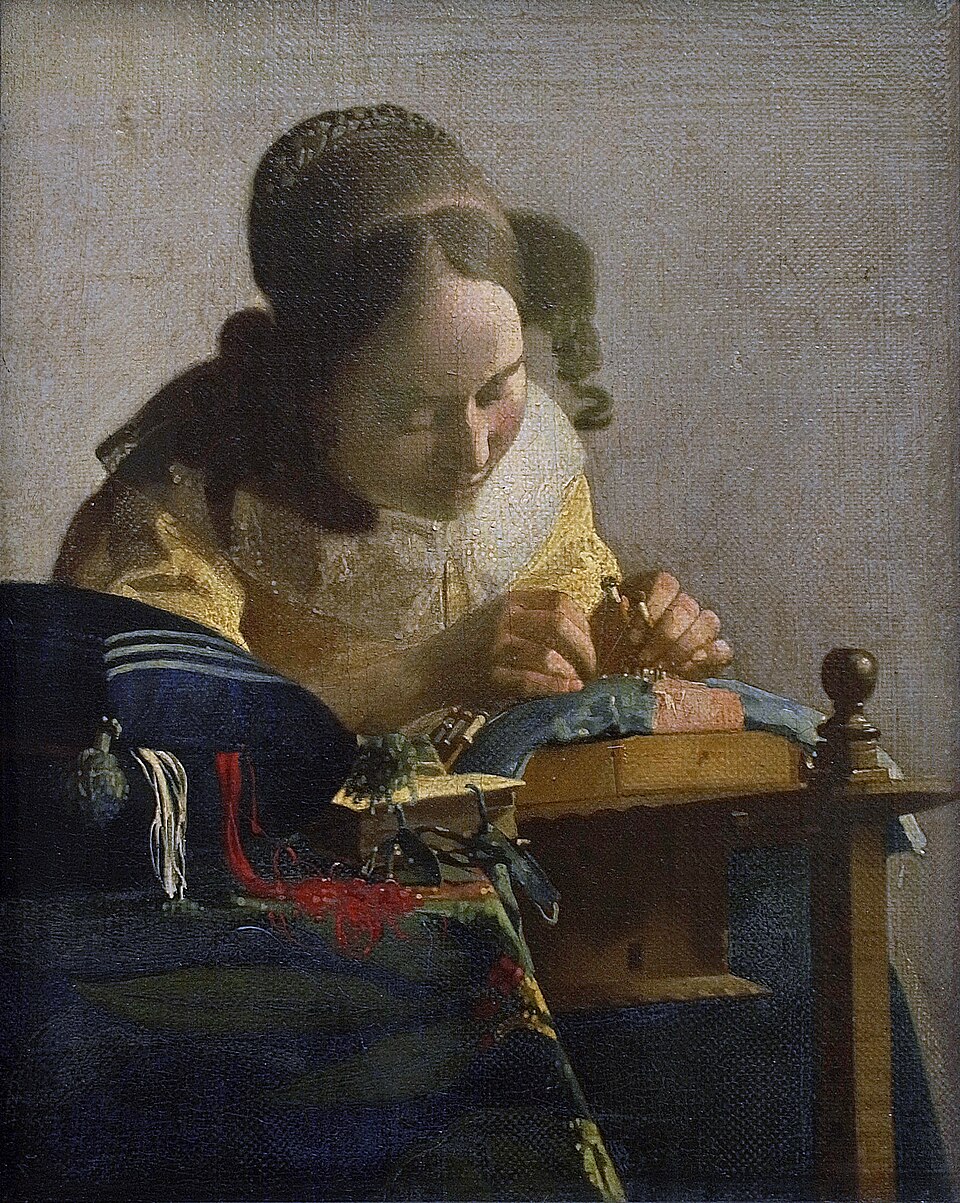
A young woman in a yellow bodice bends over her lace pillow, placing a single pin. It is the smallest painting Vermeer ever made, and one of the most absorbing: everything in it pulls you toward her hands.
The story behind the painting
Vermeer completed The Lacemaker around 1669 to 1670, and it is now in the Louvre in Paris. At 24.5 by 21 cm it is the smallest of all his paintings, described by one author as one of his most abstract and unusual. The canvas was cut from the same bolt as the one used for A Young Woman Seated at the Virginals, and the two paintings seem to have had identical dimensions originally. As with The Astronomer of 1668 and The Geographer of 1669, Vermeer probably studied his subject carefully before he painted it: the craft of lacemaking is shown closely and accurately.
What to look for
The young woman holds a pair of bobbins in her left hand while she carefully sets a pin in the pillow on which she makes her bobbin lace. She sits against a blank wall, probably so that nothing distracts from her. Look at the foreground: it is blurred, one of the optical effects typical of projection that make some believe Vermeer used a camera obscura. By leaving parts of the canvas out of focus he suggests depth of field, unusual for Dutch painting of the time but common in his interiors. Red and white threads spill from the sewing cushion in an almost liquid way, in sharp contrast with the precise lace she is working on.
Meaning and intent
The picture is about concentration. Everything is stripped back so that a tiny, exact gesture can fill the whole canvas, and the soft, nearly liquid threads in front make her careful work seem even more precise. The art historian Lawrence Gowing saw it as the complete achievement of Vermeer's maturity, writing that there is only one Lacemaker and that we cannot imagine another. The painting is often compared to a 1662 canvas by the Dutch portrait and genre painter Caspar Netscher, which shares its contemplative tone.
Legacy
The Lacemaker has fascinated later artists. Salvador Dali admired Vermeer and painted his own version of The Lacemaker in 1955, probably on commission for Robert Lehman. Around the same time he also made The Paranoiac-Critical Study of Vermeer's Lacemaker, turning the quiet Dutch interior into a subject for his own experiments. That a painting just 24.5 by 21 cm could hold the attention of a twentieth century Surrealist says a great deal about its power. Today it hangs in the Louvre, where its small size asks visitors to come close, much as the lacemaker leans close to her work.
Le saviez-vous ?
- Painted around 1669 to 1670.
- At 24.5 by 21 cm, the smallest of Vermeer's paintings.
- Its canvas came from the same bolt as A Young Woman Seated at the Virginals.
- Salvador Dali painted his own version in 1955.
À propos de l'artiste
Johannes Vermeer (1632-1675)
scène de genre · département des peintures du musée du Louvre · âge d'or de la peinture néerlandaise
Autres œuvres de Johannes Vermeer
 La Jeune Fille à la perle - Johannes Vermeer (1665)
 La Laitière - Johannes Vermeer (c. 1658)
 Vue de Delft - Johannes Vermeer (1660s)
 L'Astronome - Johannes Vermeer (1664)
 L'Art de la peinture - Johannes Vermeer (1660s)
 La Ruelle - Johannes Vermeer (1658)
 La Liseuse à la fenêtre - Johannes Vermeer (1650s)
 La Femme à la balance - Johannes Vermeer (1665)
Œuvres d'artistes liés
 La Ronde de nuit - Rembrandt van Rijn (1642)
 Autoportrait - Rembrandt van Rijn (1659)
 La Fête de la Saint-Nicolas - Jan Steen (1660s)
 La Mangeuse d'huîtres - Jan Steen (1658)
 Le Joyeux Buveur - Frans Hals (1620s)
 Le Cavalier riant - Frans Hals (1624)
 Le Moulin près de Wijk bij Duurstede - Jacob van Ruisdael (1670)
 Le Cimetière juif - Jacob van Ruisdael (1650s)
 La Cour d'une maison à Delft - Pieter de Hooch (1658)
 La Peleuse de pommes - Pieter de Hooch (1663)