La Sainte Famille
Paul Véronèse · 1570s
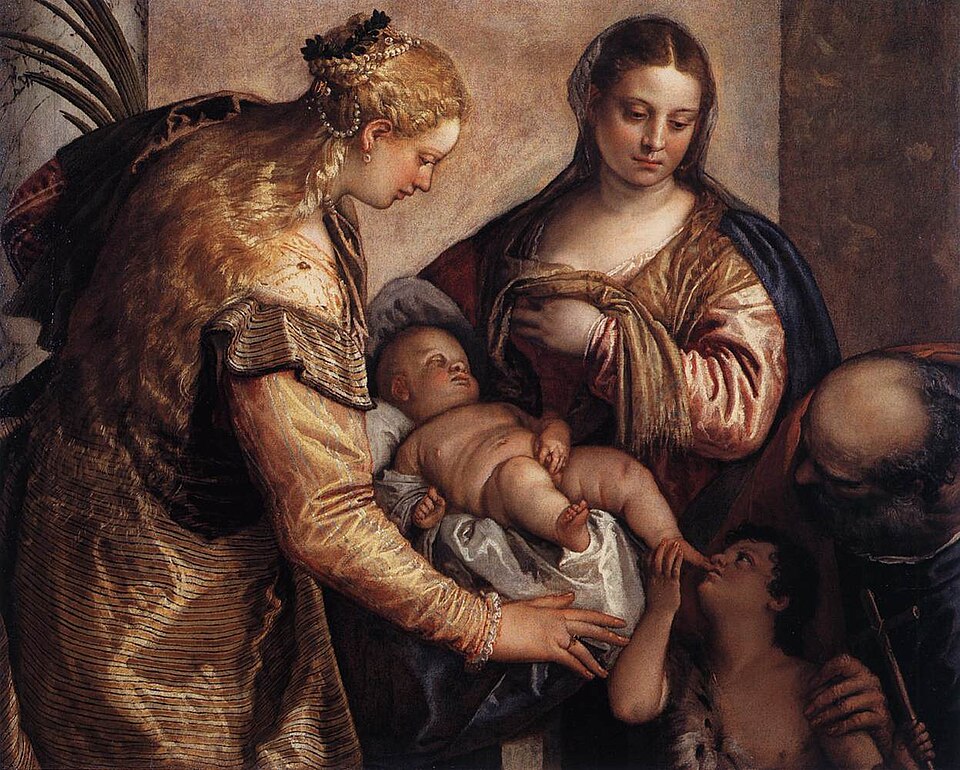
A young saint dressed like a princess kneels beside the sleeping Christ Child while the little John the Baptist kisses his foot. Even the name of that saint, and the date of the painting, are still debated.
The story behind the painting
No record survives of who commissioned this oil on canvas by Paolo Veronese. The scholar Martinelli suggests the Barbaro family of Venice, whose patron saint was Catherine of Alexandria and who had already ordered other works from the painter. The date is debated too. Some place it in Veronese's early period, but most scholars put it in his late one, influenced by Tintoretto, around 1562 to 1565, according to Wikipedia. Wikidata gives the 1570s. The canvas measures about 86 by 122 cm. Early copies survive, including one on parchment by Carlo Loth and one by Gian Antonio Guardi.
What to look for
The figures stand against a neutral background, broken only by the edge of a wall. On the right, Mary offers her sleeping son to the homage of a female saint in the foreground, dressed like a princess and holding a martyr's palm. The child John the Baptist kisses the baby's foot, while Joseph bends over him and rests a hand on his shoulder, a fatherly gesture. Look at how the poses lean along a diagonal, at the weight and texture of the fabrics, the highlights in the saint's blond hair and the care of her hairstyle, and at the play of light and shadow across the group.
Meaning and intent
The female saint has few attributes, so who she is remains open. Early sources name Catherine of Alexandria, the martyred princess of Egypt. Her gesture supports this: she holds out her hand with a ring on her finger, as if the mystic marriage of Saint Catherine, a classic subject, has just taken place. Later studies have suggested instead that she is Saint Barbara. Either way, the scene is intimate rather than grand: a quiet act of homage around a sleeping child, with a family drawn close together, and the princess and the young Baptist kneeling in devotion.
Legacy
The painting was recorded in Venice in 1648, in the house of the Windmann family from Carinthia near the church of San Canciano. In 1654 Paolo del Sera, the Venetian agent of Cardinal Carlo de' Medici, sold it to the cardinal. After his death, Cardinal Leopoldo de' Medici acquired it, and it passed from him to its present home, the Uffizi in Florence. A third early copy of almost the same size, in the Baltimore Museum of Art, may be by Veronese himself. Conservation before the 1988 exhibition The Art of Paolo Veronese removed an old yellowed repaint.
Le saviez-vous ?
- No record survives of who commissioned the painting.
- The female saint may be Catherine of Alexandria or Saint Barbara.
- Dated around 1562 to 1565 by most scholars; Wikidata gives the 1570s.
- Once owned by the Medici, now in the Uffizi, Florence.
À propos de l'artiste
Paul Véronèse (1528-1588)
art religieux · femme · Marie · Enfant Jésus · garçon · maniérisme · galerie des Offices · petit saint Jean · Barbe la grande martyre
Autres œuvres de Paul Véronèse
 Les Noces de Cana - Paolo Veronese (1560s)
 Le Repas chez Levi - Paolo Veronese (1573)
 Vénus et Adonis - Paolo Veronese (1580)
 Allégorie du Vice et de la Vertu - Paolo Veronese (1565)
 Vénus et Mars - Paolo Veronese (1570s)
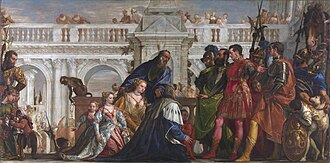 La Famille de Darius devant Alexandre - Paolo Veronese (1565)
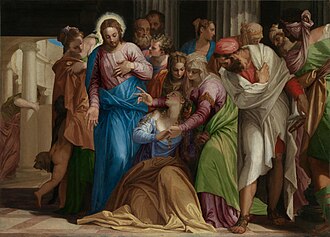 The Conversion of Mary Magdalene - Paolo Veronese (1548)
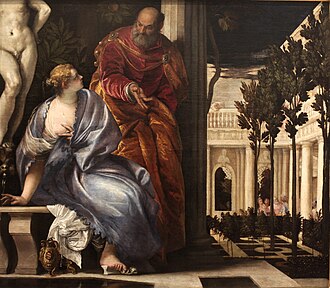 Bethsabée au bain - Paolo Veronese (1575)
Œuvres d'artistes liés
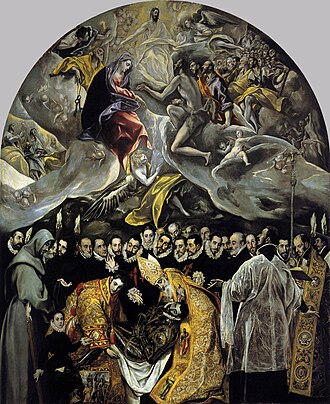 L'Enterrement du comte d'Orgaz - El Greco (1586)
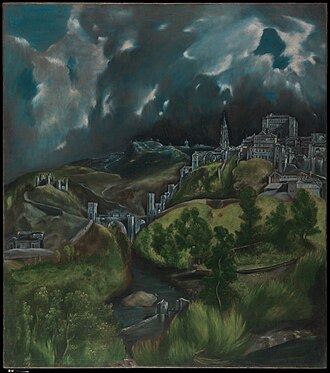 Vue de Tolède - El Greco (1596)
 La Cène - Jacopo Tintoretto (1563)
 Miracle de l'esclave - Jacopo Tintoretto (1540s)
 Vénus d'Urbin - Titian (1538)
 L'Assomption de la Vierge - Titian (1510s)
 Le Souper à Emmaüs - Caravaggio (1601)
 La Vocation de saint Matthieu - Caravaggio (1609)
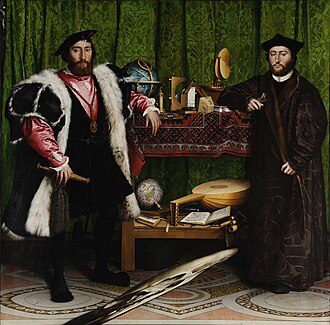 Les Ambassadeurs - Hans Holbein the Younger (1533)
 Le Christ mort - Hans Holbein the Younger (1520s)