Le Reniement de saint Pierre
Caravaggio · 1610
.jpg)
A maid points, a soldier looms, and Peter lifts his hands to his chest: not me. This may be one of the last two paintings Caravaggio ever made, probably finished in Naples in the summer of 1610.
The story behind the painting
The painting is generally thought to be one of Caravaggio's last two works, the other being The Martyrdom of Saint Ursula, and was probably finished in Naples in the summer of 1610. The date rests on style and composition. In October 1609 Caravaggio had been attacked at the Osteria del Cerriglio in Naples, and it seems he never fully recovered; the broad brushwork and unfocused quality of this picture have been linked to that. By 1613 it was in Rome, where the painter Guido Reni accepted it in settlement of a debt, described as a painting by the late Michelangelo da Caravaggio showing the denial of Saint Peter with a maid.
What to look for
Three half-length figures fill the canvas, closely cropped and surrounded by deep shadow. On one side a soldier in a helmet, in the middle a maid pointing, and Peter turned towards them with his hands at his chest. Caravaggio smothers large areas in darkness, which avoids awkward depictions of bodies and concentrates everything on faces and gestures. The brushwork is broad and loose, quite unlike his earlier polished surfaces. Look at the helmet: a very similar one appears in Battistello Caracciolo's Liberation of Saint Peter of 1615 in Naples. The canvas measures about 94 by 125.4 cm.
Meaning and intent
In the Gospels, after Jesus was arrested, Peter followed him into the courtyard of the high priest. There he was accused three times of being a disciple, and three times he denied it, fulfilling Christ's prophecy that he would deny him before the cock crowed. Caravaggio does not show a crowd or a fire, only the accusation and the lie, at close range. The article notes the psychological intensity typical of his late work. The maid's pointing finger and Peter's defensive hands make a small human drama of fear and betrayal, painted by a man who, it seems, never fully recovered from his own wounds.
Legacy
Artists in Rome soon knew the picture: José de Ribera and Lionello Spada made works based on it. It later belonged to Cardinal Paolo Savelli and his heirs. A Denial of Saint Peter by Caravaggio was also recorded in the Certosa di San Martino in Naples, praised by Bernardo de' Dominici as a miracle of art; whether it is the same work is not known, and Bellori described a version with figures warming themselves at a fire, so a second version may be unaccounted for. After the Second World War the present canvas was bought in Naples as an anonymous work, attributed to Caravaggio by Roberto Longhi after restoration in 1959 to 1964, and entered the Metropolitan Museum of Art in 1997.
Le saviez-vous ?
- Probably finished in Naples in summer 1610.
- Considered one of Caravaggio's last two paintings.
- Rediscovered as an anonymous work after the Second World War.
- In the Metropolitan Museum of Art since 1997.
À propos de l'artiste
Caravaggio (1571-1610)
art religieux · femme · homme · Metropolitan Museum of Art · baroque · Pierre · soldat
Autres œuvres de Caravaggio
 Le Souper à Emmaüs - Caravaggio (1601)
 La Vocation de saint Matthieu - Caravaggio (1609)
 La Décollation de saint Jean-Baptiste - Caravaggio (1608)
 Le Souper à Emmaüs - Caravaggio (1601)
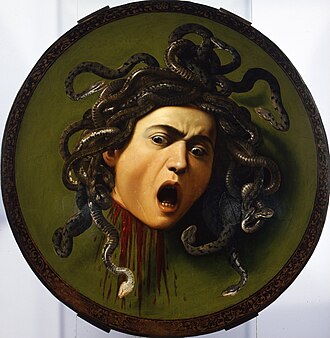 Méduse - Caravaggio (1597)
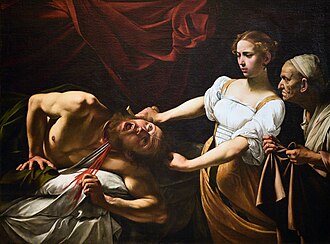 Judith décapitant Holopherne - Caravaggio (1598)
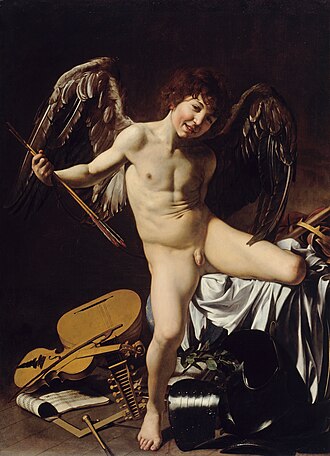 L'Amour victorieux - Caravaggio (1600s)
%2C%201595%20circa%2C%20534.jpg) Le Petit Bacchus malade - Caravaggio (1595)
Le Petit Bacchus malade - Caravaggio (1595)
Œuvres d'artistes liés
 Les Ménines - Diego Velázquez (1656)
 La Reddition de Bréda - Diego Velázquez (1635)
 La Ronde de nuit - Rembrandt van Rijn (1642)
 Autoportrait - Rembrandt van Rijn (1659)
 La Jeune Fille à la perle - Johannes Vermeer (1665)
 La Laitière - Johannes Vermeer (c. 1658)