Portrait de Gilles Joye
Hans Memling · 1472

A canon with folded hands, painted so close that he almost fills the frame. Memling dated it 1472 on the original marbled frame and noted the sitter's age, 47. The man was Gilles Joye, a famous singer and composer at the court of Philip the Good.
The story behind the painting
This panel is the first portrait by Memling whose date is certain, and its original frame survives. The sitter, Gilles Joye (1425 to 1483), became a canon of the chapter of Saint Donatian in 1459, then served as clerk and chaplain of Philip the Good's musical chapel. He was a celebrated singer and composer, living in Bruges when the portrait was painted. His youth had been turbulent and undisciplined, and he spent large sums having music copied and buying manuscripts, including two precious graduals. His identity was only rediscovered in 1960 by Frans van Molle, from an old inscription on the back of the panel.
What to look for
The framing is extremely tight compared with Memling's portraits of Tommaso Portinari and his wife. Look at the careful fur collar, the hair and the wrinkles around the eyes, typical of Memling's precision, with lead white placed exactly for modelling over an underdrawing. A coat of arms on the left of the frame also appears on Joye's second ring and on his tombstone. On the right of the frame, not on the back as usual, are his motto and emblem: a coin press inside a little chain linking the letters IOIE. Painted letters imitating metal read ANNO DOMINI 1472 above and ETATIS SVE 47 below. The paint layer is damaged, which softens the modelling.
Meaning and intent
Joye's praying hands suggest a second panel showing the Virgin, but the original frame shows no trace of hinges, and experts are divided. The trompe l'oeil lettering recalls Jan van Eyck's Portrait of Jan de Leeuw, and both may have served as commemorative monuments, which would explain their timeless air. Van Molle noted that the composer was ill when the portrait was painted, and illness may have prompted the commission of an epitaph.
Legacy
On 16 April 1919 the panel was sold in London as a picture after van Eyck, in the sale of the H. Hawley collection. The same year Sterling Clark bought it from Colnaghi in London. It was restored by William Suhr in 1959 and is now at the Clark Art Institute in Williamstown. Wikidata gives its size as 37.6 by 29.1 cm. The inscription on the back that revealed his name had travelled with the panel all along, unread. Today the canon, his rings, his coat of arms and his motto can be seen together again, frame and painting as Memling made them.
Le saviez-vous ?
- Memling's first securely dated portrait, 1472, in its original frame.
- The sitter was 47, as the painted frame inscription says.
- Identified only in 1960, from an inscription on the back.
- Sold in 1919 as a work after van Eyck; now at the Clark Art Institute.
À propos de l'artiste
Hans Memling (1435-1494)
portrait · homme · Primitifs flamands · Clark Art Institute
Autres œuvres de Hans Memling
 L'Annonciation - Hans Memling (1480s)
 Scènes de la Passion du Christ - Hans Memling (1470)
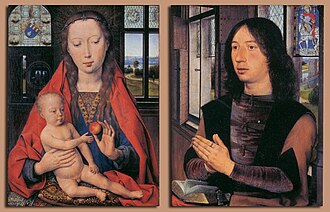 Diptyque de Maarten van Nieuwenhove - Hans Memling (1487)
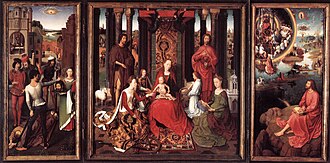 Le Mariage mystique de sainte Catherine - Hans Memling (1479)
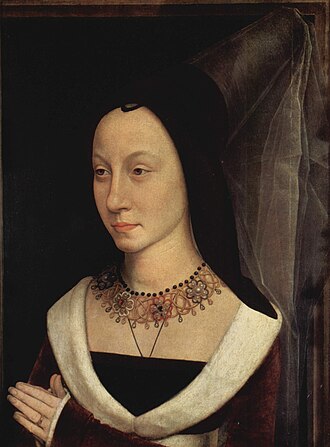 Portrait de Maria Portinari - Hans Memling (1470)
 Retable de Santa María la Real de Nájera - Hans Memling (1480s)
 Triptyque Moreel - Hans Memling (1484)
 La Vierge à l'Enfant entre saint Jacques et saint Dominique - Hans Memling (1485)
Œuvres d'artistes liés
 La Descente de Croix - Rogier van der Weyden (1440s)
 Portrait d'une dame - Rogier van der Weyden (1460)
 Les Époux Arnolfini - Jan van Eyck (1434)
 L'Agneau mystique - Jan van Eyck (1432)
 Le Jardin des délices - Hieronymus Bosch
 La Nef des fous - Hieronymus Bosch (1500s)
 Les Chasseurs dans la neige - Pieter Bruegel the Elder (1565)
 Les Proverbes flamands - Pieter Bruegel the Elder (1551)