La Bien-Aimée ou La Mariée
Dante Gabriel Rossetti · 1865
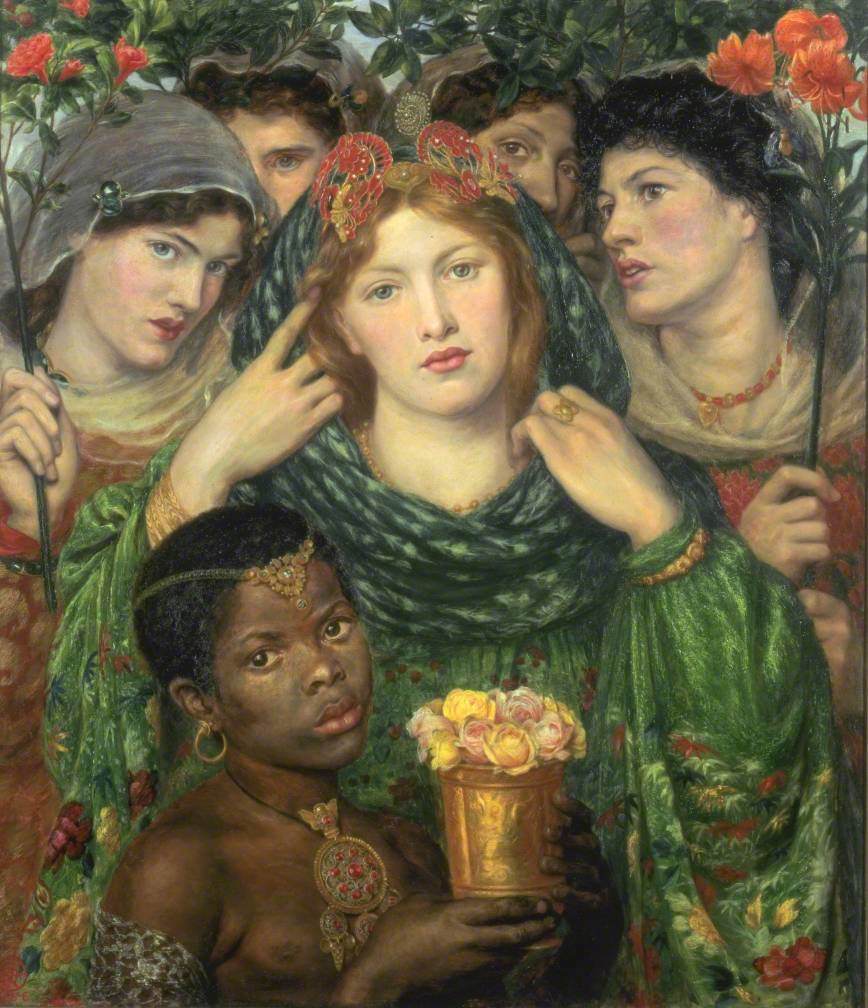
A red-haired bride lifts her veil, surrounded by attendants and a page holding a vase. Rossetti began her as Dante's Beatrice and ended with the bride of the Song of Solomon.
The story behind the painting
The painting was commissioned in 1863 by Rossetti's regular patron, the Birkenhead banker George Rae. The composition was already broadly set, but the subject was meant to be Dante's Beatrice. After a month or two in the summer of 1863 Rossetti switched to the Song of Solomon, apparently because the complexion of his model, Marie Ford, was too bright for his idea of Beatrice. Work went slowly. In November 1864 he visited Edouard Manet's studio in Paris, where he may have seen Olympia in progress. He signed the canvas 1865-6, and it was first shown for a single day at the Arundel Club on 21 February 1866.
What to look for
The bride, caught as she moves back her veil, is surrounded by four bridesmaids and an African page. His dark skin contrasts with her red hair and pale skin, and with the varied hair and skin tones of the bridesmaids, a contrast carefully painted as a frame around her face. In March 1865 Rossetti painted a Japanese dress over the main figure and replaced a girl in the page's role with a boy, preferring his darker skin. The critic F. G. Stephens praised the colour but noted the page's hands looked unnatural on the vase, and that his necklace does not lie flat but turns to show its pattern.
Meaning and intent
The picture fits Rossetti's series of bust-length oil paintings of beautiful women, his main output from 1859 to about 1867, a deliberate turn towards flesh painting and colour after the dense narrative scenes of his Pre-Raphaelite years. Unlike those single tightly framed figures, this one is a group. It is generally agreed that he set out to show a range of skin colours, but how the figures are identified and interpreted varies greatly. Scholars suggest debts to Manet's Olympia, where a white nude contrasts with a black maid, and to Titian, especially his Allegory of Marriage in the Louvre.
Legacy
Stephens described the painting in the Athenaeum on 21 October 1865, but he and Rossetti were close, and Rossetti probably saw the text first; Stephens sometimes let him write such pieces himself. In 1873 Rossetti took the canvas back and altered it considerably, changing the tone and making the heads of the bride and the woman to her right, and the bride's hands, more ideal. A photograph of the earlier state survives. The 1911 Encyclopaedia Britannica biography, by Stephens and Theodore Watts-Dunton, praised its brilliance and splendour of lighting. The painting is now in Tate Britain, London.
Le saviez-vous ?
- Commissioned in 1863 by the banker George Rae.
- First planned as Dante's Beatrice, then changed to the Song of Solomon.
- Dated 1865-6 on the canvas and reworked in 1873.
- Tate Britain, London.
À propos de l'artiste
Dante Gabriel Rossetti (1828-1882)
National Gallery · préraphaélisme · Tate
Autres œuvres de Dante Gabriel Rossetti
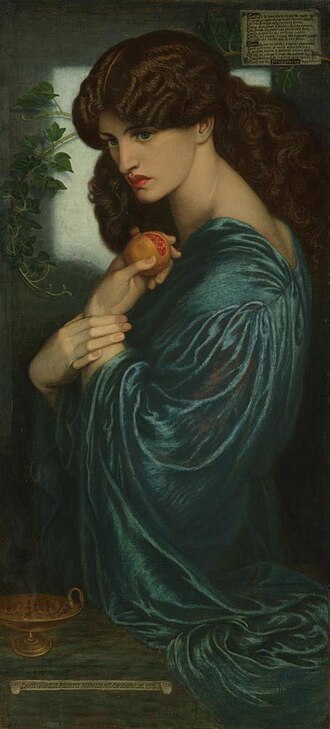 Perséphone - Dante Gabriel Rossetti (1874)
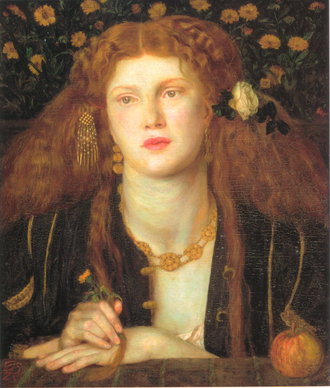 Bocca Baciata - Dante Gabriel Rossetti (1859)
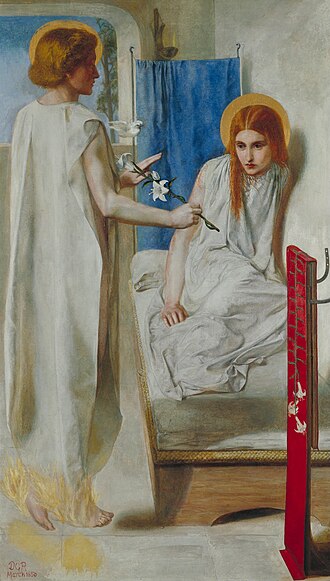 Ecce Ancilla Domini - Dante Gabriel Rossetti (1850)
.jpg) Le Rêve de Dante - Dante Gabriel Rossetti (1871)
Le Rêve de Dante - Dante Gabriel Rossetti (1871)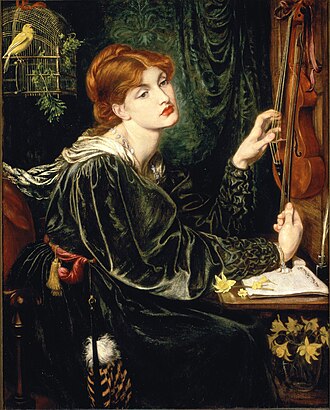 Veronica Veronese - Dante Gabriel Rossetti (1872)
.jpg) Monna Rosa - Dante Gabriel Rossetti (1867)
Monna Rosa - Dante Gabriel Rossetti (1867)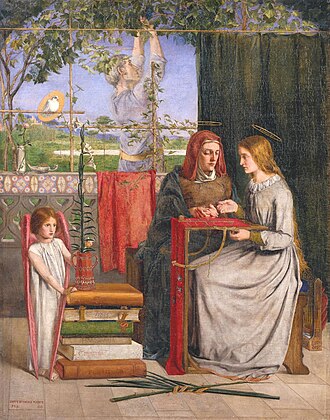 L’Enfance de la Vierge Marie - Dante Gabriel Rossetti (1840s)
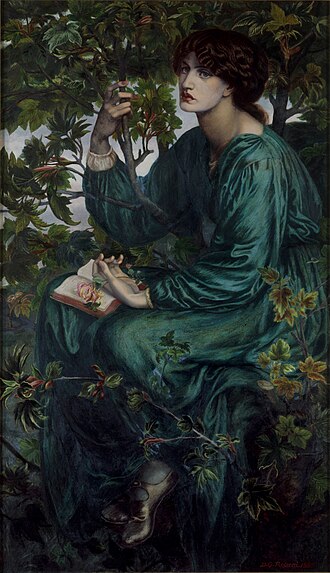 The Day Dream - Dante Gabriel Rossetti (1880)
Œuvres d'artistes liés
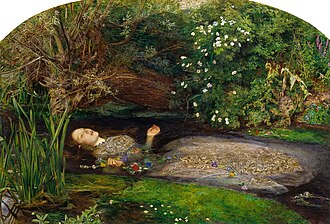 Ophélie - John Everett Millais (1851)
%20-%20Google%20Art%20Project.jpg) Le Christ dans la maison de ses parents - John Everett Millais (1849)
Le Christ dans la maison de ses parents - John Everett Millais (1849) Hylas et les nymphes - John William Waterhouse (1896)
.jpg) The Lady of Shalott - John William Waterhouse (1888)
The Lady of Shalott - John William Waterhouse (1888)