Banquet des officiers du corps des archers de Saint-George, Haarlem 1616
Frans Hals · 1616
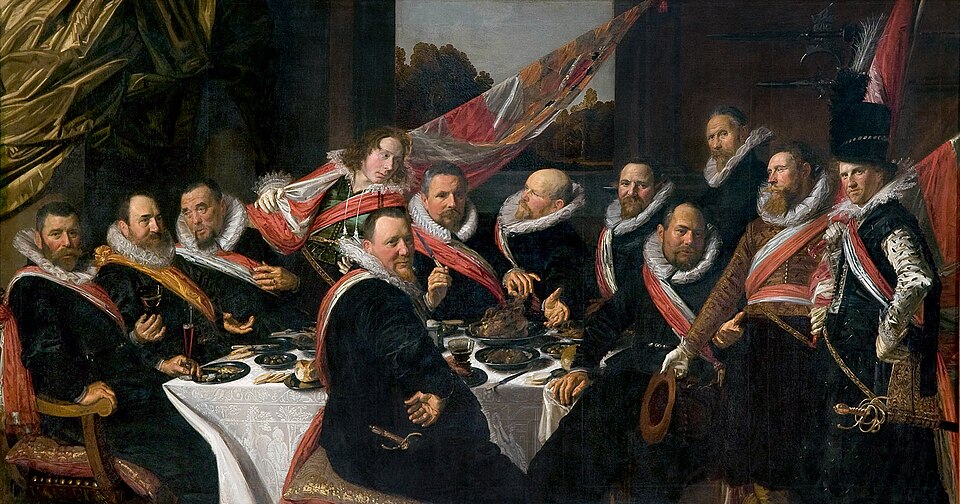
Frans Hals was in his thirties and not yet an established portraitist when he painted these officers at table. The picture won him commission after commission, and the militia called him back twice.
The story behind the painting
This is the first of five large militia group portraits, or schutterstukken, by Frans Hals, made for the St George civic guard of Haarlem in 1616. Hals had himself been a member of that militia from 1612 to 1615. Officers were chosen by the town council for three years, and this group had just finished its term and marked it with a portrait. The painting may have been made on site: Hals lived in the Peuzelaarsteeg, very close to the guard's headquarters, and a canvas this size, about 175 by 324 cm, would have been hard to handle in his studio. As official restorer for the city, he had probably already worked there.
What to look for
The man with the orange sash, Colonel Hendrick van Berckenrode, heads the table, with his second in command on his right. The three ensigns stand, Jacob Cornelisz Schout holding the flag, and a servant at the back carries a plate. In front of the table sit Captain Nicolaes Woutersz van der Meer and Lieutenant Pieter Adriaensz Verbeek. Look past the faces too: the painting shows off a Haarlem damask tablecloth, brocade cushions on the chairs and halberds hanging on the wall. In one canvas Hals displays portraiture, still life and landscape.
Meaning and intent
Hals had models in Cornelis Cornelisz van Haarlem, who painted the town's militia companies in 1583 and 1599. But Cornelis's figures, set evenly in a large square composition, look stiff and formal. Hals chose a horizontal format that gives the group a believable space in which to talk and relax naturally. He makes the hierarchy of the company readable while giving each man a distinct portrait of his own. The result is less a row of officials than a party caught in motion.
Legacy
The painting was a huge success. Hals won more portrait commissions from the sitters and their relatives, and painted this militia again in 1627 and 1639. It stayed in its original building after it became an inn, so visitors to Haarlem kept seeing it; the inn appears on Romeyn de Hooghe's 1688 map of the town, its gate topped by Saint George slaying the dragon. Today it is one of the main attractions of the Frans Hals Museum. It also hangs on the restaurant wall in Peter Greenaway's 1989 film The Cook, the Thief, His Wife and Her Lover.
Le saviez-vous ?
- The first of Hals' five large militia group portraits.
- Hals was a member of this militia from 1612 to 1615.
- He painted the same company again in 1627 and 1639.
- Frans Hals Museum, Haarlem.
À propos de l'artiste
Frans Hals (1591-1666)
Autres œuvres de Frans Hals
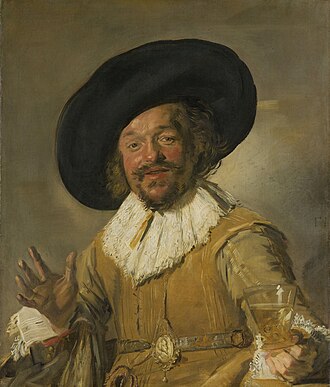 Le Joyeux Buveur - Frans Hals (1620s)
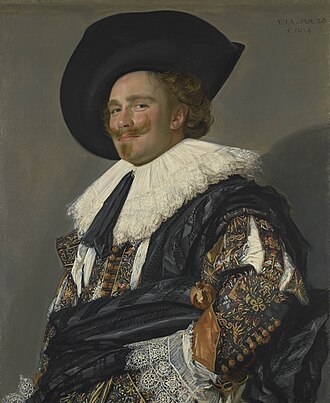 Le Cavalier riant - Frans Hals (1624)
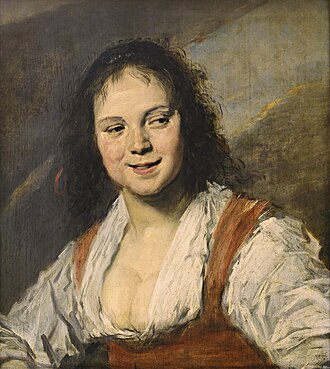 La Bohémienne - Frans Hals (1628)
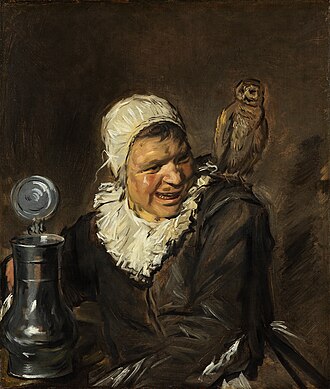 Malle Babbe - Frans Hals (1640s)
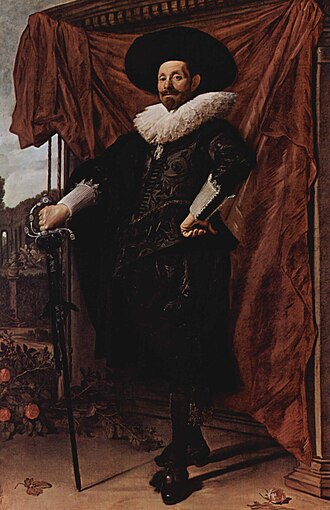 Portrait de Willem van Heythuysen - Frans Hals (1625)
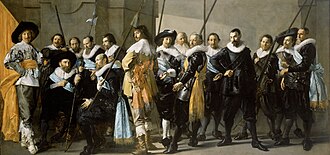 La Compagnie du capitaine Reinier Reael, dite ‘La Maigre Compagnie’ - Frans Hals (1630s)
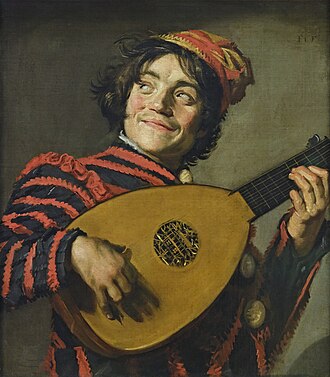 Le Bouffon au luth - Frans Hals (1623)
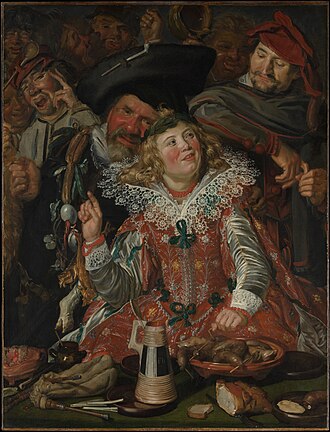 Fêtards du Mardi Gras - Frans Hals (1610s)
Œuvres d'artistes liés
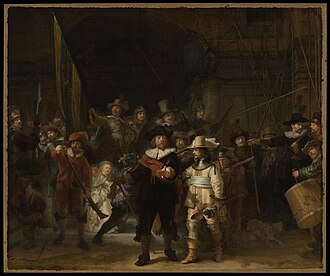 La Ronde de nuit - Rembrandt van Rijn (1642)
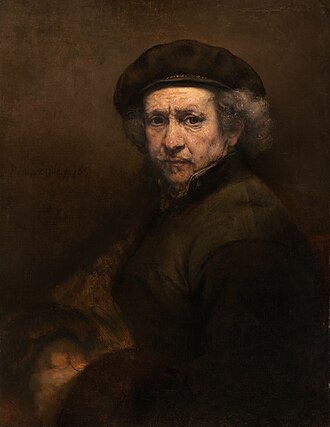 Autoportrait - Rembrandt van Rijn (1659)
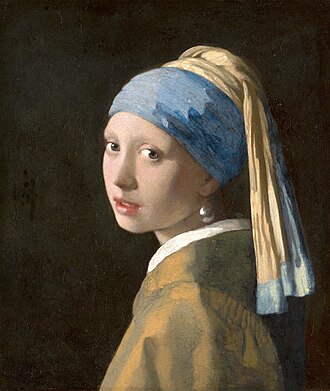 La Jeune Fille à la perle - Johannes Vermeer (1665)
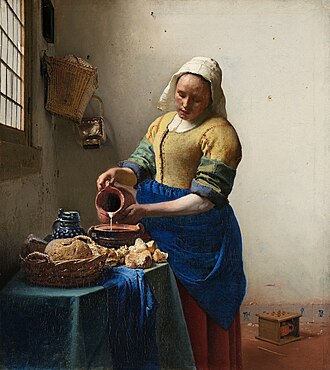 La Laitière - Johannes Vermeer (c. 1658)