Paysage champêtre, le matin
Caspar David Friedrich · 1822
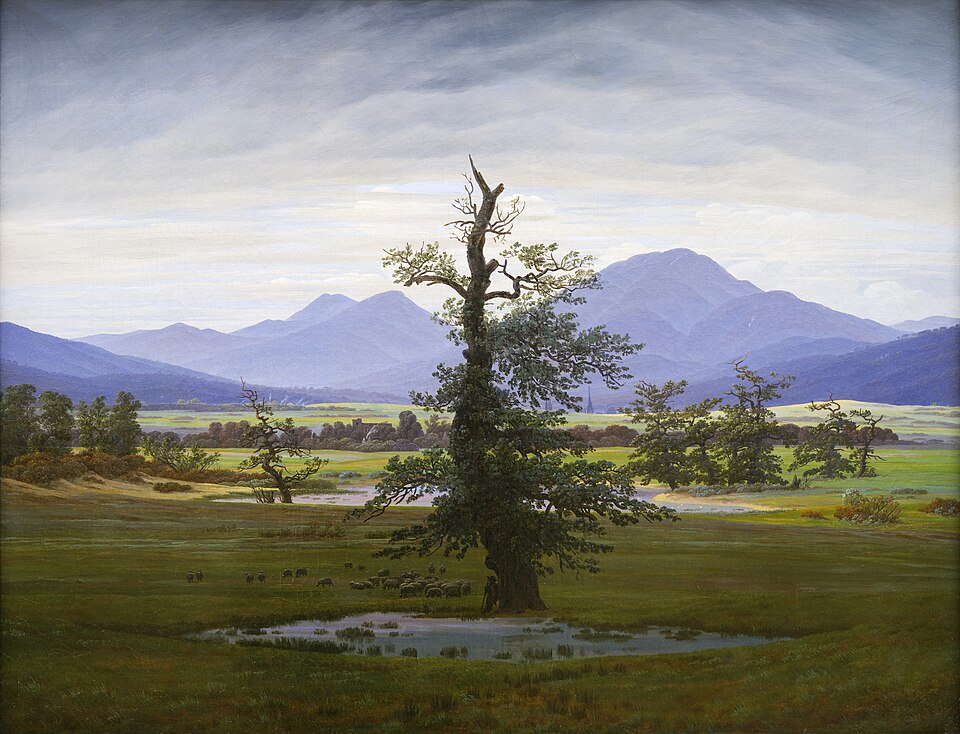
An ancient oak, its crown dead, still stands over a wide plain while a shepherd rests in its shade. Friedrich painted it as the morning half of a pair, and viewers have read it in very different ways.
The story behind the painting
Friedrich painted The Lonely Tree in 1822 for the banker and collector Joachim Heinrich Wilhelm Wagener, together with Moonrise by the Sea, to make a pair of times of the day, a morning and an evening landscape, in the tradition of Claude Lorrain. It was finished before November 1822. The art historian Helmut Börsch-Supan suggested that the mountains are the Riesengebirge, which Friedrich painted several times between 1806 and 1810, and that the double peak may be Jeschken.
What to look for
An old oak stands at the centre, clearly damaged but still standing. Its dark branches reach into an overcast morning sky, and banks of cloud seem to form a dome above it. The crown is dead, and the top of the trunk with two cut-off branches resembles a cross. A shepherd shelters under the lower branches that still bear leaves, while his sheep graze by a pond in the meadow. Villages and a town sit among trees in the middle distance, and wooded hills rise into blue-grey mountains.
Meaning and intent
The painting has drawn several interpretations. Ludwig Justi saw the old oak as a symbol of the German people, rooted in the landscape. Jens Christian Jensen saw it as a link between past and present. Charlotte Margarethe de Prybram-Gladona saw it as a symbol of loneliness. All of them start from the same image: a tree wounded at the top, still giving shelter below. The painting does not decide between them.
Legacy
Wagener donated the painting to the Berlin National Gallery in 1861 as part of its founding collection. It is now in the Alte Nationalgalerie of the Staatliche Museen in Berlin, still known by both its German title Der einsame Baum and its English names, The Lonely Tree or The Solitary Tree. Its partner, Moonrise by the Sea, was made for the same patron as the evening scene, so the oak was meant to be seen as morning, the start of a day that the second picture closes.
Le saviez-vous ?
- Painted in 1822 for Joachim Heinrich Wilhelm Wagener.
- Paired with Moonrise by the Sea as morning and evening.
- The mountains may be the Riesengebirge.
- In the Berlin National Gallery since 1861.
À propos de l'artiste
Caspar David Friedrich (1774-1840)
paysage · arbre · romantisme · montagne · Alte Nationalgalerie
Autres œuvres de Caspar David Friedrich
 Le Voyageur contemplant une mer de nuages - Caspar David Friedrich (c. 1818)
 L'Abbaye dans une forêt de chênes - Caspar David Friedrich (1800s)
 La Mer de glace - Caspar David Friedrich (1820s)
 Falaises de craie sur l'île de Rügen - Caspar David Friedrich (1818)
 Le Moine au bord de la mer - Caspar David Friedrich (1808)
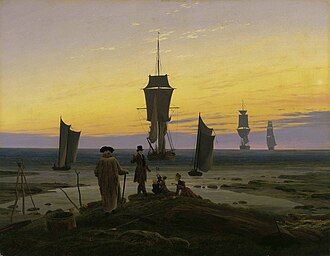 Les Âges de la vie - Caspar David Friedrich (1834)
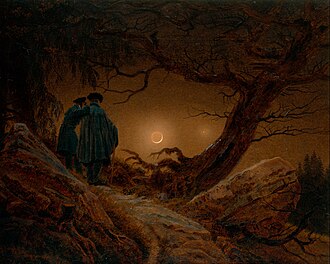 Deux Hommes contemplant la lune - Caspar David Friedrich (1810s)
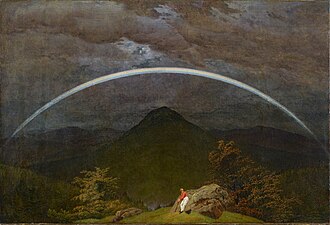 Paysage de montagne avec arc-en-ciel - Caspar David Friedrich (1809)
Œuvres d'artistes liés
 Tres de Mayo - Francisco Goya (1814)
 La Maja nue - Francisco Goya (1800)
 La Liberté guidant le peuple - Eugène Delacroix (1830)
 La Mort de Sardanapale - Eugène Delacroix (1827)
 Le Dernier Voyage du Téméraire - J. M. W. Turner (1839)
 Pluie, Vapeur et Vitesse - J. M. W. Turner (1844)
 L'Enfant bleu - Thomas Gainsborough (1770)
 Les Époux Andrews - Thomas Gainsborough (1748)